...

By Dan Gooding
Associate News Editor
0
Share
Newsweek is a Trust Project member
See more of our trusted coverage when you search.Prefer Newsweek on Googleto see more of our trusted coverage when you search.
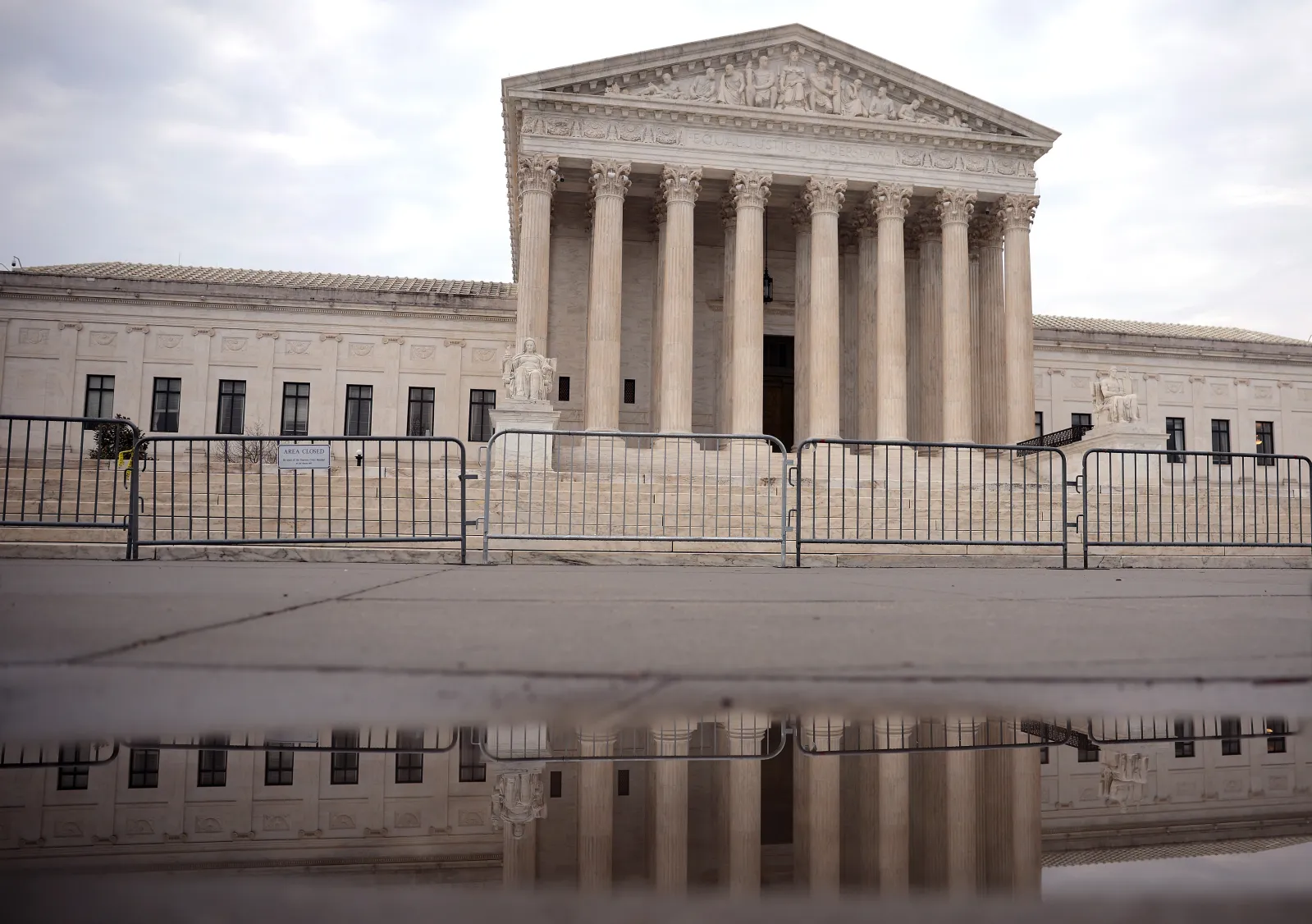
Confidence in the U.S. Supreme Court has fallen to its lowest level in at least a quarter-century, with just 22 percent of registered voters expressing a great deal or quite a bit of confidence in the institution, according to a new NBC News poll.
The survey, conducted among 1,000 registered voters between February 27 and March 3, showed that the share of those with a great deal or quite a bit of confidence in the court had steadily fallen from 52 percent in 2000 to the new 22 percent low.
There was a slight shift at the other end of the scale, with 38 percent of voters saying they had very little or no confidence, down from a high of 42 percent in 2024. Forty percent had some confidence. The survey had a margin of error of plus or minus 3.1 percentage points.
Read More on News
Why It Matters
The rating underscores a sustained erosion in public trust that accelerated after landmark rulings in recent years, even as the court’s latest high-profile decision striking down many of President Donald Trump’s tariffs gained approval from lawmakers on both sides of the aisle, voters across the political spectrum and the companies suing the government over costs.
The Supreme Court’s authority ultimately depends on public acceptance, and confidence levels can shape how elected officials and the public respond to consequential rulings on issues like abortion, voting, presidential power, and immigration. However, justices serve lifetime appointments and are not directly accountable to voters, which insulates them from electoral pressure.
...
What To Know
Partisan splits remained stark in the survey as 9 percent of Democrats and 35 percent of Republicans said they had a great deal or quite a bit of confidence in the court, a gap that has shifted over time in response to major decisions.
NBC News noted that the previous low came in 2022, after the court overturned Roe v. Wade in its ruling in Dobbs v. Jackson Women's Health Organization. Then, 27 percent expressed high confidence, while the series high was 52 percent in December 2000 just before Bush v. Gore, which resolved the 2000 election dispute over results in Florida, confirming Bush's victory.
The new NBC News poll followed the court’s decision striking down many of Trump’s tariffs. A separate YouGov survey conducted online on February 20 among 3,023 U.S. adults found 60 percent approved of the tariffs ruling and 23 percent disapproved, with a margin of error of about 3 percent.
YouGov also reported that the tariffs decision had not markedly shifted net job approval of the court at the time of its polling, moving from minus 15 in October 2025 to minus 13 among adult citizens.
Last August, a Pew Research Center survey of 3,554 adults found favorable views of the Supreme Court to be near a three-decade low, with 26 percent of Democrats and Democratic leaners viewing the court favorably versus 71 percent of Republicans and Republican leaners.
Pew also reported that 47 percent of Americans described the court as conservative, 44 percent as middle of the road and 7 percent as liberal, likely a reflection of the court's current make-up with a 6-3 conservative majority.
Gallup’s institutional trust reporting in October 2024 found trust in the judicial branch, which includes the Supreme Court, generally ranged from 40 percent to 48 percent, with Republicans expressing more trust than Democrats at that point, providing additional context for the court’s standing among U.S. institutions.
What People Are Saying
Jeff Horwitt, a Democratic pollster at Hart Research Associates who helped to conduct the survey, told NBC News: “It’s one thing to make controversial rulings that one party may or may not like but maintain respect and confidence. What we are seeing is quite the opposite, where the court is making controversial rulings but not being respected and in fact confidence is being eroded."
President Donald Trump, on Truth Social following the tariffs decision: "The supreme court (will be using lower case letters for a while based on a complete lack of respect!) of the United States accidentally and unwittingly gave me, as President of the United States, far more powers and strength than I had prior to their ridiculous, dumb, and very internationally divisive ruling," Trump said in a Monday morning post on Truth Social. For one thing, I can use Licenses to do absolutely “terrible” things to foreign countries, especially those countries that have been RIPPING US OFF for many decades."
Pete Buttigieg, transportation secretary under President Joe Biden, on X last month: "The Supreme Court has struck down Trump’s unlawful tariffs, which we've been paying for about a year now. This is good news for the American people - and it's the latest proof that this president, no matter what he says, can be stopped."
What Happens Next
Upcoming rulings on contested policies, including immigration and executive authority, may further influence partisan views and overall confidence in the Court.
In a polarized era, the center is dismissed as bland. At Newsweek, ours is different: The Courageous Center—it's not "both sides," it's sharp, challenging and alive with ideas. We follow facts, not factions. If that sounds like the kind of journalism you want to see thrive, we need you.
When you become a Newsweek Member, you support a mission to keep the center strong and vibrant. Members enjoy: Ad-free browsing, exclusive content and editor conversations. Help keep the center courageous. Join today.


View 0 Comments
Submit Correction
View Editorial & AI Guidelines