...

By Andrew Stanton
Reporter
0
Share
Newsweek is a Trust Project member
See more of our trusted coverage when you search.Prefer Newsweek on Googleto see more of our trusted coverage when you search.
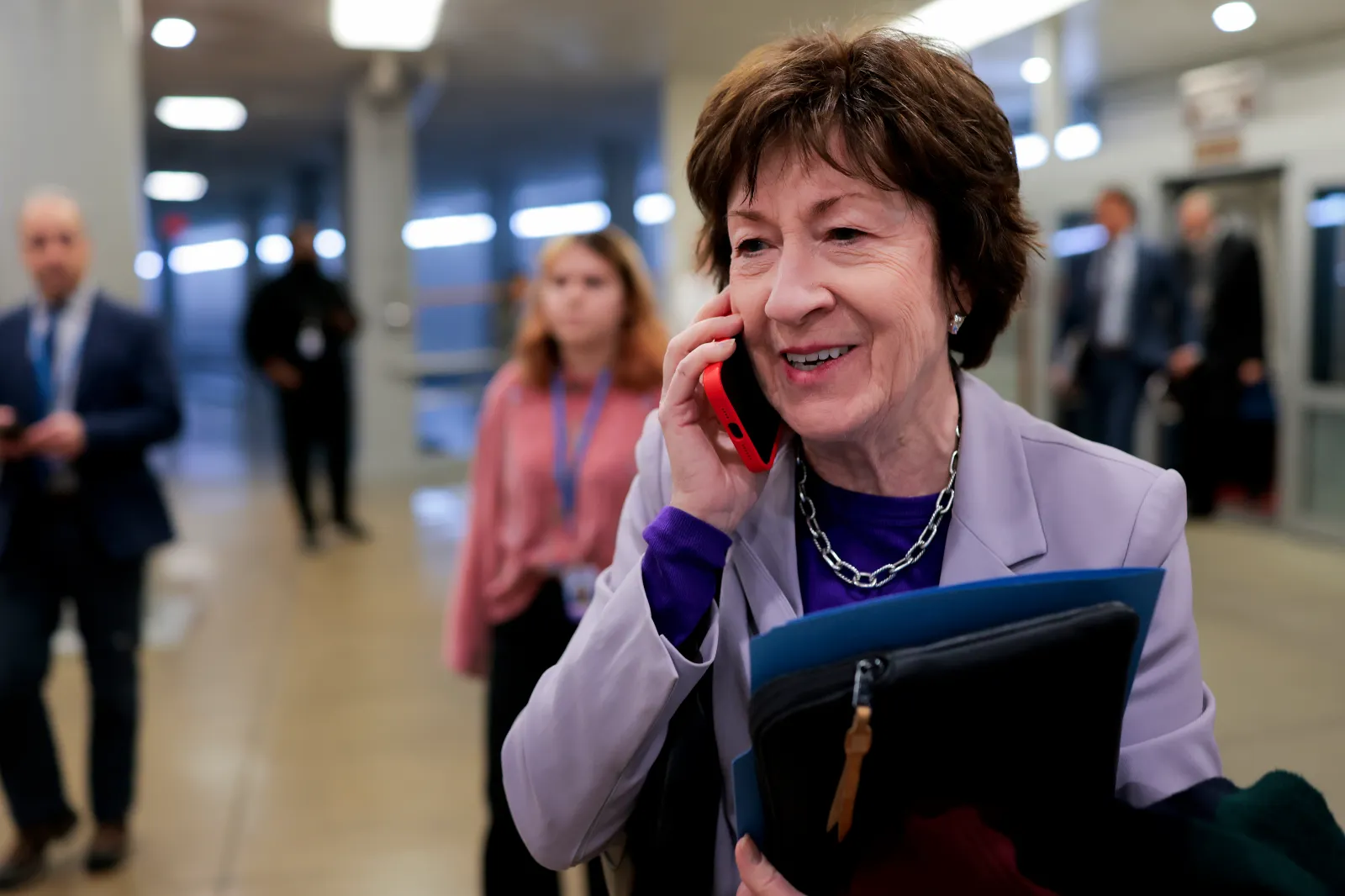
Maine Senator Susan Collins, a Republican, trailed Democratic challenger Graham Platner in two polls of the state’s 2026 race released this week.
Newsweek reached out to the campaigns of Collins, Platner and Maine Governor Janet Mills for comment via email.
Why It Matters
Collins could face her toughest reelection bid yet in Maine, a generally Democratic-leaning state where her popularity has helped the Republican incumbent win tough races in the past. She is one of the Democrats’ top targets; Vice President Kamala Harris won the state by seven points in 2024.
Read More on Politics
Democrats are hoping a favorable national environment, fueled by President Donald Trump’s declining approval rating, will boost their chances against Collins. But Republicans hope Collins’ long tenure and bipartisan appeal will keep the seat in their hands even amid a blue wave.
Maine’s race is a must-win for Democrats hoping to win control of the Senate in November. Forecasters like the Cook Political Report and Sabato’s Crystal Ball view the race as a pure toss-up three months ahead of the primary.
But Democrats are facing a competitive primary between Platner, a progressive oyster farmer and political newcomer, and Mills, the state’s two-term governor. The most recent polls give Platner an advantage in the primary, though Mills has received support from many in the party’s establishment, including Senate Minority Leader Chuck Schumer of New York.
What To Know
A new poll from On Message Public Strategies reported by Politico on Wednesday showed Collins trailing Platner, giving him a two-point advantage over Collins (44 percent to 42 percent), with 14 percent remaining undecided. In better news for Collins, she was tied with Mills in the poll, each receiving 42 percent support. In that matchup, 16 percent remained undecided.
It surveyed 600 likely voters from March 3-8, 2026, with a margin of error of plus or minus 4 percentage points.
...
A poll from Quantus Insights released this week also showed Platner leading Collins by about 7 points (49 percent to 42 percent). That poll, however, did show Collins with a lead over Mills (45 percent to 43 percent). Platner led Mills in the primary (43 percent to 38 percent).
It surveyed 800 likely voters from March 3-5, 2026, with a margin of error of plus or minus 3.4 percentage points.
Mills vs. Platner: What Polls Show About Democratic Primary
Mills is viewed as the preferred choice of the Democratic Party's establishment. Her supporters argue she is a proven winner in Maine, having won two terms as governor, and praise her opposition to the Trump administration on issues such as transgender rights. But critics have raised concerns about her middling approval rating and her age, as Mills is 78.
Platner is viewed as the more progressive candidate in the race.
His supporters say his background as an oyster farmer and a political newcomer may be a strong fit for Maine. But some Democrats have worried that a series of scandals would leave him more vulnerable in a general election.
Unearthed social media posts about women, rural white people and Black people, as well as the revelation that he had a tattoo resembling the Totenkopf, or “death’s head,” a symbol adopted by the Nazi SS, have threatened to upend his campaign. Platner has apologized for the posts and has had the tattoo covered. He previously told Newsweek, “I absolutely would not have gone through life having this on my chest if I knew that—and to insinuate that I did is disgusting.”
Democrats’ fears center on the possibility that he could face more criticism about this in the general, as Republicans are likely to invest significantly in advertising in the state. But his supporters note that Mainers are already aware of these scandals and that his polling has not suffered since the news broke in 2025.
Most recent polls give Platner an advantage in the primary. A Pan Atlantic Research poll released earlier in March gave him a 7-point lead over Mills (46 percent to 39 percent). It surveyed 810 likely voters from February 13 to March 2, 2026, and had a margin of error of plus or minus 3.7 percentage points.
A University of New Hampshire poll, meanwhile, showed Platner leading by a wide margin (64 percent to 26 percent) in the primary. It surveyed 462 likely voters from February 12-16, 2026 and had a margin of error of plus or minus 2.9 percentage points for the overall poll.
Collins v. Platner and Mills: What Other Polls, Betting Odds Show
The Pan Atlantic Research poll showed Collins and Mills locked in a dead heat with 44 percent each. It gave Platner a modest advantage (44 percent to 40 percent). Meanwhile, the University of New Hampshire poll gave Mills a single-point lead over Collins (41 percent to 40 percent) and Platner an 11-point lead (49 percent to 38 percent).
However, a recent poll from Fabrizio, Lee & Associates gave Collins a single-point lead over both Mills and Platner (45 percent to 44 percent). It surveyed 800 likely voters from January 20-24, 2026, according to The New York Times.
Kalshi's predictions market gives Democrats a 69 percent chance of winning Maine's Senate race as of Wednesday morning.
Maine uses a ranked-choice voting system in which voters rank their preferred candidates. If no candidate reaches 50 percent support, the candidate with the fewest votes is eliminated, and their votes are redistributed to the other candidates according to their second-choice rankings. This continues until a candidate reaches majority support.
Why Maine's Senate Race Is So Important for Democrats
Maine is viewed as a must-win state for Democrats this year. Republicans hold a 53-47 majority in the Senate, so Democrats must flip three seats for a tie and four for an outright majority.
In addition to Maine, North Carolina, where Republican Senator Thom Tillis is retiring, is the Democrats' other top target. Former Governor Roy Cooper, a Democrat, has polled well against Republican Michael Whatley. But even if Democrats hold every seat they currently hold and flip those two seats, they would still be held to a 49-seat minority.
No other Republican-held seats in Harris-won or single-digit Trump states are up for grabs. This means Democrats must compete in more conservative territory. They are eyeing double-digit Trump states such as Alaska, Iowa, Ohio, and Texas as potential flip opportunities. Democrats are hoping a 2018-style blue wave could carry them to victory in more conservative states.
What People Are Saying
New Mexico Democratic Senator Martin Heinrich endorsed Platner this week, writing on X: “Graham Platner is focused on delivering for Mainers, not billionaire donors. He's building a movement around folks who work hard for their family and community–folks who deserve a Senator fighting in their corner. I’m proud to endorse and help send him to the Senate in November.”
Governor Janet Mills criticized Collins in a post on X on Tuesday: “From his chaotic tariffs to signing health care cuts into law, Trump has sent costs skyrocketing for Maine people. @SenSusanCollins has refused to stand up to him. I'm the only candidate in this race who's stood up to Trump — and I'll do it again in the U.S. Senate.”
NRSC Chairman Tim Scott wrote in a statement after Collins announced her campaign: “From protecting Social Security to supporting small businesses, no one works harder and is more dependable at delivering prosperity and opportunity. I’m confident Susan will defeat whoever emerges from the messy Democrat primary, because Mainers know they can always count on her.”
Lakshya Jain of SplitTicket wrote on X: “Lot to be said about Platner's deficiencies, and this is not to excuse them — but it's also pretty clear that Mills is just a bad candidate. You'd still expect Mills to win. But early polling numbers do mean more when there's universal name recognition for both candidates.”
What Happens Next
Maine remains a toss-up race for this November. The primary is set for June 9, 2026, and the general election will be held on November 3, 2026.
In a polarized era, the center is dismissed as bland. At Newsweek, ours is different: The Courageous Center—it's not "both sides," it's sharp, challenging and alive with ideas. We follow facts, not factions. If that sounds like the kind of journalism you want to see thrive, we need you.
When you become a Newsweek Member, you support a mission to keep the center strong and vibrant. Members enjoy: Ad-free browsing, exclusive content and editor conversations. Help keep the center courageous. Join today.


View 0 Comments
Submit Correction
View Editorial & AI Guidelines