
By Daniel Allott and Jordan Allott
Author of "On the Road in Trump’s America;" Founder of In Altum Productions
0
Share
Newsweek is a Trust Project member
See more of our trusted coverage when you search.Prefer Newsweek on Googleto see more of our trusted coverage when you search.
When Bashar al-Assad’s government collapsed, the dominant international narrative was one of return. Refugees, it was said, would come home. A postwar Syria would begin rebuilding. What has drawn far less attention is a quieter movement in the opposite direction. Across Syria, members of minority communities are preparing to leave.
Fourteen months after Assad’s fall, departure has become the clearest verdict many Syrians are rendering on the country’s transition. For ethnic and religious minorities in particular, the end of the regime has not restored a sense of citizenship but introduced a new calculation about safety. Leaving, for many families, feels less like panic than like prudence.
...
Read More on Opinion
Last fall, in the coastal city of Latakia, a 13-year-old Alawite boy—a member of the minority sect from which former Syrian President Bashar al-Assad hails—whom we will call Ali, was walking to school when four masked men forced him into a car. Ali was held for nearly three weeks in a cellar, where his captors pressured him to abandon his Alawite identity. “They taught me how to pray,” Ali told us. “They told me my teachers were infidels.”
Ali said he already considered himself Muslim. It did not matter. “I knew the prayers and the pillars,” he said. “But they still called me kafir,” an unbeliever. When his father paid a reduced ransom, Ali was released on the outskirts of a town north of Latakia.
Since his son’s release, Ali’s father said, he has had a single goal: to leave Syria. “From the moment they released my son,” he said, “I felt this is not my country.” They are now trying to leave as soon as possible—Malaysia, Indonesia, Europe, anywhere that will take them.

...
Ali’s kidnapping was not isolated. Activists have documented numerous disappearances and abductions of Alawites since Assad’s fall, including women taken without ransom or explanation. Following a brief rebellion by former Assad loyalists last spring, violence spread through Alawite communities along Syria’s Mediterranean coast. Reuters reported that nearly 1,500 Alawites were killed in the unrest, a wave of violence that accelerated quiet departures from the region.
That fear has reached even Alawites who opposed Assad. Hassan Ahmad, an Alawite from Tartous, criticized the former regime from his teenage years and was imprisoned for his activism. When Assad fell, he initially felt relief. It didn’t last. As violence against Alawites spread, Hassan began documenting killings and kidnappings and speaking out publicly—an effort that, he said, has left him exposed once again.
“I don’t feel safe because I’m an Alawite,” he told us. “So how would it be as an Alawite activist?” He is now planning to try to secure a scholarship abroad.
What replaced Assad’s government has struggled to reassure people like Hassan. Much of Syria is now governed by Hay’at Tahrir al-Sham, led by Ahmed al-Sharaa, which emerged from Syria’s former al-Qaeda-linked insurgency and now governs much of the country. The group has pledged to protect all sects and hold perpetrators accountable, but many Syrians we spoke with said those assurances have not translated into consistent protection. Armed actors continue to operate with uneven restraint, and accountability remains uncertain.
Alawites are not alone in reassessing their future. Yara, a Druze civil engineer from Sweida—part of Syria’s small Druze religious minority centered in the south—had moved to Damascus for work when she received a video one morning last summer. It showed armed men threatening Druze families. “We came to kill you,” a voice said. “We’re at the center of the city.”
In July, clashes in Sweida left Druze civilians dead. Yara’s family survived, she said, largely by chance. Damascus no longer felt safe. Yara is now applying to graduate programs abroad. “I don’t call myself Syrian anymore,” she said. “I identify as Druze, and that’s exactly why I’m leaving.”
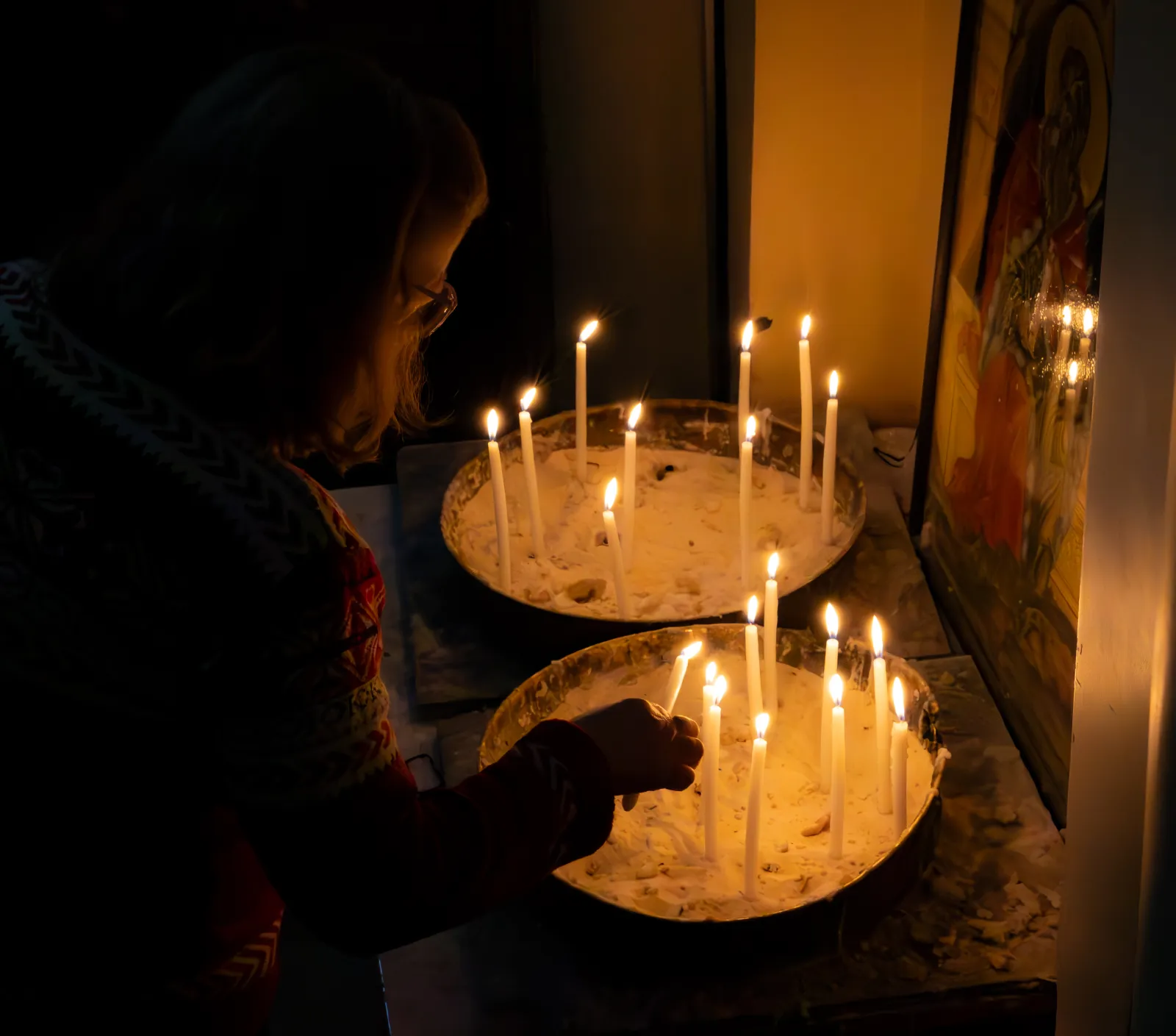
Christians have reached similar conclusions. As fighting spread in southern Syria last summer, dozens of Christian families fled to a church-run shelter in Khabab, south of Damascus. One woman compared the experience to being “sealed inside a jar, closed in, unable to get out.”
Christians described being caught between Druze and Bedouin groups. “They accuse us of being with the Druze, and the Druze accuse us of being with the Bedouins,” one man told us. “They both call us traitors.” Several described being targeted as infidels, their neutrality ignored. “We don’t have weapons,” one woman said. “We coexist with everyone. But where are we supposed to be?”

...
That sense of exposure deepened in June, when a jihadist attack on the Mar Elias Greek Orthodox church in Damascus killed 30 people during evening services. A seminarian who witnessed the attack told us that most of his community now wants to leave. Since the war began in 2011, Syria’s Christian population has fallen by roughly 80 percent.
Even some Sunni Syrians who welcomed Assad’s fall describe a narrowing sense of possibility. Layla, a 25-year-old Sunni lawyer in Damascus, said the old regime was oppressive but predictable. “If someone went missing, you knew which branch to check,” she said. Now, she worries about uncertainty. “If I could leave today or tomorrow,” Layla said, “I wouldn’t hesitate.”
For many Alawites, leaving has already become a reality. Thousands have crossed into Lebanon’s Bekaa Valley, often without documentation. Several people we spoke with there said they were easily exploited. “They don’t give us a good salary because you’re Syrian, you’re Alawite,” one woman said.

...
When asked what it would take to return to Syria, many struggled to answer. “The streets are covered in the blood of my neighbors,” one woman said. Her cousin, a former army engineer, did not hesitate. “Give me safety. Give me my land. Give me my house,” he said. “Give me my soul.”
The international conversation about Syria remains focused on stabilization, reconstruction and return. But a country in transition is also judged by who feels able to stay. The steady departure of minorities is not a temporary aftershock of Assad’s fall. It is a signal. Until citizenship matters more than identity, Syria’s transition will continue to be measured not by who comes back—but by who feels compelled to leave.
Daniel Allott is the former chief opinion editor at The Hill and the author of On the Road in Trump’s America.
Jordan Allott is a filmmaker and photographer and founder of In Altum Productions.
The views expressed in this article are the writers’ own.
View 0 Comments
Submit Correction
View Editorial & AI Guidelines