Newsweek/AP/Ferrari

By Newsweek Editors
0
Share
Newsweek is a Trust Project member
See more of our trusted coverage when you search.Prefer Newsweek on Googleto see more of our trusted coverage when you search.
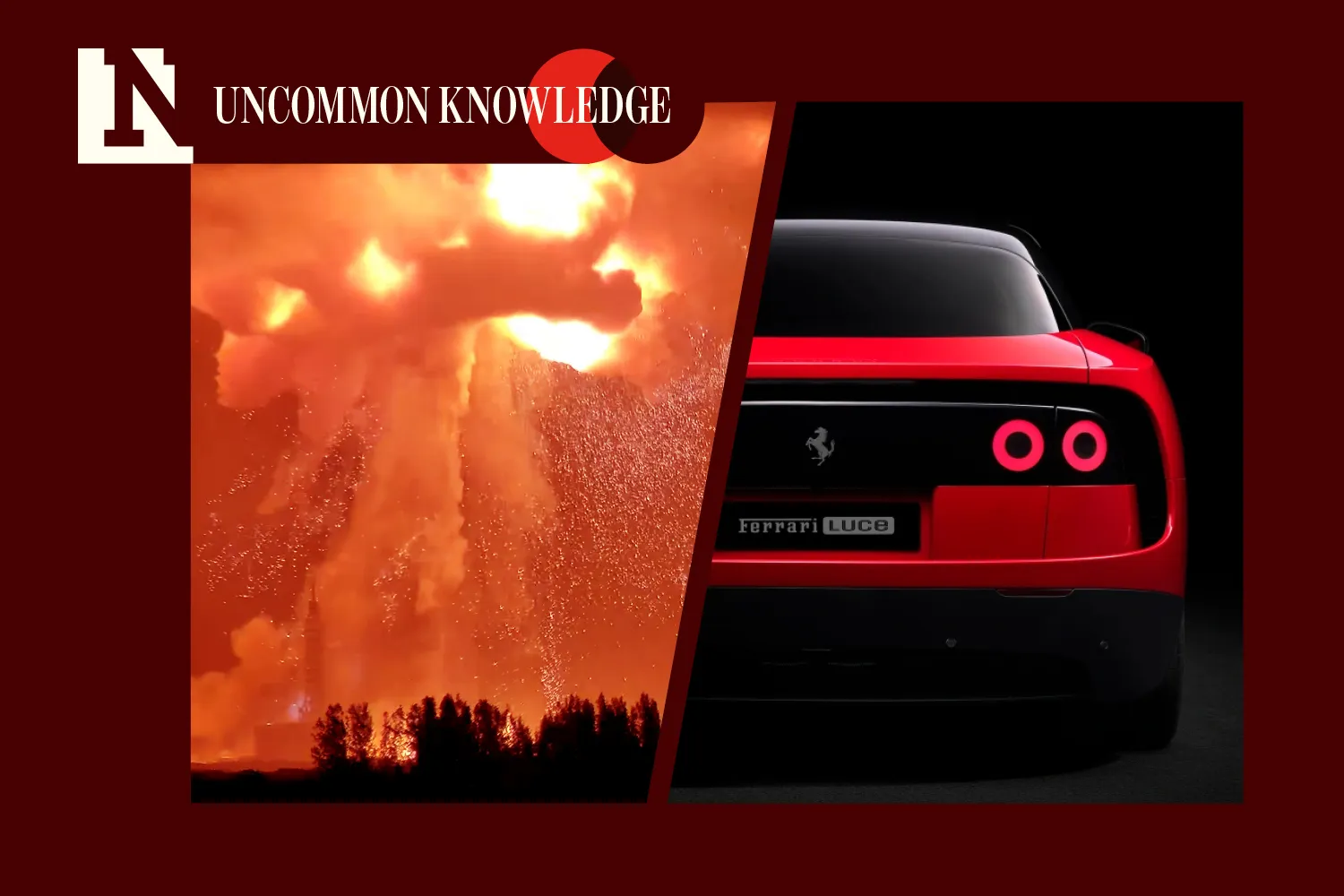
Last week a rocket blew up in Florida and a Ferrari blew up the internet. Only one of those happened on purpose.
On May 28, Jeff Bezos' New Glenn rocket suffered what his company Blue Origin called an "anomaly" during a test at Cape Canaveral. Nobody was hurt but the rocket, and the launchpad, weren't so lucky. The entire ambitious program now faces months of delays, much to the delight of Bezos' critics.
Three days earlier, in Rome, the explosion was merely aesthetic. Ferrari unveiled the Luce, its first fully electric car, and the reaction, at least online, was overwhelmingly one of astonishment, dismay and derision. Allegedly inspired by an aborted Apple car, and definitely created with the input of Apple design grandee Jony Ive, it instantly became one of the most controversial cars in history.
Read More on Analysis
Meanwhile, Elon Musk is asking investors to value SpaceX like planetary infrastructure and Tesla shareholders to treat him as a trillion-dollar savior, while Sam Altman is describing raw intelligence as something people will soon buy by the meter. The men (and they are largely men) who once promised to "move fast and break things" have moved past algorithms and on to actual things: rockets, cars, robots, chips, landers, satellites and data centers.
These men can be arrogant, tasteless, offensive, thin-skinned, overpaid, overpraised, under-regulated and deeply irritating. They can also change the shape of the world. It's up to politicians, posterity and voters to change that shape into something respectable.
Common Knowledge
Blue Origin's fireball was a serious setback for Bezos as he tries to close the gap on Musk’s IPO-bound SpaceX. For critics, this was the private space race all over: enormous private ambition dependent on public launch infrastructure, and ultimately a costly humiliation.
Critics of the Luce saw it more as a betrayal. Former Ferrari chairman Luca di Montezemolo warned that the car "risks destroying a legend." People compared it unfavorably to mass-produced cars like the Nissan Leaf (including Nissan itself) and the stock fell 6 percent after the reveal. The complaint wasn't just that Ferrari had gone electric, but that it had swapped its prancing horse for an iPhone on wheels that still costs $640,000.
Musk’s situation is the most financially combustible. SpaceX is expected to chase a valuation between $1.75 trillion and $2 trillion, despite posting nearly $5 billion in losses on $18.7 billion of revenue in 2025. Tesla finishes the caricature. Shareholders signed off on a pay package that could approach $1 trillion if Musk clears a set of extraordinary milestones: an $8.5 trillion valuation, 20 million vehicles delivered, a million Optimus robots and a million robotaxis. You do not have to be a socialist to question the merit of all this.
Altman, for his critics, is the dystopian flourish. OpenAI, he says, sees a future in which intelligence becomes "a utility, like electricity or water," sold to people "on a meter." The activist Erin Brockovich has gone after the machinery beneath that vision, saying that communities feel data centers are being "shoved down their throat in secrecy," wrapped in NDAs and euphemisms like "warehouses."
So the critics have their case, and it is a good one. The rocket blew up. The Ferrari became a meme. SpaceX may be priced like science fiction, Tesla's pay plan is comic in scale, and AI is eating land, money, power, attention and trust.

...
Uncommon Knowledge
The critics aren't telling you the whole story.
The Luce isn't really about design. It's about a company that has decided not to die a beautiful death.
Historically, Ferrari has sold scarcity, noise, the suggestion of danger, and Italian theater. The Luce departs from almost every line of that pitch. It is electric, five-seat, four-door, roomy, minimalist (though massive, despite being called "Light" in Italian) and shaped in part by LoveFrom, the studio that Ive founded with industrial designer Marc Newson. Ferrari chief executive Benedetto Vigna said that leadership demands "the courage to dare and to take on the challenge of new technologies."
That is corporate speak, but not devoid of truth. Ferrari’s mainland China sales, based on cars possessing that Italian theater, have more than halved since 2023. That's why Ferrari marketing boss Enrico Galliera tells petrolheads to "please don’t buy" the Luce, because the target customer is someone else.
McKinsey’s 2025 China auto-consumer report describes five years in which electrification and smart features have built real momentum, Chinese buyers have embraced new models and advanced technology, and domestic automakers have earned respect through their own engineering. EVs now account for more than half of new-car sales in China, with homegrown brands like BYD and Xiaomi muscling in on the luxury tier on high-tech models. Chinese brands also passed 15 percent of Europe’s EV sales for the first time in April 2026, as fully electric sales from the likes of BYD and Chery more than doubled year on year to 38,281 units.
Put it all together and it's something that may be uncomfortable for Ferraristas. The Luce is not Ferrari trying to be Tesla, but a sign it is to trying to stop itself becoming a museum piece.
For a century, global automotive prestige has been set in Europe. That prestige no longer works. German engineering is not so appealing to China. Italian drama is not so appealing to China. British nostalgia is not so appealing to China. Premium is drifting away from pedigree toward software, battery architecture, cabin intelligence, driver assistance, voice control, screen discipline, charging networks and the way the car slots into the rest of a digital life. McKinsey calls this "technological democratization."
Which is why the Luce, even though it is clearly a product for the elite, unsettles people. A five-seat Ferrari is a confession that tomorrow’s buyer may not be the man who wants a svelte red machine to make a noise on a Sunday morning. He, or she, might be a Chinese founder, a software billionaire, or a collector chasing the closest thing on the market to the Apple car Apple never shipped. That's why Ferrari has blown it up.

...
The same logic governs the rocket race, with more literal results. Private space is not new, but it has crossed a threshold. NASA’s Artemis III mission will test rendezvous and docking between Orion and the commercial spacecraft needed to put astronauts back on the Moon, a test that may involve commercial landers from SpaceX and Blue Origin.
All of this is easy to mock, because the cast is so mockable. Blue Origin's motto of "Gradatim Ferociter" ("step by step, ferociously"), reads a little darkly when the step ends in a fireball. Yet Blue Origin and SpaceX's reusable rockets have already reset expectations.
It is also an uncomfortable arrangement, because the public-private line is blurry. Taxpayers fund NASA, which signs contracts with private companies, which then build capabilities that serve public goals and potentially private monopolies alike. The fix is not to pretend the boundary is clean but to govern it transparently.
History provides a guide to the risks and rewards.
Cornelius Vanderbilt helped build out American shipping and railroads while building a personal fortune north of $100 million. John D. Rockefeller's Standard Oil imposed order on a chaotic oil business and grew so dominant that the Supreme Court unanimously upheld its breakup in 1911. Andrew Carnegie's steel helped create modern America, even as the 1892 Homestead Strike at one of his plants became one of the defining labor clashes of the industrial age. Henry Ford’s moving assembly line, introduced in 1913, transformed mass production, but his antisemitism, broadcast through the Dearborn Independent, is a dark stain on his reputation.
Moral ugliness should not be forgotten. But we should also drop the lazy reflex that treats unpleasantness as proof of ignorance. Industrial revolutions are rarely led by consensus-minded managers. They are led by obsessives who overbuild, overpromise, bully incumbents, offend good taste, bend politics, hoover up capital and expose the weaknesses in the old order. Then law, labor, journalism, democracy and markets spend the next several decades disciplining whatever got built.
That is the frame for Musk, Bezos, Altman and, yes, even the Luce. AI may be the biggest of these explosions because it is everywhere. Stanford's 2026 AI Index puts organizational adoption at 88 percent, finds that four in five university students now use generative AI, and clocks generative AI reaching 53 percent population adoption within three years, faster than the PC or the internet managed. The same report notes that industry produced more than 90 percent of notable frontier models in 2025.
That's also why Altman’s "intelligence on a meter" line sounds creepy. He is not building a chatbot company but an infrastructure company. OpenAI announced Stargate in 2025 as a plan to invest $500 billion over four years in U.S. AI infrastructure, starting with a $100 billion deployment, and later said the project had expanded with Oracle and SoftBank toward five new American sites and a $500 billion, 10-gigawatt buildout.
The objections are obvious. Just to start with, who elected Altman minister of cognition? Who decides whether the meter is fair? Who should pay for data centers that will enrich the tech class?
But the counterargument is just as serious. If AI really can speed up drug discovery, scientific modeling, software development, teaching, translation, logistics and the grinding work of administration, then refusing to build it because of personal morality or taste is not a moral position. It is a decision to let someone else build it instead—in this case, again, China.
So the real argument isn't whether tech billionaires are admirable. Often they are not. The question is whether a society can harvest the benefits of their ambition without swallowing their mythology whole.
This is the lesson the old magnates left us, or should have. The answer to Rockefeller was not to un-invent oil refining, it was antitrust. The answer to Carnegie was not to un-invent steel, it was labor power, regulation and memory. The answer to Ford was not to deny the assembly line, it was to tell the whole truth about mass production and mass prejudice.
This might mean putting disclosure around the valuations and safety rules around rockets. Putting water, noise, grid and land-use conditions around data centers, and antitrust lawyers around AI adoption. Send the taste critics to Maranello too, though Ferrari is free to ignore them.
Then build.
The alternative is a civilization that is brilliant at spotting hypocrisy, morally pure, and stuck in the slow lane. You do not have to like the men who blow things up. But if they are blowing up the right assumptions, you may one day owe them a wary thank-you.
View 0 Comments
Submit Correction
View Editorial & AI Guidelines