
AP Newsroom


By Jesus Mesa and Alex J. Rouhandeh
0
Share
Newsweek is a Trust Project member
See more of our trusted coverage when you search.Prefer Newsweek on Googleto see more of our trusted coverage when you search.
Three Democratic congressional incumbents faced off against each other in Tuesday's Texas primary runoffs, with each race revealing a different fracture in the party as redistricting forces former allies into direct conflict.
The contests span a wide ideological and generational spectrum. There is a battle over cryptocurrency, a candidacy mired in antisemitic remarks, and an awkward reunion between a former congressman and his chosen successor.
Whoever wins the races will likely hold those seats through November, but the party's identity in Texas, and how vulnerable Democrats appear heading into this year's midterms, may depend on which versions of themselves these three districts choose.
Read More on Politics
Al Green vs. Christian Menefee in Houston
For two decades, Al Green has been the face of Houston's Black political establishment. The 78-year-old congressman, first elected in 2004, speaks with the authority of someone who has built relationships across three administrations, who knows how to work the back channels of the U.S. Capitol, who has accumulated the kind of seniority that moves money and resources into his district.
Christian Menefee is less than half his age and operates in a completely different register. The 37-year-old former Harris County attorney won a special election in January to fill the seat left vacant by Sylvester Turner's death, making him the newest member of Congress. He ran for office for nearly a year before redistricting scrambled the map, and he's campaigning on the idea that Congress has become so broken that seniority means little if you're not producing results.
Their March primary was close. Menefee led Green 46.0 percent to 44.2 percent, but neither cleared 50 percent, sending them to a runoff that has become the most expensive House race in Texas. The difference between them has nothing to do with ideology. Both are Democrats, both are Black, both sit on similar committees. The defining distinction is simpler: Menefee has been backed by a cryptocurrency super PAC that has spent more than $4 million on his behalf.

...
Green has seized on this as the defining issue of the race.
"The seniority can be a very important tool, when it actually yields results," he told supporters this week. He argues that his decades in Congress and his relationships in Washington give him the ability to deliver real resources to Houston, Harris County and Fort Bend County.
Menefee counters that Congress has become so dysfunctional that relationships matter less than the willingness to produce results from day one.
"The seniority can be a very important tool when it actually yields results," Menefee said to KRIV in Houston in a recent interview.
The Associated Press (AP) called the race in Menefees' favor at 8:33 p.m. ET Tuesday. Menefee had 68.6 percent of the vote compared to Green's 31.4 percent with 61 percent of the vote counted.
A University of Houston poll from earlier this month gave Menefee a slight edge, with 50 percent support to Green's 43 percent and 7 percent undecided. But the internals revealed something more interesting: Menefee ran stronger with white and Latino voters and with anyone under 55. Green held a narrow advantage with Black voters and older voters.
Among Fort Bend County voters in the district, Green led 55 percent to 36 percent. Among Harris County voters, Menefee led 55 percent to 39 percent. Nearly all voters view both men favorably: 84 percent for Green, 82 percent for Menefee.
The district itself tells you something about what's at stake. It is deep blue, 44.8 percent Black, 35.5 percent Hispanic, 12.8 percent white, 7.5 percent Asian and home to some of the most significant figures in Black American politics. Menefee will almost certainly represent the district for the next two years.
Maureen Galindo vs. Johnny Garcia
Democrats view the 35th Congressional District as a potential flip opportunity. Texas Republicans redrew it to favor Republicans after Vice President Kamala Harris won it by 34 points under the old lines in 2024.
Maureen Galindo arrived as a surprise. The sex therapist and housing activist finished first in the March primary with 29.2 percent of the vote, narrowly ahead of Bexar County Sheriff's Deputy Johnny Garcia at 27.1 percent. Just under 1,200 votes separated them. She spent less than $5,400 on her campaign.
What happened next turned the race into something national. As Galindo's remarks about Israel and Zionists surfaced, Democratic leaders moved to stop her. A December post said she wouldn't accept Israel's "blood money." A January comment referenced "Jewish church leadership" having "dominant economic and political and media power." In a Texas Public Radio interview, she claimed the U.S. is being occupied by Israel.
During that same interview, Galindo escalated.
"Maybe Johnny Garcia and others who support him, or anybody who is supported by Israel, should be tried for treason," she said.

...
Most provocatively, she posted on her campaign Instagram that she would transform an Immigration and Customs Enforcement (ICE) facility into a jail for "American Zionists and former ICE officers for human trafficking." She added it "will also be a castration processing center for pedophiles, which will probably be most of the Zionists." She later clarified she meant "billionaire Zionists, regardless of religion."
House Minority Leader Hakeem Jeffries of New York and Democratic Congressional Campaign Committee Chair Suzan DelBene issued a joint statement: "House Republican leadership must immediately cease propping up this antisemitic candidacy." Representative Alexandria Ocasio-Cortez, a New York Democrat, called the comments "disgusting." Democratic Representatives Josh Gottheimer of New Jersey and Jared Moskowitz of Florida said they would force votes to expel her from Congress every day if she won.
Yet the super PAC Lead Left, billing itself as opposed to Trump, has spent nearly $1 million supporting Galindo with mailers and ads. National Democrats say the group is Republican-funded. Punchbowl News reported that Lead Left's website included links to a Republican fundraising platform.
Democrats point to why Galindo won in March: a surge of voters drawn by the competitive U.S. Senate primary between state Representative James Talarico and Representative Jasmine Crockett.
"That brought a lot of untraditional Democratic primary voters that may be not as informed," Bert Santibañez, a San Antonio-based Democratic strategist, told CNN.
Garcia, backed by the DCCC and Democratic Majority for Israel, believes the runoff will be different.
Katherine Fischer, executive director of the Texas Majority PAC, said: "People didn't have much of an awareness of her [Galindo's] more controversial statements and opinions in March, and now they do."
The AP called the race for Garcia at 10:35 p.m. ET. As of 10:55 p.m., Garcia had 60.5 percent of the vote compared to Galindo's 39.5 percent. The news agency reported that 70 percent of the votes had been counted.
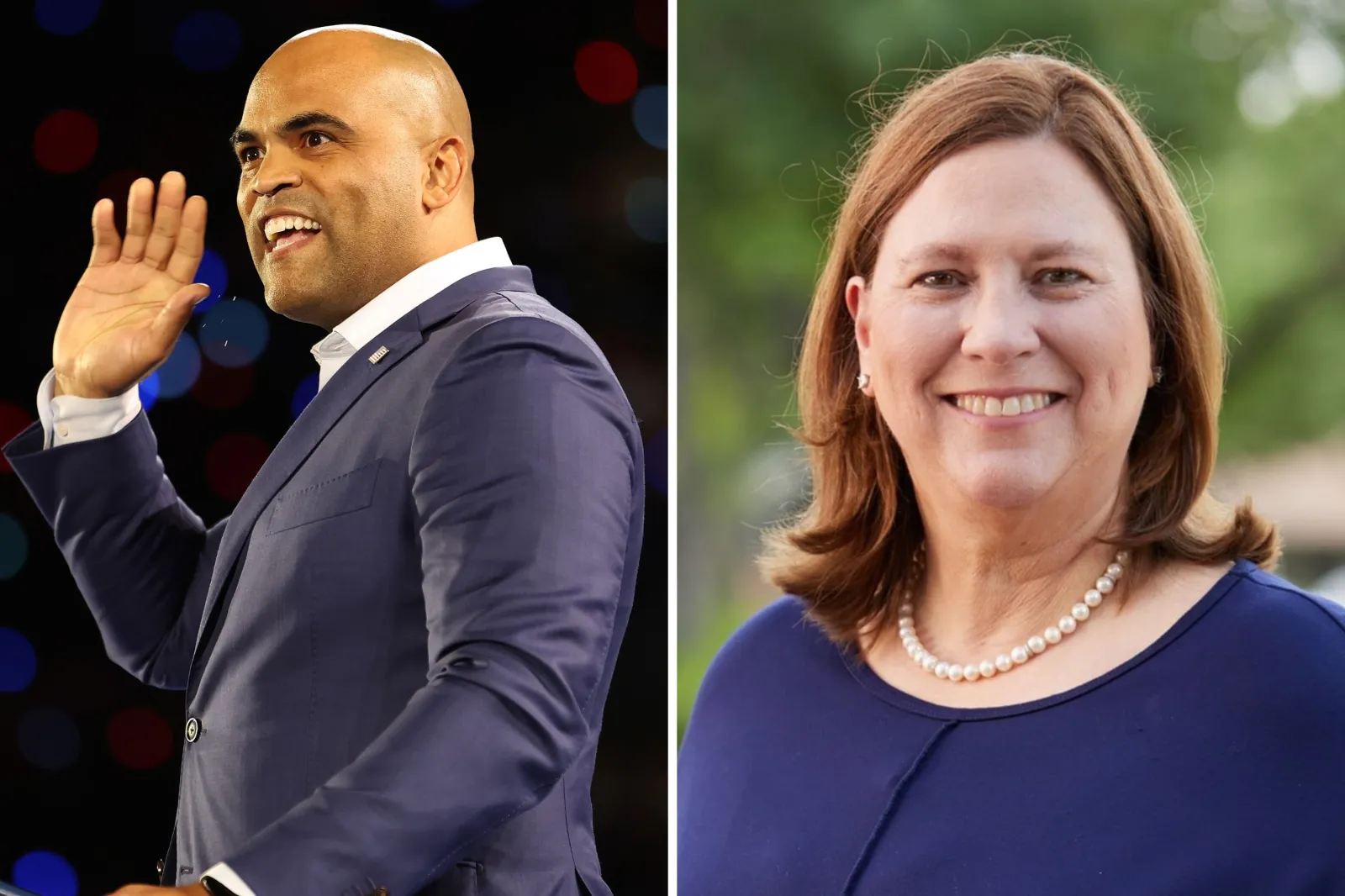
Colin Allred vs. Julie Johnson
Colin Allred represented the Dallas-area 32nd Congressional District until he ran for Senate in 2024 and lost to Republican Senator Ted Cruz. Before leaving, he endorsed Julie Johnson, a Dallas city councilwoman, to succeed him. She won and was sworn in January 2025.
In December, Allred announced he would run for Congress again. Redistricting had redrawn the map, and the new 33rd District looked appealing. Johnson, now the incumbent, was in an unfamiliar district herself. Neither cleared 50 percent in the March primary. Allred led with 45.5 percent to Johnson's 34.0 percent.
The politics are stark: the endorser is now challenging his endorsee. Johnson's response after the primary made the tension clear.
"Some people thought this race would be decided outright," she said. "Instead, we forced a runoff with a candidate with statewide name recognition and a significant financial advantage."
...
Allred has been a professional athlete, civil rights attorney and staff member at the U.S. Department of Housing and Urban Development under President Barack Obama. Johnson served one year in Congress on the Foreign Affairs, Transportation and Infrastructure, and Veterans' Affairs committees.
Immigration has become the flashpoint. When Allred ran for Senate in 2024, he explicitly appealed to voters dissatisfied with the Biden administration's border policies. Now he's questioning Johnson's record on the issue. Johnson is defending her voting record from a year in Congress.
"At a time when Donald Trump and his allies are attacking our rights and our democracy, the people of this district deserve a fighter who has shown they can deliver results," Allred said after the primary.
Redistricting has been to Allred’s advantage. The new 33rd District includes more of his old 32nd District territory. His 11-point primary margin suggests voters in this familiar terrain know his name better than they know Johnson’s.
The AP called the raced for Allred at 11:03 p.m. ET. As of 11:38 p.m., Allred has 54.7 percent of the vote compared to Johnson's 45.3 percent with 70 percent of the vote counted.
What Happens Next in Texas
The three runoffs on Tuesday reveal the central tension facing Democrats in Texas. The party needs to hold together a coalition spanning progressives and moderates, Zionist opponents and Gaza critics, new money and old establishment.
Talarico's victory in the Democratic Senate primary offers one answer. He mobilized 28,000 volunteers, sent 4.7 million peer-to-peer texts, and conducted more than 100,000 door conversations. He invested millions in Spanish-language media and culturally targeted outreach. The result was historic turnout among Latino voters. Starr County saw primary turnout jump 67 percent compared to its 2020-2024 average. Hidalgo County jumped 51 percent. These are communities that drifted toward Republicans in 2024.
Jim Kessler, executive vice president for policy at Third Way, a centrist Democratic think tank, articulated the mathematical challenge facing the party.
"To win in Texas, a Democrat needs to win about 60 percent of self-identified moderate voters," Kessler told Newsweek in prior reporting. "That is the baseline reality." He argued that the winning candidate combines "a reform agenda with a focus on everyday concerns, especially kitchen-table issues."
Despite the Democratic infighting triggered by these runoffs, Terri Burke, executive director of the of the Texas Democratic Party, believes the candidates will unite their coalitions ahead of the general election. The Supreme Court’s decision to rollback protections on majority-minority districts resonance strongly in a multicultural state like Texas where Whites are not a plurality. Burke believes Democrats will galvanize despite the current tensions to ensure diverse representation come November.
“The message is you can be upset, you can be pissed off, whatever, but in the end, there's something at stake here that is just huge in a state where white folks are the minority, where males are actually a minority, we're going to have all of them running the state,” she told Newsweek. “I don’t that when this is over with [the losing candidate] is going to go crawl under a rock and not be heard from after today because they understand what's at risk.”
View 0 Comments
Submit Correction
View Editorial & AI Guidelines