
...

By Robert Birsel
Reporter
0
Share
Newsweek is a Trust Project member
See more of our trusted coverage when you search.Prefer Newsweek on Googleto see more of our trusted coverage when you search.
Thailand launched airstrikes against Cambodian forces on their disputed border on Monday, throwing into question a ceasefire that President Donald Trump helped to broker earlier in the year.
The Southeast Asian neighbors blamed each other for starting the latest fighting and Thai Prime Minister Anutin Charnvirakul appeared to rule out negotiations with Cambodia or a role for Trump or other mediators in restoring the ceasefire.
Why It Matters
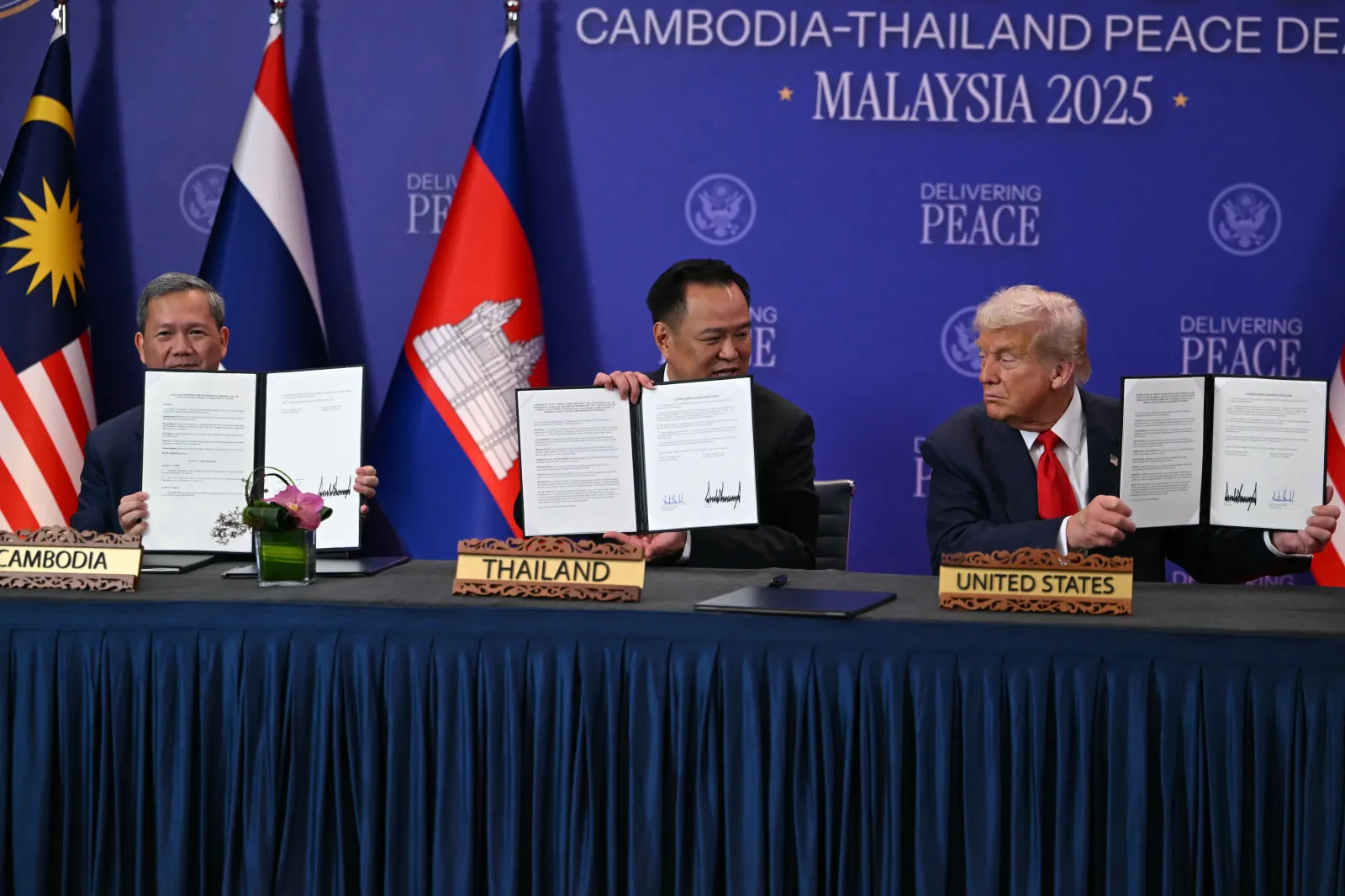
Trump claimed credit for a ceasefire on July 28 that ended days of deadly clashes between the neighbors. The renewed clashes are the most serious breaches of the peace terms since then.
Read More on News
While both countries maintain good relations with the United States and China, Thailand is a major non-NATO ally of the U.S. while China is particularly close to Cambodia, which has offered China access to a naval base in the disputed waters of the South China Sea.
What To Know
A Thai army spokesperson said Cambodian forces had launched attacks on Sunday on the border in Thailand’s Sisaket province, with clashes breaking out in several more areas of their 500-mile border the next day. One Thai soldier was killed and eight were wounded.
"The Thai side has begun using aircraft to attack military targets in several areas to deter attacks by Cambodian military fire support weapons," said the Thai army, which accused Cambodian forces of firing a BM-21 multiple rocket launcher into a civilian area of Buriran province. There were no immediate reports of any casualties.
The Cambodian Defense Ministry said the Thai assertion that the Cambodian side had started the fighting was false and its forces were not responding to Thai attacks.
"The Thai military has launched its attack on the Cambodian military on the morning of December 8, 2025, since 5 a.m. The action comes after the Thai military had been acting for countless days…with the intent to provoke the clashes," the Cambodian ministry said.
Thai F-16 jets conducted strikes in the northern Cambodian border province of Preah Vihear, Cambodia said. It gave no details.
"In the spirit of respecting all agreed agreements and peaceful resolution of disputes in accordance with international law, Cambodia did not retaliate at all," the Defense Ministry said.
It called for an observer mission from the Association of Southeast Asian Nations (ASEAN), of which both countries are members, to investigate the flare-up "to find the truth and ensure transparency, justice and fairness."
Thailand's Prime Minister Anutin said military operations would be conducted as necessary and ruled out talks with Cambodia after a meeting of his National Security Council.
"No negotiations," he told reporters. "If they want to stop fighting, they must comply with what Thailand has determined."
Asked if he had spoken to Trump, Anutin said: "I haven't spoken to him. This is an issue between Thailand and the other party."
Former Cambodian Prime Minister Hun Sen, who retains immense power over the government and ministry, said earlier Thailand was intent on drawing the Cambodian side into conflict to destroy the July ceasefire.
"All front-line forces need to be patient because the invaders are using all kinds of weapons firing at us since yesterday, last night and this morning in order to pull us into retaliation to destroy this ceasefire," Hun Sen, who is president of Cambodia's Senate and leader of its ruling party, said in a statement on his Facebook page.
He said Cambodian commanders had set "a red line to respond." He did not elaborate but said he had canceled other engagements to be with the prime minister, his son, Hun Manet, who is commanding the Cambodian forces.
The long-standing dispute between the countries over their border, largely mapped by France when it ruled Cambodia, was reignited in May after an exchange of gunfire that killed a Cambodian soldier.
This escalated into clashes in July before talks in Malaysia led to a ceasefire, for which Trump claimed credit—after he had threatened to impose heavier sanctions on both belligerents.
The fighting earlier in the year displaced hundreds of thousands of civilians on both sides of the border. The Thai military said on Monday that more than 35,000 people had registered in temporary shelters while many more were in the process of moving to safety or were staying with friends.
Thailand, with a population of some 70 million people compared with Cambodia's 17 million, has a much bigger economy and military than that of its neighbor. Thailand regularly conducts military exercises with U.S. forces.
Cambodia suspended its exercises with the U.S. military for several years during a period of strained ties but recently announced a resumption in the drills.
...
What People Are Saying
Thailand’s Prime Minister Anutin Charnvirakul said in a statement: "Thailand has never been the aggressor or initiated the conflict but it will not tolerate any violation of its sovereignty and will act in a reasonable and prudent manner, guided by the principles of peace, security and humanity."
Cambodia's Defense Ministry spokesperson General Mali Socheata said: "The Ministry of National Defense of the Kingdom of Cambodia reaffirms its firm commitment to respect and implement the ceasefire agreement and joint peace statement between Cambodia and Thailand to the fullest and to continue to cooperate closely at all levels, referring to practical cooperation to promote peace and stability between the two countries, as well as return to back to normal quickly."
Malaysia's Prime Minister Anwar Ibrahim said on X: "The renewed fighting risks unraveling the careful work that has gone into stabilizing relations between the two neighbours…We urge both sides to exercise maximum restraint, maintain open channels of communication and make full use of the mechanisms in place…Our region cannot afford to see long-standing disputes slip into cycles of confrontation. The immediate priority is to halt the fighting, safeguard civilians, and return to a diplomatic path supported by international law and the neighborly spirit on which ASEAN depends."
What Happens Next
The United States and China are likely to appeal to both sides to stop fighting and abide by their ceasefire agreement. It remains to be seen if Trump will intervene as he did before.
Update 12/8/25 4 a.m. ET: This breaking news story has been updated to include more information.
View 0 Comments
Submit Correction
View Editorial & AI Guidelines