10
Loading video...

By Muhanad Seloom
0
Share
Newsweek is a Trust Project member
See more of our trusted coverage when you search.Prefer Newsweek on Googleto see more of our trusted coverage when you search.
The economic damage the U.S.-Israeli-led war against Iran has inflicted on the Gulf states is extraordinary, almost entirely unscrutinized, and points to a structural flaw at the heart of American security arrangements in the region.
The world has fixated on the price of oil, the posture of navies in the Strait of Hormuz, and the diplomatic choreography between Washington and Tehran. What it has not examined is the aggregate cost borne by the countries that did not start this war, did not authorize it, and had no institutional means of preventing their own territory from becoming its principal theater of destruction.
The $100 billion bill now accumulating across the Gulf is not collateral damage. It is the material price of hosting American military power under arrangements that grant Washington operational access without requiring political consent. The real question it poses is not who pays for it; it is what Gulf states must now insist upon to ensure they are never left holding the bill again.
Read More on Opinion
The figures that have emerged are not incremental. QatarEnergy estimates $20 billion in annual losses from the damage to Ras Laffan, the world’s largest liquefied natural gas (LNG) facility, a figure that must be set against a national revenue budget of $54 billion.

...
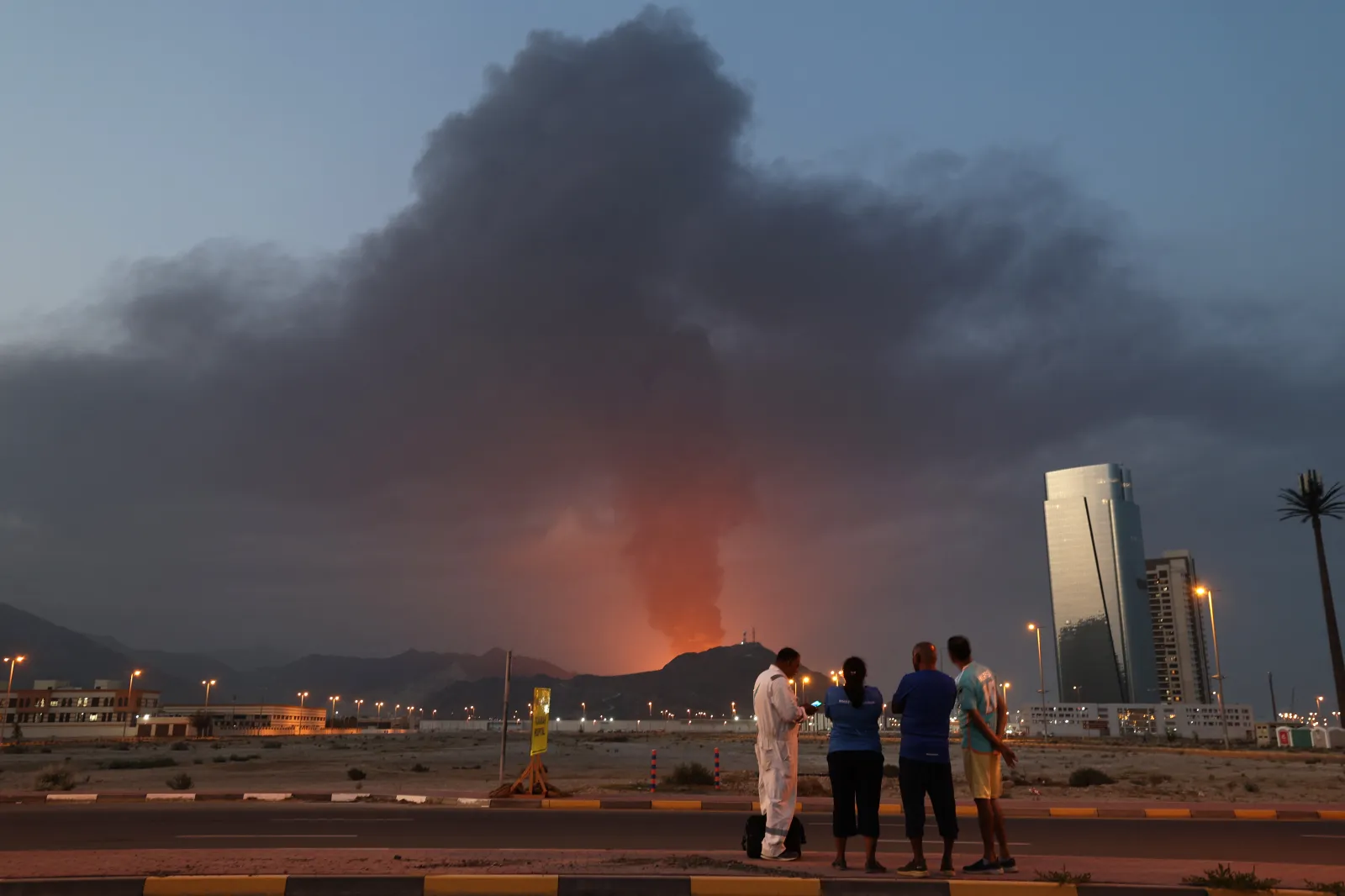
Goldman Sachs projects GDP contractions of up to 14 percent for Kuwait and Qatar. The United Nations Development Programme places the wider cost to Arab economies at $120 to $194 billion. The UAE Ministry of Defence reports that Iran directed 438 ballistic missiles, over 2,000 drones, and 19 cruise missiles at targets on Emirati soil in the war's first month alone. Dubai’s stock market shed 16 percent. The region’s tourism sector, the centerpiece of decades of painstaking economic diversification, is losing an estimated $600 million per day.
Desalination plants in Kuwait, which supply 99 percent of the country’s drinking water, were struck repeatedly. An 11-year-old girl in Kuwait was killed by shrapnel. A woman in Bahrain died when a missile hit her apartment building.
These numbers are striking. But the numbers are not the story.
The story is what they expose: a security arrangement in which sovereign states host American military personnel on their own national bases, under legal defense cooperation agreements that affirm host-state sovereignty and set out detailed protocols governing the use of those facilities in both peace and war.
These agreements are not loose accommodations. They are carefully negotiated instruments, and the Gulf states have exercised them with discipline. What the agreements do not confer, and what no host-state arrangement with a superpower could realistically confer, is any say over the patron’s sovereign decision to go to war in the first place.
Tehran chose to treat the mere presence of American forces on Gulf soil as sufficient pretext for retaliation. In a single decision, that choice collapsed the legal and political distinction Gulf governments have spent decades constructing and exposed the one asymmetry the agreements could never resolve: the right to make war remains Washington’s alone, while the cost of that decision is borne by its hosts.
Two cases sit awkwardly within this pattern, and they sharpen rather than complicate the diagnosis. Saudi Arabia, despite hosting the largest concentration of American hardware in the region, was not subjected to the same campaign of strikes its smaller neighbors absorbed. Its 2023 normalization with Tehran, brokered by Beijing, had established a political distance from Washington’s strategic posture that Iran’s targeting calculus appears to have respected.
Iraq, the closest neighbor to Iran and host to a residual American military footprint, sat outside the war’s principal theater for the same reason: its political accommodation with Tehran insulated it from the targeting logic Iran applied to American hosts*.*
...
The implication is unavoidable. The basing arrangements themselves did not determine which hosts were attacked. What determined it was the political distance each host had cultivated from the patron’s strategic decisions. Qatar, Kuwait, the UAE, and Bahrain had cultivated little. They paid the difference.
The Structural Flaw
The Gulf states’ relationship with the United States has long rested on an implicit exchange. They provide basing access and purchase American weapons systems. In return, the American military presence deters regional adversaries from threatening them. The arrangement was forged in the aftermath of Iraq’s invasion of Kuwait in 1990, refined through two decades of operations against Iraq and various non-state actors, and embedded in a network of basing agreements that today positions American forces across Qatar, Bahrain, Kuwait, the UAE, and Saudi Arabia.
What the arrangement never included, and what this war has violently exposed, is any requirement that Washington consult its hosts before making the decision to go to war against a neighboring state capable of retaliating against all of them simultaneously. The United States did not, in the end, use its Gulf facilities to strike Iran. It did not need to.
Al Udeid Air Base in Qatar, which houses the forward headquarters of U.S. Central Command, remained operational throughout the war. Ali Al Salem in Kuwait, Al Dhafra in the UAE, and the Fifth Fleet headquarters in Bahrain continued to function. None were turned into launchpads for offensive strikes.
And yet, in each case, the legally negotiated, sovereignly authorized hosting of U.S. personnel under bilateral defense agreements was sufficient to mark the host state as a legitimate object of retaliation. The agreements themselves were never the problem. They were designed for a strategic context in which the United States and the Gulf states faced shared threats, and the American presence served a mutual purpose.
What the agreements did not—and could not—anticipate was a war of choice in which Washington’s sovereign prerogative to act would expose its hosts to catastrophic retaliation for an operation from which their own territory had been scrupulously kept.

...
This is not solely a story about American sovereignty. The 2026 war was Israeli in its origin and American in its prosecution; the Gulf states were patron-adjacent to both. That doubles, rather than dilutes, the asymmetry. The basing agreements through which Washington operates carry no provision for the strategic decisions of a third party, even when those decisions trigger the very chain of events that turns Gulf territory into a target. The patron’s war calculus is now effectively a two-capital calculus. The host state’s exposure is borne alone.
Qatar had, for years, cultivated a carefully calibrated relationship with Tehran, a hedging strategy that recognized its geographical proximity, its shared gas field, and the cost of being caught between Washington and its principal regional adversary. That strategy was not naive. It was sovereign. And it collapsed in a single afternoon.
When the United States launched its preemptive attack on Iran while negotiations were still underway, without consulting the Gulf states whose territory formed the backdrop to the operation, Qatar found itself absorbing Iranian missiles in a war it had not authorized. The contradiction was not merely diplomatic. It was structural: the legal and political architecture that had long distinguished Qatari sovereignty from American power offered no protection against an adversary who chose not to recognize the distinction.
Iran understood this perfectly. When the Revolutionary Guard declared that “all U.S. assets throughout the region are considered legitimate targets,” it was articulating a logic that the basing agreements had made possible. The Gulf states were not adversaries of Iran. They were, in Tehran’s precise and devastating formulation, American addresses.
What the Bill Reveals
This is not merely war damage in the conventional sense. It is the price, denominated in shattered LNG terminals, grounded airlines, and the dead, of hosting a superpower’s forward-deployed forces under arrangements that offered no mechanism for restraint, no requirement of consultation, and no provision for the possibility that the patron might one day use those forces in a manner that exposed every host state to devastating retaliation.
Washington has not acknowledged this. The administration’s public statements measure the war’s economic impact in terms of oil prices and shipping disruptions, metrics that matter to American consumers and global markets.
When the United States experienced a GDP contraction of 3.5 percent during the COVID-19 pandemic, it was treated as a national crisis warranting trillions of dollars in fiscal stimulus. Qatar and Kuwait now face contractions that, at the upper end of Goldman’s projections, run several times that magnitude—not from a virus, but from a political decision made in Washington.

...
What the Gulf Must Now Insist Upon
If the ceasefire holds and a settlement follows, the temptation in Washington will be to restore the status quo ante: reopen the Strait, restart the bases, resume the arms sales, and proceed as if the arrangement that produced this catastrophe requires no fundamental revision. The Gulf states must resist this with every instrument at their disposal.
The question before them is not who compensates them for what has been destroyed. There is no treaty, no legal precedent, and no realistic prospect of the United States accepting financial liability for the consequences of its own military operations on allied soil. To pursue that question is to pursue a dead end.
What the Gulf states demand in the coming weeks will decide whether this war was an exception to the rules or a new rule in itself. The choice is not between reconstruction and reparations; it is between accepting the arrangement that produced this bill and insisting upon the one that would prevent the next.
Three Demands Are Essential
First, the Gulf states must push beyond the existing basing agreements to establish political mechanisms of consultation that address the one asymmetry the agreements cannot reach: the patron’s unilateral right to make war. What is needed is not a revision of operational protocols, which function as designed, but a political framework that gives host governments a voice in the strategic decisions whose costs they will ultimately absorb. This is not a modest request; it is a structural revision, and the old arrangement cannot be restored.
Second, the Gulf states must invest in autonomous defensive capabilities that do not depend on the patron’s command structure. The war demonstrated that the American air defense umbrella cannot shield host states from the consequences of American decisions. Independent air and missile defense, indigenous intelligence systems, and cyber capabilities that function regardless of Washington’s strategic posture are no longer aspirational. They imply diversified procurement: European systems, Asian systems, indigenous development, and joint Gulf capabilities that can be coordinated without American mediation.
The region has already begun to move in this direction. The war has made the direction urgent. They are the minimum condition of sovereign security in a region where the patron’s choices now carry existential consequences for its partners.
Third, and most consequentially, the Gulf states must insist on a seat at whatever negotiating table emerges from this war—through a unified Gulf Cooperation Council (GCC) presence, bilateral participation alongside Washington and Tehran, or a parallel forum convened by the Gulf states themselves. The form matters less than the principle: the states whose territory absorbed the war must shape the terms of its settlement.
M. Javad Zarif’s proposal in Foreign Affairs envisions a bilateral U.S.-Iran settlement. Brett McGurk’s public framing treats the endgame as a matter between Washington and Tehran. Neither framework includes the states that absorbed the missiles, lost the revenue, buried the dead, and are now expected to ratify the terms that produced the catastrophe. A settlement that excludes them will be no more stable than the arrangement that preceded it, because it will rest on the same asymmetry: decisions made in one capital, costs falling on another.

...
The objection to these demands writes itself: a consultation requirement of any substance would weaken extended deterrence, the very benefit the basing arrangements are meant to deliver. The objection is not without force, but it has been answered by events. The deterrent the arrangements were meant to provide failed in 2026. It did not deter Iran from striking Gulf territory; it produced the conditions that made Gulf territory worth striking. To preserve unconditioned patron arrangements in the name of a deterrent that did not deter is to mistake the architecture of the failure its solution.
The Asymmetry Cannot Hold
The Gulf states have been, for three decades, among the most consequential partners of American military power anywhere in the world. They have provided land, airspace, logistics, and the political backing that has made possible operations spanning Iraq, Afghanistan, and Syria. They have done so without formal treaties of mutual defense, without the institutional protections that NATO affords European allies, and without the bilateral security guarantees that Japan and South Korea take for granted. What they received in return was an implicit promise: that the American presence on their soil would protect them. The 2026 war has proven the opposite. The presence did not protect them. It made them targets.
The $100 billion bill is the cost of that asymmetry. It is the price of a partnership in which one side retains the sovereign right to make war while the other is left to bear the consequences without complaint. If this war achieves nothing else of lasting consequence, it must achieve the end of that arrangement; not the end of the partnership, which remains in the strategic interest of both sides, but the end of the terms on which it has been conducted.
The Gulf states did not choose this war. They should not be expected to absorb its costs in silence. And they must not permit the conditions that produced those costs to survive the ceasefire intact.
Muhanad Seloom is an assistant professor at the Doha Institute for Graduate Studies and an honorary research fellow at the University of Exeter. He writes from Doha and posts on X at @muhanadseloom
The views expressed in this article are the writer’s own.
View 0 Comments
Submit Correction
View Editorial & AI Guidelines