
...

By Mark Johnson
0
Share
Newsweek is a Trust Project member
See more of our trusted coverage when you search.Prefer Newsweek on Googleto see more of our trusted coverage when you search.
Recognizing that the shift to sustainability will depend on more than high-tech solutions and tentpole projects, the Newsweek Japan SDGs Awards (aligned with the United Nations’ Sustainable Development Goals) were launched in 2023, aiming to shine a light on Japanese companies working in this space. Newton Plus, which makes automatic doors that run without using electricity, took the top prize at the 2025 awards, presented at a ceremony in March.
The Only Way Is Up, and Then Down Again
Intermittency is cited as a major hurdle in the renewable energy transition. How to generate power when the sun doesn’t shine, the wind doesn’t blow or reservoirs and rivers run low is a legitimate concern, and one often invoked by renewables skeptics. But there is one natural force that can be relied upon anytime and anywhere on Earth: gravity. And it is gravity that Newton Plus utilizes to power its door systems via a mechanism so seemingly simple that it leaves academics and engineers wondering how nobody had thought of it sooner.
Read More on Business
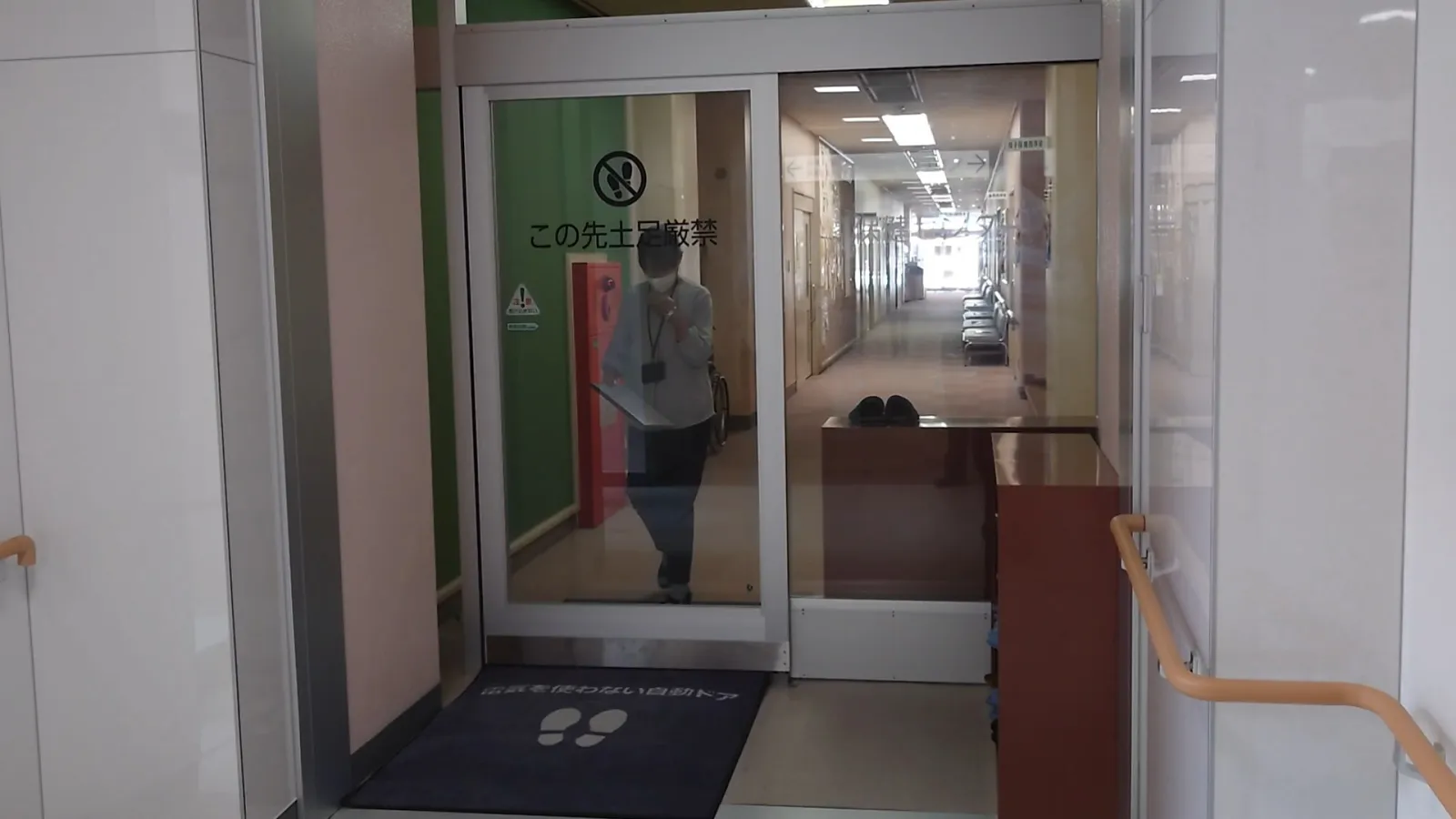
When someone approaches a Newton door, a plate under the doormat sinks slightly, their body weight creating enough force to slide the doors open. After they have passed through the doorway, gravity again does its work to close them. The patented technology operates in much the same way as regular automatic doors, but requires no external energy and is thus emission free. Other significant advantages include being unaffected by power cuts (a big plus in disaster-prone nations like Japan), never suffering electrical malfunctions and closing so gently that the risk of injury is close to zero.
Using the Earth’s gravitational pull to open and close doors was the brainchild of Yasuo Nakano, and adopted by the trio of sexagenarians who founded the company in 2012. Sadly, cancer took Nakano a couple of years later, before he could see his invention widely adopted. Even after it hit the market, initial progress was slow.
“When we started out, I was brimming with expectation, convinced that this was a product the world needed. But for the first seven or eight years, we only sold a few annually,” recalls Hiroyasu Kawanabe, company president. “People understood what the product did, but understanding wasn’t enough to get them to adopt it. One of the barriers was price competitiveness.”
Public Exposure
Hiroyasu Kondo, a co-founder and company advisor, explains that pilot deployments by public authorities were key in cracking the wider market: “Once the doors were adopted by public facilities, people from factories, shops and other businesses saw them there, and thought, ‘If a government building uses it, it must be safe.’ That’s how awareness has spread. Cumulatively, we now have around 400 sets of doors installed across Japan.”
...
As well as hospitals, logistics centers and convenience stores, Newton doors can increasingly be seen at the entrance to condominiums, where more than 100 have gone into operation in the last few years.
“We have finally brought our initial price down to roughly the same level as a conventional electric automatic door. As the production volume increases, we can bring that down further,” explains Kondo.
But the real economic benefits accrue as time passes: the absence of electricity bills and the related ease of maintenance make the costs over a 10-year period approximately a fifth of those of regular automatic doors. Newton doors are most viable when installed in new buildings, rather than replacing existing doors, which can bump up the installation price significantly.
Looking Further Afield and Outside the Box
With around a dozen staff at its Tokyo headquarters, and manufacturing outsourced to a factory in Koriyama, Fukushima Prefecture, the company is small but has big ambitions, looking for overseas partners to collaborate with on diffusing its seminal technology. Interest from abroad is on the rise, including inquiries from India, Romania, South Korea, Thailand and Vietnam.
“If Newton could spread around the world while we are still alive, we would be very happy,” says Kawanabe with a smile.
They are already working with one major Japanese company on Newton doors for houses, while another is in talks on licensing the technology for a non-door application.
Kondo also sees real potential in what at first sounds like a novelty use — Newton doors for pets: “We’ve built prototypes; a Chihuahua can open them. We’re looking at scaling that up for bigger dogs, which are common in countries like the US, and embedding the mechanism into corridors and walls. This could spread worldwide faster than the main Newton door.”
According to Kondo, engineers and university professors who visit the company are equal parts fascinated and bewildered by the simplicity of the Newton door mechanism, unable to stop playing with demonstration models or wondering why it took someone so long to make the discovery.
Kawanabe sums up the company’s philosophy and vision: “Newton is not just an automatic door — it is a sustainable entrance that opens the way to the future. Building on these fourteen years of effort, we will continue to deliver a product we can be proud of, for people, for society, and for the planet.”
This article has been paid for by a third party. The views and opinions expressed are not those of Newsweek and are not an endorsement of the products, services or persons mentioned.
View 0 Comments
Submit Correction
View Editorial & AI Guidelines