...

By Michael Hershman
0
Share
Newsweek is a Trust Project member
See more of our trusted coverage when you search.Prefer Newsweek on Googleto see more of our trusted coverage when you search.
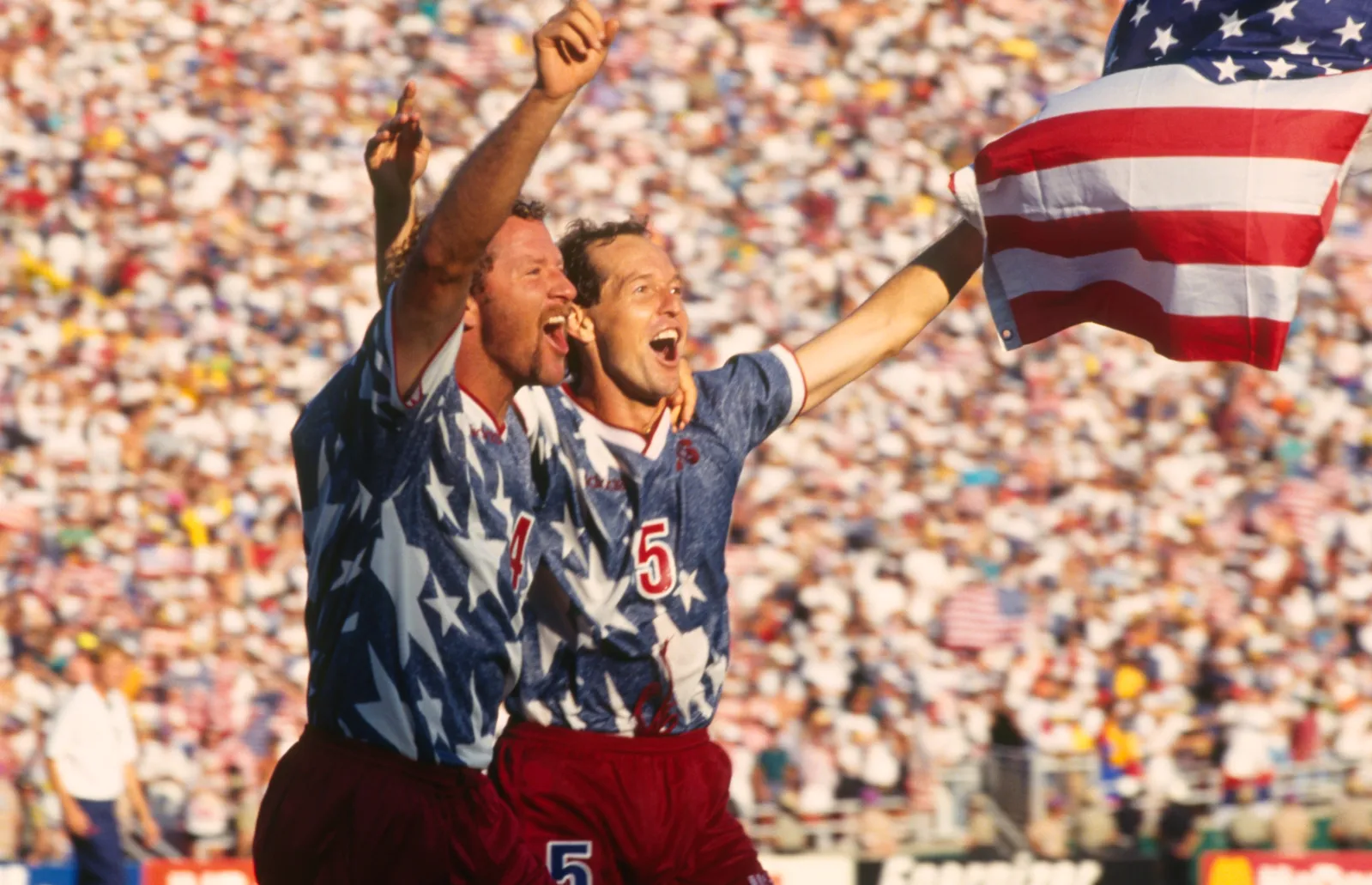
Thirty-two years ago, the United States hosted a World Cup that most Americans didn't know was coming. Some polls at the time found that 71 percent of the country was unaware the tournament was headed to their shores, and 29 percent didn't care. Soccer ranked somewhere around America's 67th favorite sport behind—as the joke goes—tractor pulling. The stadiums were full, the spectacle was magnificent, and then it was over, leaving behind a question: Had any of it stuck?
The answer, it turns out, was yes—in ways that are only fully visible now that the World Cup has returned.
This June, the greatest sporting event on Earth kicks off again in North America—this time shared across the United States, Canada, and Mexico—running from June 11 through the final at MetLife Stadium on July 19. What awaits fans is something that would have been almost unrecognizable to anyone watching Alexi Lalas sprint across the Rose Bowl turf in 1994—a tournament transformed in scale, structure, and cultural meaning.
Read More on Opinion
The most dramatic change is the field itself. The 1994 tournament featured 24 nations competing across nine American cities in 52 matches, while 2026 will see 48 teams playing 104 games across 16 cities spanning three countries. It is the largest World Cup in history, by design. FIFA, never shy about growth, expects up to 5.5 million fans to attend—obliterating the attendance record that the United States set in 1994 and has quietly held ever since.
...
The expanded format has its critics. Purists worry that 12 groups of four waters down early-round competition and that the logistics of a three-nation tournament strain players and fans alike. Matches will be played from Vancouver to Miami, Toronto to Mexico City, Seattle to Dallas—with all the jet lag, travel costs, and carbon footprint concerns that come with it. The summer heat in open-air venues in Houston, Miami, and Kansas City is a concern that organizers have been slow to offer answers to.
But there is an upside to the bigger bracket: more nations from Africa, Asia, and the Americas get a seat at the table. There are first-time qualifiers like Cabo Verde, Curaçao, Uzbekistan, and Jordan. The World Cup, in theory, becomes more truly global—though FIFA's expanded format has always been at least partly about expanding revenue, projecting $11 billion over the tournament cycle.
What has changed most profoundly, however, is not the format—it is the country receiving it.
In 1994, the United States had no top-division professional soccer league. FIFA made the establishment of one a condition of awarding the tournament to America. The result, Major League Soccer, launched in 1996 with ten teams and the skepticism of every serious sports pundit in the country. Today, MLS has 30 clubs, soccer-specific stadiums in 22 cities, and total attendance that ranks second in the world behind only England's Premier League. Eighteen of the fifty most valuable professional soccer teams in the world are now MLS franchises—a statistic that sounds invented but is not.
The cultural shift is equally striking. The 2022 World Cup in Qatar drew an average of 4.7 million American viewers per match. Soccer now ranks as the third most popular sport in the United States, surpassing baseball. You cannot walk through a mall, a supermarket, or an airport today without encountering World Cup branding. The contrast with 1994—when the tournament arrived like a politely welcomed foreign dignitary—could not be sharper.
The American men's national team has changed, too.
In 1994, the U.S. was a crew of journeymen thrilled to advance past the group stage for the first time since 1930, ultimately losing a 1-0 heartbreaker to eventual champions Brazil. Today, ranked 16th in the world, the team is built around players competing for Europe's elite clubs. They are not expected merely to participate. They are expected to contend.
The match card for 2026 is rich. Spain, Argentina, France, and England—the world's top four sides—are seeded into opposite halves of the bracket and, barring upsets, cannot meet until the semifinals. That is a promise of quality deep into the tournament. Traditional powerhouses Brazil and Germany are present and dangerous, as always.
For American fans attending—at MetLife or elsewhere—the atmosphere will be unlike anything previously staged on this continent: a World Cup halftime show at the final (Coldplay, in an NFL-style Super Bowl first), multilingual crowds, and the particular electricity that comes only when the planet's most watched event arrives at your doorstep.
In 1994, America hosted a World Cup, hoping soccer might one day matter here. In 2026, it hosts one knowing it already does. The sport planted its roots. Now it flowers. The only question left is how deep the next set of roots will grow.
Michael Hershman is a former adviser to FIFA . He’s also the co-founder of Transparency International and a member of the team that wrote the first comprehensive reform plan for FIFA in 2014. He is the former CEO and currently an advisory board member of the International Center for Sports Security, where he spent two years leading the organization in the fields of safety, security and integrity and President of the Fairfax Group, a global risk management firm.
The views expressed in this article are the writer's own.
View 0 Comments
Submit Correction
View Editorial & AI Guidelines