...

By Kristina Foltz
Rotary Scholar
0
Share
Newsweek is a Trust Project member
See more of our trusted coverage when you search.Prefer Newsweek on Googleto see more of our trusted coverage when you search.
The stunning capture of Nicolás Maduro by U.S. special forces last month has many pundits voicing concern. Phrases like “executive overreach,” “gunboat diplomacy,” and “imperialism” are making the conversation, once again, all about President Donald Trump.
But this moment should not be about Trump. It should belong to the Venezuelan opposition who have earned it. This moment should be about the emancipation of all of Venezuela, and by association, the entire hemisphere, from a decades-long scourge of lawlessness, brutality, disinformation and violence that has damaged the efforts and credibility of those who have risked their lives to build democracy in Latin America. While much of the world criticizes the actions of last month, a recent poll found that a strong majority of Venezuelans supported the U.S. military and Maduro’s removal.
...
Read More on Opinion
This moment should not be about Trump, except to remind him that not only Maduro, but Maduro’s entire inner circle must go, and the elected leadership given the chance to govern according to their mandate.
Venezuela has been suffering an unprecedented institutional crisis. After a brazen election-steal in 2024, a deadly wave of oppression throughout the country suffocated opposition voices and protesters. All the branches of power were stacked with Chavist loyalists. Rule of law was nonexistent. Human Rights Watch documented cases of extrajudicial arrests and killings of those who dared to speak out against the regime. As U.S. military pressure increased the stakes for Maduro, he proposed to further cement his stranglehold on power in 2026, through the constitutional establishment of a Cuban-style “communal state,” that would further transfer power from traditional institutions to “communal councils” controlled by the regime.
Too often democracies fail to take root after dictatorships are dismantled. Accusations of American imperialism—internationally and through opposition propaganda channels—threaten to overshadow the need to give legitimately elected leaders a chance to govern. And Venezuela’s most recent attempt at a U.S.-backed democratic transition in 2020, under the leadership of Juan Guaidó, failed. Guaidó’s interim government was quickly surrounded by controversy, accusations of financial abuses and exclusionism, which are all fatal to democratic legitimacy. And Guaidó, as leader of the National Assembly, was essentially participating in a politically compromised institution, making a democratic rebuilding of Venezuela through the legislature virtually impossible.
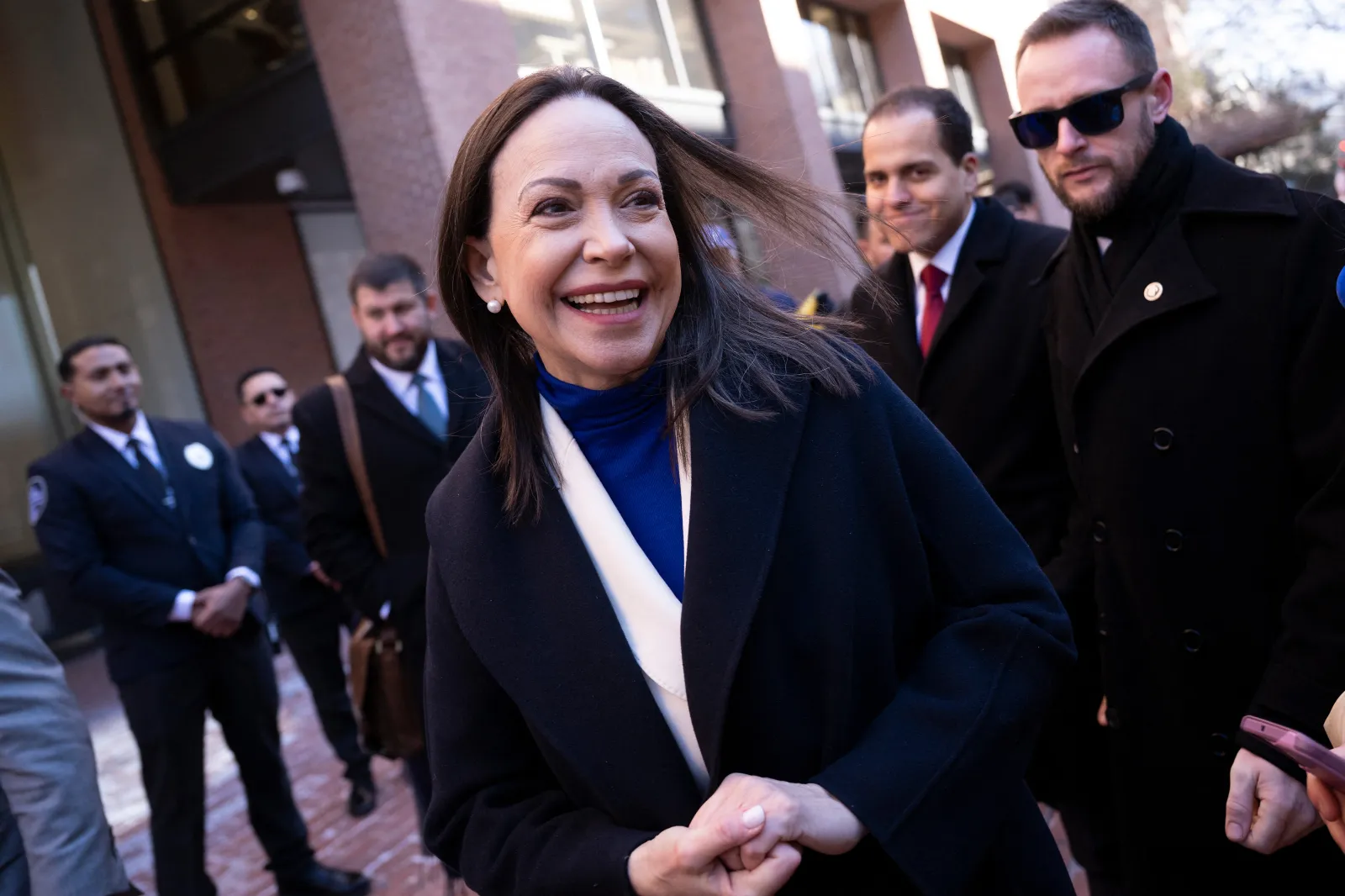
The opposition movement of María Corina Machado bears none of those liabilities. Where Guaidó was a self-pronounced, unelected president, Machado and Edmundo González were elected in an opposition primary and a national presidential election, by the overwhelming majority. They are the moral leaders of the country, with a 2025 Nobel Peace Prize to their name and the unwavering support of the Venezuelan people. Together with their team, they represent decades of combined expertise. Their modus operandi is to rebuild Venezuela’s institutions with transparency and trust, which they believe is the foundation of democracy.
U.S. Secretary of State Marco Rubio recently told the Senate that the Venezuelan opposition, led by Machado, would be placed front and center of the transition negotiations, emphasizing that the transition to democracy is going much faster than anyone expected. Machado has repeatedly spoken of the need to bring immediate transparency to Venezuela’s public accounts quickly, not only for the sake of citizen trust, but for viability in international markets.
In 2023, Machado presented the Tierra de Gracia plan, which aligned with that framework and was adopted in 2024 by Venezuela's legitimately elected president, Edmundo González, as a transition framework. The plan re-establishes the military as a non-partisan institution under legitimate civil authority that would guarantee security, while the political rules are rewritten to support an inclusive, representative democracy and elections as soon as possible.
According to the way they voted in 2024, approximately 70 percent of Maduro’s personnel would, in the moment of truth, support the opposition, according to Carlos Blanco, Machado’s political advisor. That has become evident in the recent cooperation between the FBI and the Bolivarian Intelligence agency (SEBIN) in the capture of leading Chavist enabler Alex Saab.
If the U.S. president seems tempted to make this into a power grab, Trump's volte-face on his commitments to the opposition could cause the operation to go south quickly.
Trump’s boasting about the U.S. military success in Venezuela notwithstanding, this moment is about Venezuela’s emancipation. In a perilous era for democracy worldwide, it’s tempting to be cynical about Venezuela’s prospects for a democratic transition out of 25 years of dictatorship. But never has a Nobel laureate and her hand-picked president-elect had the chance to rebuild a country. This moment belongs to Venezuelans.
Kristina Foltz is a writer and analyst focusing on Latin American affairs.
The views expressed in this article are the writer's own.
View 0 Comments
Submit Correction
View Editorial & AI Guidelines