
...

By Amanda Greenwood
Associate News Editor
0
Share
Newsweek is a Trust Project member
See more of our trusted coverage when you search.Prefer Newsweek on Googleto see more of our trusted coverage when you search.
Thousands of residents across parts of Southern California have been urged to stay indoors and "keep windows and doors closed" as poor air quality blankets the region, driven by windblown dust, according to the National Weather Service (NWS).
Areas Affected
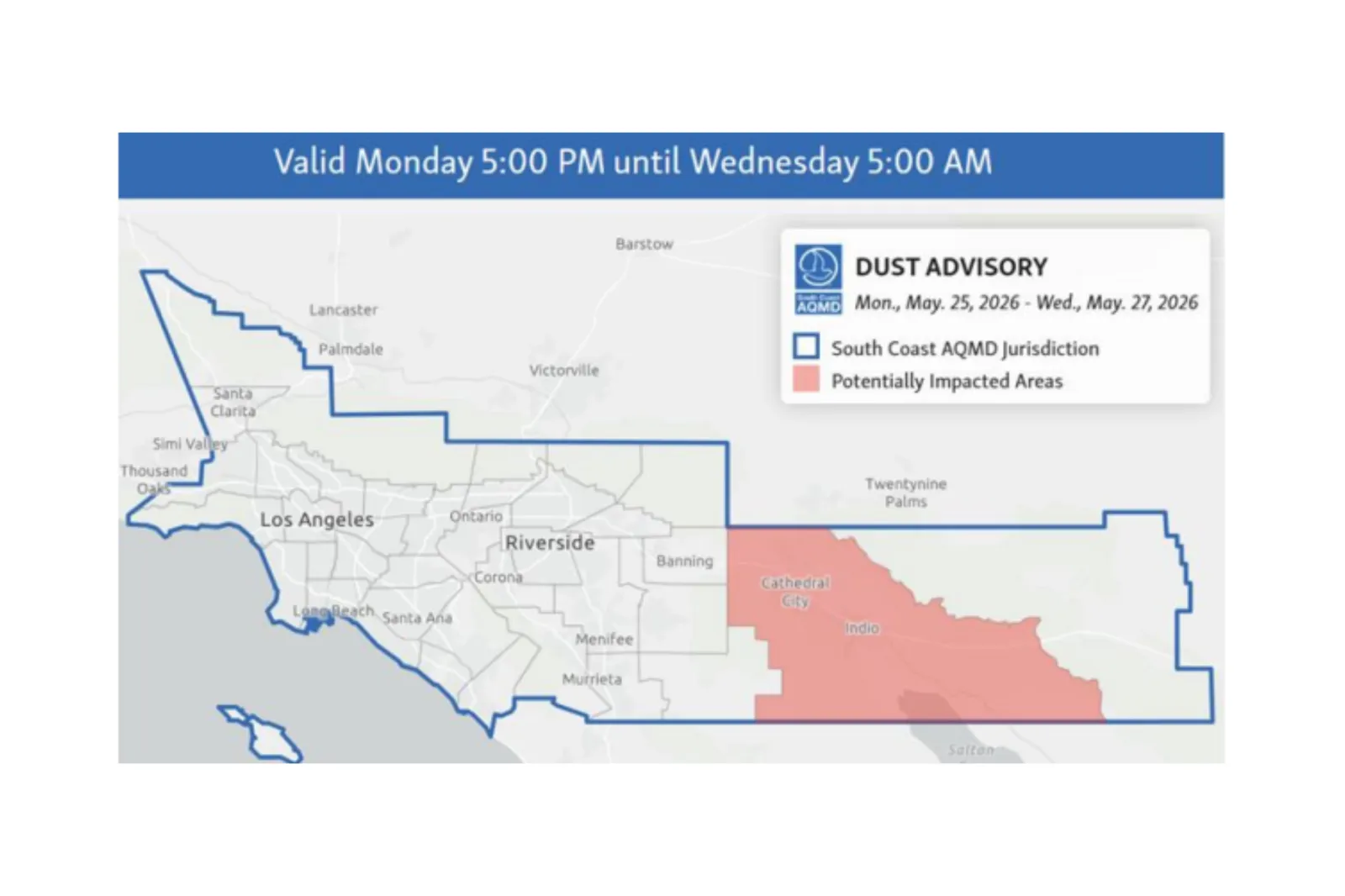
Air quality alerts are currently in place across the Coachella Valley and Imperial Valley in southeastern California.
Read More on News
In the Coachella Valley, which includes the cities of Palm Springs, Indio, Cathedral City, Palm Desert and La Quinta, the South Coast Air Quality Management District (AQMD) issued an air quality advisory that began on Monday afternoon and is now in place until early Wednesday morning.
...
A separate alert has been issued for Imperial County, covering El Centro, Calexico, Brawley, Salton City and surrounding communities. This advisory is set to run from Tuesday afternoon through to Wednesday night, according to the NWS.
Together, these warnings affect tens of thousands of people across Southern California’s desert regions, where air quality is expected to fluctuate between "unhealthy" and "unhealthy for sensitive groups."
Why Air Quality Is So Poor in California
According to the official AQMD advisory, the deterioration in air quality is being caused primarily by strong winds sweeping across dry, desert terrain, lifting large amounts of dust into the air.
Forecasts indicate wind gusts could reach up to 50 mph in parts of the Coachella Valley, creating ideal conditions for windblown dust and elevated particle pollution, sometimes referred to as particulate matter (PM10).
These tiny airborne particles can linger and spread widely depending on local weather patterns. Even brief bursts of high winds across exposed or loose soil and agricultural land can trigger sharp spikes in pollution levels, particularly in desert regions like Imperial Valley.
As a result, air quality is expected to vary throughout Tuesday—and in some areas through Wednesday—with the worst conditions likely during windy periods.

...
Why Particle Pollution (PM10) Is Dangerous
Health officials warn that particle pollution—particularly PM10—poses significant risks to public health.
Fine particles, especially those less than 10 micrometers in diameter, can penetrate deep into the lungs and even enter the bloodstream, where they can trigger a range of serious health issues.
Short-term exposure has been linked to:
- Asthma attacks
- Irritation of the airways
- Coughing and difficulty breathing
Longer-term or high-level exposure can lead to more severe complications, including:
- Heart attacks or irregular heartbeat
- Worsening of chronic lung disease
- Increased risk of lung infections
While anyone can be affected, children, older adults, and individuals with heart or lung conditions face the greatest risk.
How People Can Protect Themselves
Authorities are urging residents to take precautions as air quality worsens. Key recommendations include:
- Stay indoors and keep windows and doors closed
- Use air conditioning or air purifiers to filter indoor air
- Avoid using appliances that draw in outside air, such as swamp coolers or whole-house fans
- Limit or avoid outdoor exercise, especially during peak pollution periods
- Reduce additional indoor pollution by avoiding candles, fireplaces and gas-powered equipment
Outlook For The Rest of The Week
The air quality outlook depends heavily on wind patterns and dust conditions.
In the Coachella Valley, officials expect conditions to gradually improve after early Wednesday morning, although intermittent periods of poor air quality could persist if winds continue.
In Imperial County, the alert extends later into Wednesday night, suggesting lingering dust and unstable conditions through the midweek period.
Forecasters note that while winds may ease during portions of the day—potentially bringing temporary improvements—renewed gusts could quickly degrade air quality again, keeping conditions unpredictable.
Key Takeaway
For now, officials say the best course of action is simple: Limit exposure, stay informed, and keep indoor air as clean as possible.
View 0 Comments
Submit Correction
View Editorial & AI Guidelines