...

By Amanda Greenwood
Associate News Editor
0
Share
Newsweek is a Trust Project member
See more of our trusted coverage when you search.Prefer Newsweek on Googleto see more of our trusted coverage when you search.
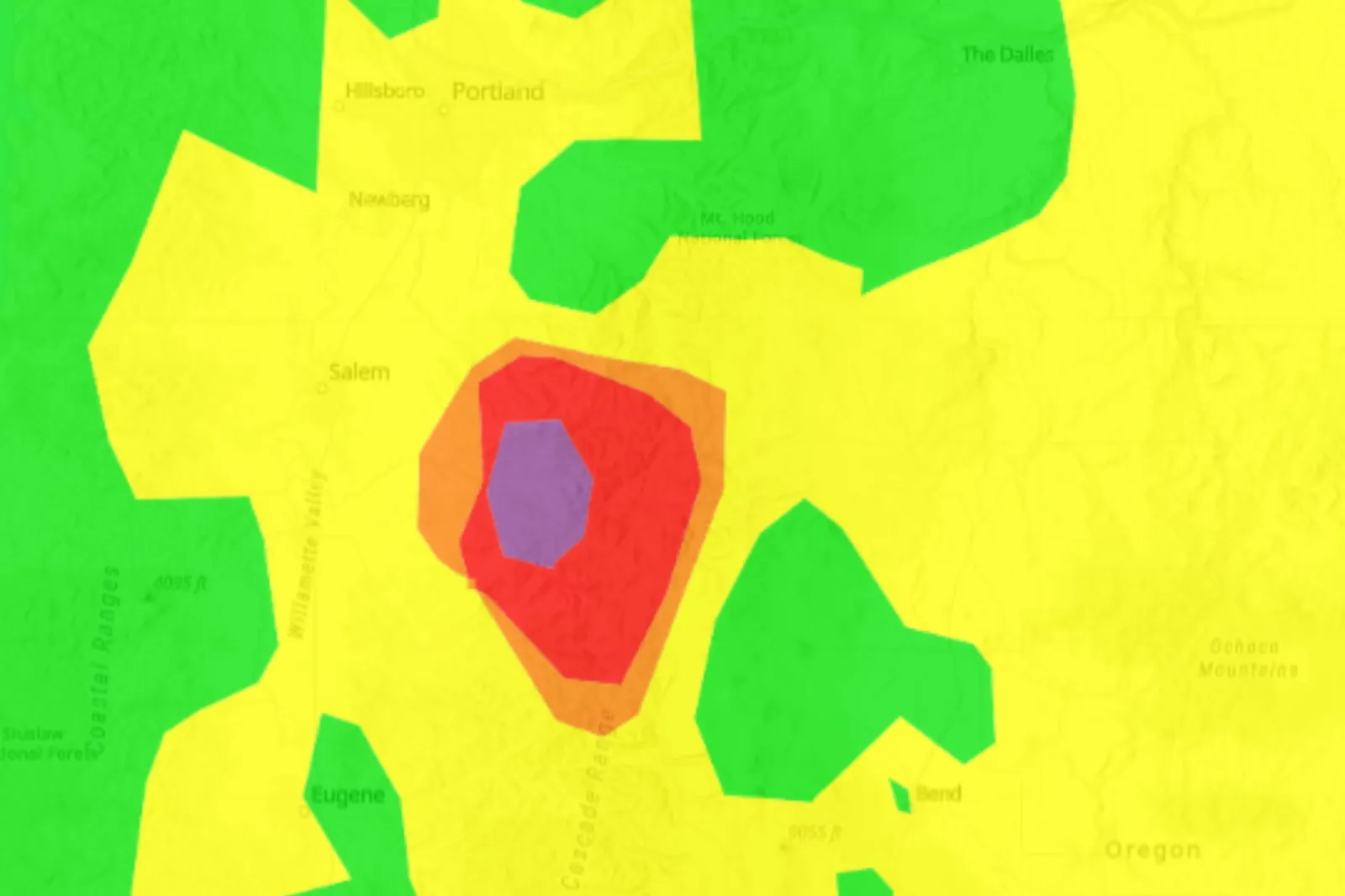
Thousands of residents in Oregon have been urged to stay inside amid concerns over high air pollution levels, a live map from AirNow shows.
The map shows an area of fine particle (PM2.5) pollution in the "very unhealthy" Air Quality Index (AQI) category around Mill City as of 7 a.m. ET on Wednesday. This is surrounded by an area of "unhealthy" air quality.
Why It Matters
Air pollution can affect all members of the public, but the elderly, young children, and those with existing heart and lung issues are particularly vulnerable.
Read More on News
Poor air quality can trigger symptoms including eye, nose, and throat irritation, coughing, shortness of breath, tightness in the chest, and exacerbation of existing respiratory conditions such as asthma.
...
What To Know
The AQI describes a "very unhealthy" air quality warning as a "health alert," where the "the risk of health effects is increased for everyone."
The AQI is a standardized system designed to measure air quality levels across the U.S. It uses six color-coded categories and a scale of 0 to 500 to rate the air pollution levels in the atmosphere:
- 0—50 (Green): Good—air quality is satisfactory, and air pollution poses little or no risk.
- 51—100 (Yellow): Moderate—air quality is acceptable. However, there may be a risk for some people, particularly those who are unusually sensitive to air pollution.
- 101—150 (Orange): Unhealthy for sensitive groups—members of sensitive groups may experience health effects. The general public is less likely to be affected.
- 151—200 (Red): Unhealthy—some members of the general public may experience health effects; members of sensitive groups may experience more serious health effects.
- 201—300 (Purple): Very Unhealthy—health alert. The risk of health effects is increased for everyone.
- 301 and higher (Maroon): Hazardous—health warning of emergency conditions. Everyone is more likely to be affected.
PM2.5 are tiny particles of pollution that are usually 2.5 micrometers or less in size that enter the atmosphere and are often unknowingly inhaled. They can come from various sources, ranging from construction sites and wildfires, to power plants and car emissions.
What People Are Saying
AirNow says on its website: "Particle pollution, also known as particulate matter, is composed of microscopic solids or liquid droplets that are so small that they can get deep into the lungs and cause serious health problems. When exposed to these small particles, people with heart or lung diseases and older adults are more at risk of hospital and emergency room visits or, in some cases, even death from heart or lung disease. Even if you are healthy, you may experience temporary symptoms from exposure to elevated levels of particles."
The EPA warns on its website: "Numerous scientific studies have linked particle pollution exposure to a variety of problems, including:
- premature death in people with heart or lung disease
- nonfatal heart attacks
- irregular heartbeat
- aggravated asthma
- decreased lung function
- increased respiratory symptoms, such as irritation of the airways, coughing or difficulty breathing.
"People with heart or lung diseases, children, older adults, minority populations, and low socioeconomic status populations are the most likely to be affected by particle pollution exposure, either because they are more sensitive or may have higher exposures."
What Happens Next
Residents in affected areas should continue monitoring the air quality maps and respond to the warnings. The warnings are updated throughout the day on the AirNow website.
Update 12/4/25 04.15 a.m. ET: The headline of this article was updated.
View 0 Comments
Submit Correction
View Editorial & AI Guidelines