...

By Micah McCartney
Reporter
0
Share
Newsweek is a Trust Project member
See more of our trusted coverage when you search.Prefer Newsweek on Googleto see more of our trusted coverage when you search.
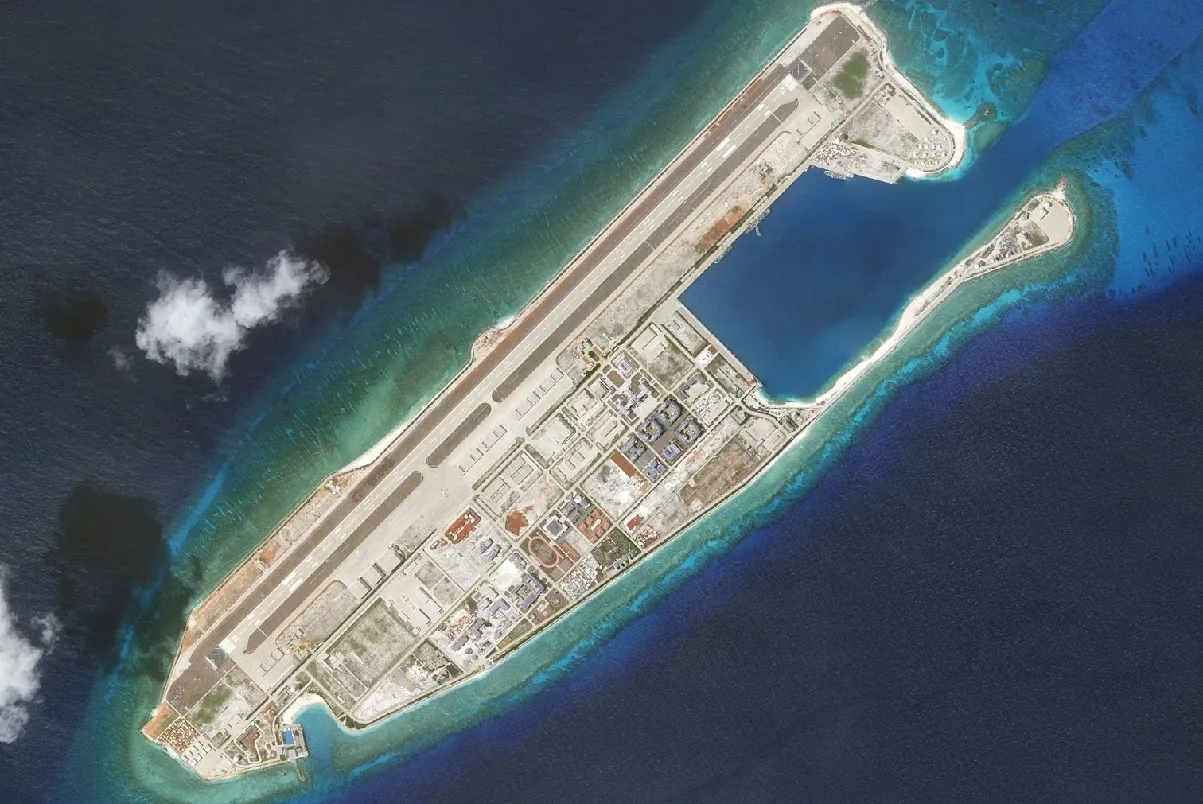
Built atop an atoll, Fiery Cross Reef is one of seven China reclaimed during its 2013–2016 dredging spree that created more than 3,000 acres of new land.
Today, it is a fortified base for the People's Liberation Army (PLA) that Beijing calls the seat of its Nansha District.
A timelapse compiled by Newsweek shows the transformation of China's most important outpost in the disputed Spratly Island archipelago.
Read More on World
Why It Matters
China claims sovereignty over more than 80 percent of the South China Sea, an energy-rich waterway through which as much as $5 trillion in trade flows each year (CSIS).
Those claims extend to the Spratlys, which are also claimed, fully or in part, by Vietnam, the Philippines, Malaysia, Taiwan and Brunei—the latter being the only claimant not to occupy any features. Beijing's neighbors have protested the island-building, particularly U.S. defense treaty ally the Philippines, which is locked in a territorial dispute with the East Asian power.
Newsweek reached out to the Chinese Foreign Ministry by email with a request for comment.
What To Know
Satellite images from Copernicus, the European Space Agency's (ESA) Earth observation program, show the final stages of construction on Fiery Cross Reef in the late 2010s and continue onto the present.
Fiery Cross, named after a British trade ship that wrecked on the reef in 1860, covers about 680 acres of reclaimed land, with the surrounding atoll stretching 44 square miles.
Features identified by the Washington, D.C., think tank the Center for Strategic and International Studies include a 10,000 foot runway, hardened aircraft shelters, fuel and munitions storage, radar and sensor arrays, and hangars that can accommodate two dozen combat aircraft or several larger planes.
The reef also features a port, which a 2024 Chinese Academy of Sciences study found significantly reduced Chinese response times in the region.
Alongside Subi and Mischief Reefs, Fiery Cross is among the "Big Three" fortified outposts equipped with airstrips, missile launchers, and hardened shelters—despite Chinese President Xi Jinping's 2015 pledge to then-U.S. President Barack Obama not to militarize them.
The hub has served the PLA Navy, China's coast guard, the so-called "Maritime Militia," and government research vessels.
...
Fiery Cross also has administrative significance, having been designated as the administrative seat of the new Nansha District, under Sansha City in China's southernmost province of Hainan in 2020.
Unlike Mischief Reef, Fiery Cross is situated outside the Philippines' exclusive economic zone, and it is over 700 miles from Hainan.
Because the reef is almost entirely covered by water at high tide, with exception of two rocks, it cannot be claimed by any state, according to the United Nations Law of the Sea.
In a landmark 2016 case brought forward by the Philippines, a Hague-based arbitral tribunal dismissed China's sweeping claims over the South China Sea. Beijing refused to send representation and claims the decision is invalid, citing "historical" rights.
While China leads the region in land reclamation, Vietnam has also accelerated its own dredging operations since 2023 and now boasts around 70 percent the acreage of China's reclaimed land. The Philippines has undertaken far smaller projects.
The South China Sea Probing Initiative (SCSPI), a Beijing-based think tank, complained of the focus on China's land reclamation relative to its neighbors, saying it was driven by political motivation.
"Western countries, especially the U.S., have primarily focused their South China Sea narratives on China due to power competition, ideological biases and sympathy for the underdog, while deliberately downplaying or ignoring the aggressive actions of Vietnam and the Philippines," SCSPI wrote on X Sunday.
The timelapse begins in 2016, shortly after the ESA launched the first of its Sentinel-2 satellites.
What People Have Said
The Philippines' Department of Foreign Affairs said in a November 2023 statement: "You may all recall that in 1995, when we protested China's construction of a structure in Mischief Reef, China promised that it was only a "fisherman's shelter" and would remain as such.
"The reef is now a militarized artificial island. So are Calderon Reef, also known as Cuarteron Reef; [Fiery Cross Reef]; [Gaven Reefs]; [Hughes Reef]; Johnson Reef; and [Subi Reef]. Let us not forget that."
Guo Jiakun, a spokesperson for the Chinese Foreign Ministry, said of Vietnam's island-building activities during an August 25 press briefing: "Nansha Qundao [the Spratly Islands] have always been China's territory. China firmly opposes relevant countries' construction activities on islands and reefs they illegally occupy."
What's Next
Fiery Cross Reef will likely remain central to Chinese power projection in the South China Sea.
View 0 Comments
Submit Correction
View Editorial & AI Guidelines