
10
Loading video...

By Alex J. Rouhandeh
National Political Correspondent
0
Share
Newsweek is a Trust Project member
See more of our trusted coverage when you search.Prefer Newsweek on Googleto see more of our trusted coverage when you search.
Maine Democrats on Saturday formally selected Troy Jackson as their nominee for a U.S. Senate seat, ending a chaotic saga that nearly derailed the party's chances to oust Republican Senator Susan Collins and flip one of Democrats' top Senate targets of 2026.
On July 8, Platner dropped from the race following allegations of sexual misconduct, sparking a crowded race to succeed him that ultimately resulted in the rise of Jackson under four weeks’ time.
While Jackson is a familiar face in Maine state politics, serving off and on in the state legislature since 2002, including two years as Democratic leader and six as Senate president, he lacks the star power that surrounded Platner, raising concerns about whether he can pull off what four other Democratic challengers have failed to do: unseat Collins.
Read More on Politics
When Newsweek looked at Platner’s campaign in May, before his campaign was undone by the scandal, one of the points his supporters reiterated was that Platner’s skills as an organizer and ability to connect with the state’s working class had allowed him to brush off past baggage and put him on a path to flipping the Senate seat.
Fortunately for Democrats, those two qualities may be just as strongly represented, if not stronger, in Jackson. “In Maine labor circles, the gold standard is Troy Jackson,” Jason Shedlock, Maine labor leader and statehouse candidate who helped identify Platner, told Newsweek. “I’ve introduced him countless times at different events as the patron saint of labor in Maine, and he is. When we’re looking at things, there’s not going to be another Troy Jackson.”
Shedlock provided his description of Jackson back when the latter was running for governor, a contest where he ultimately placed third. Shedlock said in Maine politics, no matter whether the race sits at the top or bottom of the ballot, labor leaders assess candidates by comparing them to Jackson.
A fifth-generation logger and card-carrying union member, Jackson’s entrance to politics came in 1998 when he helped lead a logging blockade along the Maine-Canada border where he and others physically blocked entry to temporary Canadian workers whom they viewed as encroaching on their jobs. At the time, Jackson was a Republican, having registered ahead of the 1988 presidential election on account of George H.W. Bush’s connection to Kennebunkport, Maine.

...
After the logging blockade, Jackson was motivated to run for state legislature as a Republican in 2000. He lost that race by under 200 votes and realized how Democratic his area was. In 2002, he ran again—this time as an independent—and won. Upon beginning work on the statehouse’s labor committee, he realized his views aligned with the Democratic Party and he’s been allied with the left ever since.
“I really didn't understand politics so much or pay attention to it until like 1998 when, you know, logging got so tough financially, and we started asking government to help us, and they wouldn't,” Jackson told Newsweek. “That made me so pissed off that I started, you know, paying attention. So, I tell that story a lot. A lot of people will say, ‘Well, I don't want to deal with politics.’ I'm like, ‘Man, politics is in everything, you better start dealing with it, or you're going to be like I was. You're going to be on the outside looking in.’”
It’s the people outside looking in whom Jackson must turn out to the polls in November if he wants to beat Collins. Per the Independent Voter Project, 34 percent of the state’s electorate are Democrats, 32 percent are independents and 30 percent are Republicans. Nonetheless, Collins has won election after election, even as Democratic presidential candidates carried the state.
Platner was able to energize a diverse array of voters who’d previously not been all that interested in politics by drawing on his diverse life experiences, an everyman appeal and his oratory skills. Jackson checks the first two boxes but doesn’t exactly fill Platner’s boots on the third. With his earnest disposition and northern Maine accent, Jackson is someone whose words can prove magnetic in conversation yet, when delivered from a podium, can be easily tuned out.
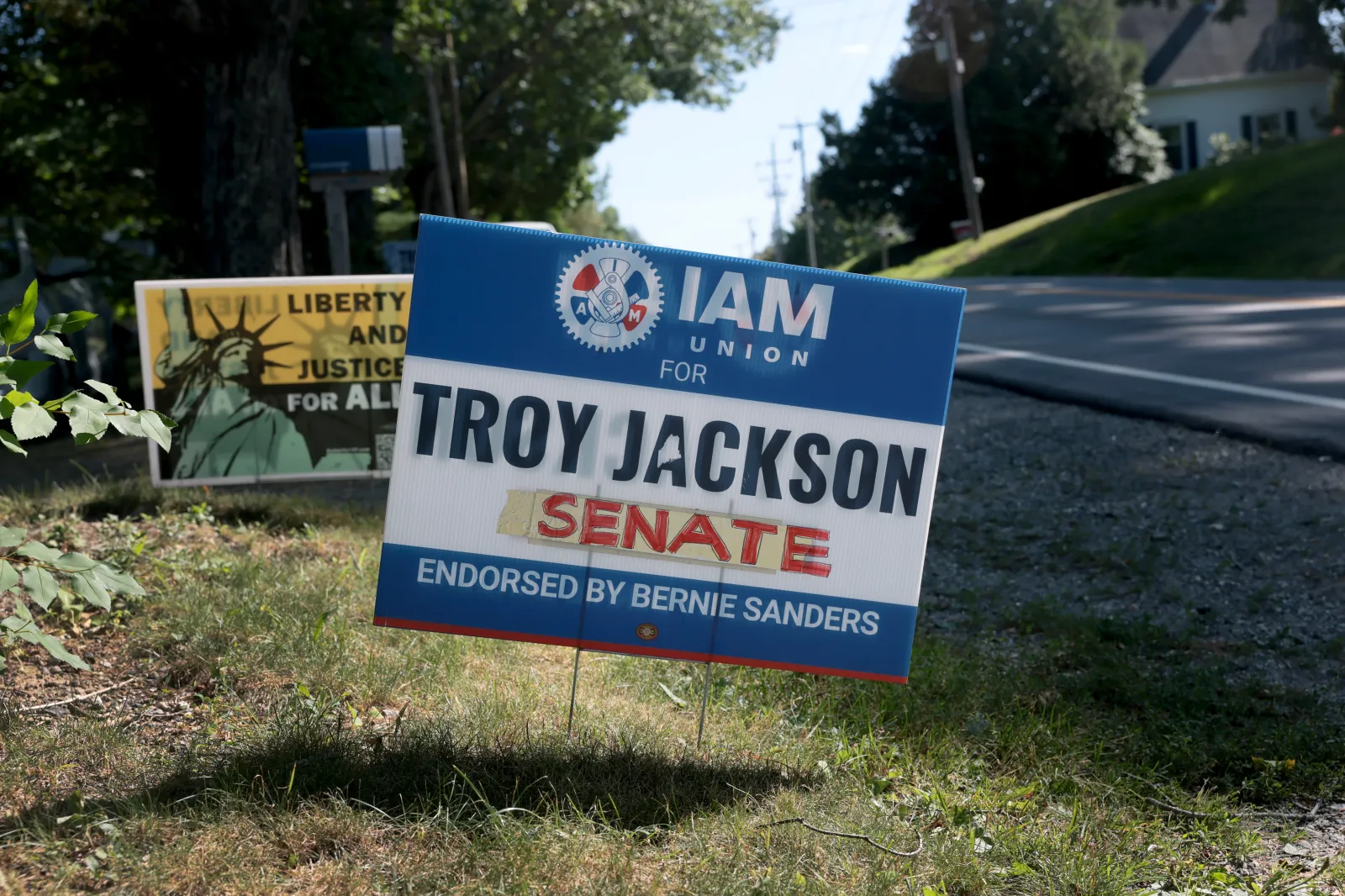
What he says, however, is very similar to Platner’s worker-centric platform that helped Jackson secure endorsements from Representative Ro Khanna and Senator Bernie Sanders, for whom Jackson backed as a superdelegate in 2016. That latter experience made him feel very much like an outsider in his party, as he and other Sanders supporters felt the Democratic National Committee had placed a thumb on the scale to secure Hillary Clinton’s 2016 nomination.
On top of that, despite being Senate president, Jackson said he’s “the person in Maine that's had the most bills vetoed ever in the history of the state.” Jackson’s "Maine Buy American and Build Maine Act," which would have given preference to Maine-based businesses in state procurement contracts, was vetoed by Governor Janet Mills, as was his bill to expand legal recourse for workers victimized by wage theft. Jackson’s legislation to ban the aerial spraying of glyphosate and other synthetic herbicides was also among those vetoed.
“In our 2022 endorsement of Janet Mills for governor, we pointed out that Maine passed more pro-labor laws in those few years than we did in the past 40 years, but that was really thanks to Troy Jackson,” Andy O’Brien, former Democratic member of the Maine legislature and current communications director for the Maine AFL-CIO, told Newsweek. “He was very dogged in his fighting for workers' rights, even if that risked high-profile fights with Mills.”
...
It was those fights that made Jackson, despite having spent over 20 years in and out of elective office, feel at odds with the party establishment and what has motivated him to seek higher office.
During his run of governor, Jackson found solidarity with Platner as the two shared strikingly similar views on labor as well as the endorsements from Sanders, the Maine AFL-CIO and a host of other unions. Where they split, however, was in their support from the Maine People’s Alliance (MPA), the state’s largest progressive organizing network. That group had endorsed Platner but elected to back Secretary of State Shenna Bellows, who also rallied alongside Platner during her bid for governor.
The MPA places a greater focus on social justice issues than much of the state’s labor unions. Jackson said he thinks there’s too much focus on identity politics nowadays, and while he believes the issues are important, he said, “If [people] can't pay the rent, they can't focus on all those issues right now.” The MPA has yet to endorse Jackson, and if he’s keen on matching the heft of Platner’s organizing apparatus, this may be an area where inroads could prove crucial. The MPA did not respond to Newsweek's request for comment.
Ultimately, turnout will be critical for both parties come November, and if Democrats turn out their voters at equal levels to Republicans, then Jackson could draw a little under half the independent vote and still win. That reality has left oddsmakers to place betting odds at over 60 percent in Jackson’s favor.
Republicans have already begun shaping their case against Jackson. Following his formal selection as the Democratic nominee Saturday, a GOP-aligned super PAC released an ad criticizing Jackson's temperament and casting him as another version of Platner.
While Collins and her $11 million war chest are not to be counted out, it’s clear that Jackson—as a former independent and Republican—has the cross-party appeal to pull from her traditional base. And unlike Platner, he has a proven political track record that may draw those who felt uneasy about supporting a political novice.
Politics has only grown more heated in the era of Trump 2.0, and as anti-incumbent sentiments have swept both parties, it’s an ideal moment for voters to select a fifth-generation logger (even one who’s spent 20 years in state politics) over a five-term incumbent.
It’s clear Maine Democrats were thrilled to go that direction after hearing the message of Platner. What remains to be seen is if that message will have the same resonance coming from Jackson. While he may not match Platner’s skills from the podium, Jackson will do his best to ensure he’s heard while speaking often and clearly about the issue he believes will define this race.
“Democrats are fighting for the [working class],” Jackson said. “They’re fighting for them every day, but you don’t hear them talking about it because we don’t talk about our priorities to the extent that we need to. We just need to get back to economics.”
View 0 Comments
Submit Correction
View Editorial & AI Guidelines