...

By Robert Alexander
Senior Crime & Court Reporter
0
Share
Newsweek is a Trust Project member
See more of our trusted coverage when you search.Prefer Newsweek on Googleto see more of our trusted coverage when you search.
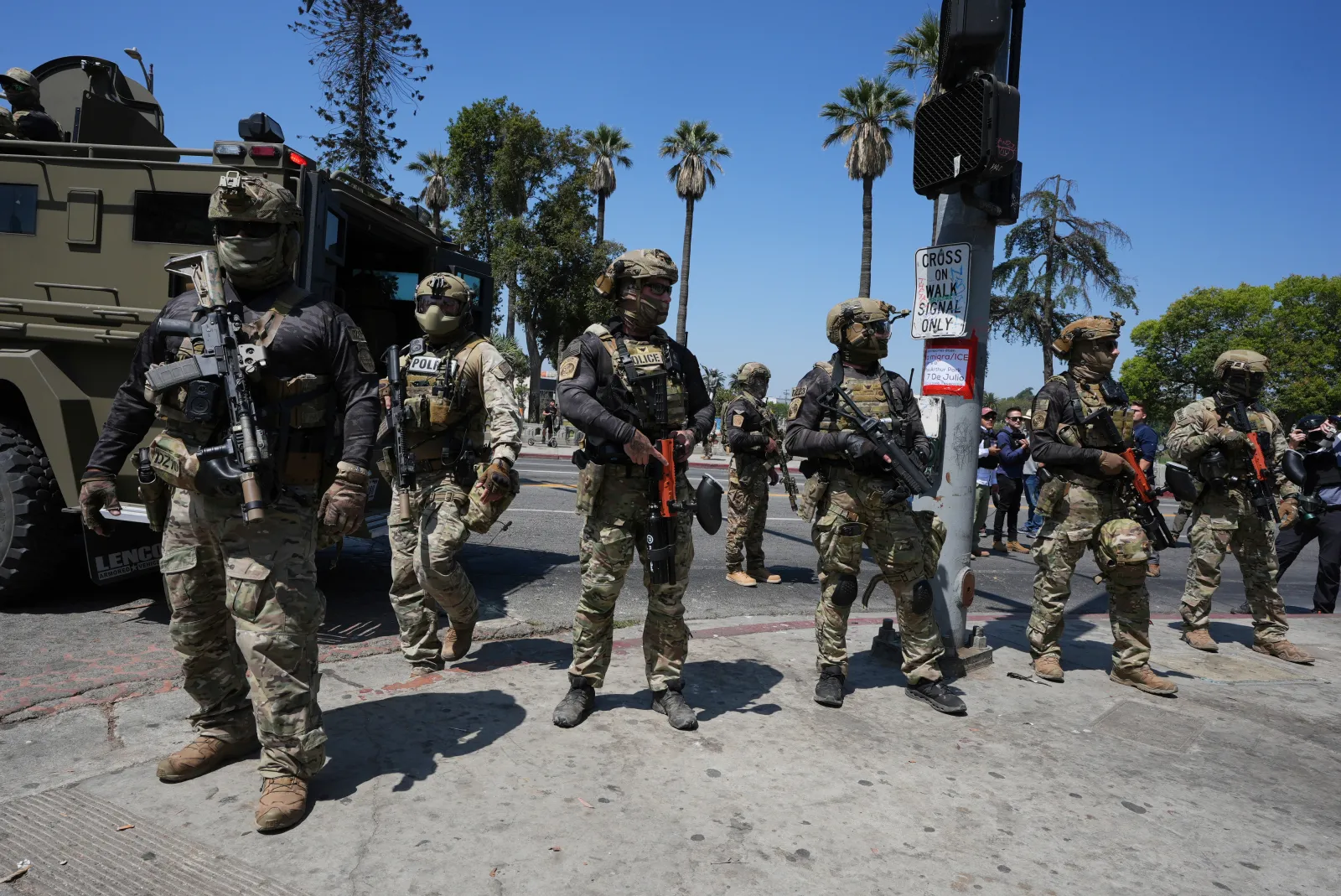
The Trump administration has filed a lawsuit against California over two recently enacted state laws that restrict the use of facial coverings by law enforcement and require visible identification for non-uniformed officers.
In a complaint filed on November 17 in the U.S. District Court for the Central District of California, the Justice Department argues that the measures—Senate Bills 627 and 805—violate the Constitution’s Supremacy Clause and unlawfully burden federal immigration enforcement.
Newsweek contacted the DOJ for comment via email outside of normal working hours on Tuesday.
Read More on U.S.
Why It Matters
California’s new restrictions on masked and unidentified law enforcement have triggered a major constitutional clash with the Trump administration, which argues the laws illegally interfere with federal immigration operations and endanger officers already facing a surge in threats and violence.
By seeking to block the measures, the federal government is testing the limits of state authority over federal agents, escalating a politically charged fight that carries implications for immigration enforcement, public transparency and Governor Gavin Newsom’s growing national profile.
...
What To Know
The Laws at the Center of the Dispute
The lawsuit targets the “No Secret Police Act” (SB 627) and the “No Vigilantes Act” (SB 805), both signed on September 20, 2025, by Governor Gavin Newsom.
According to the complaint, the statutes amount to “imposing a mask ban and identification requirement on federal agents operating in California” and represent the governor’s effort to “push[] back” against federal immigration enforcement.
The filing cites Newsom acknowledging that “it appears we don’t have the legal authority for federal agents” while discussing the mask ban.
Under SB 627, federal, local and out-of-state officers operating in California are prohibited from “wear[ing] a facial covering that conceals or obscures their facial identity in the performance of their duties.”
Agencies must also adopt a public policy governing mask use by July 1, 2026. Violations can result in infractions or misdemeanors.
SB 805 requires non-uniformed federal officers conducting enforcement operations to “visibly display identification” showing their agency and either a name or badge number.
Agencies must maintain a written identification policy by January 1, 2026, and individual violations may be charged as misdemeanors.
The federal government states unequivocally in its filing that it “does not intend to comply with the challenged laws.”
The Justice Department argues that the measures target the federal government directly and improperly regulate the operations and uniforms of federal personnel.
Citing longstanding precedent, the complaint asserts that “States have no power to ‘in any manner control[] the operations of’ the Federal Government” and that federal agencies—not states—hold authority to regulate their employees.
California lawmakers have defended the legislation as an effort to increase transparency and public trust following reports of masked ICE officers conducting street-level arrests.
Notes associated with coverage of the lawsuit characterize masked federal operations as “a contentious issue,” particularly amid expanded immigration enforcement.
Federal Safety Concerns and Operational Impact
The Justice Department, however, frames the laws as posing significant risks to federal personnel.
The complaint states that ICE officers are facing “a more than 1000% increase in assaults” and “an 8,000% increase in death threats,” citing Department of Homeland Security press releases.
It also describes threats ranging from doxing and stalking to acts of violence, including an October incident in Houston involving a Halloween display depicting “ICE agents hanging by their necks” and a Dallas shooting in which a sniper opened fire on an ICE facility.
Federal officials argue that anonymity measures, including optional masking, are necessary to protect officers and their families.
According to the complaint, denying that option “would chill federal law enforcement and deter applicants for law enforcement positions,” and could compromise undercover and plainclothes operations.
The filing also points to statements from California officials suggesting potential criminal enforcement against federal officers.
It cites an official statement from Representatives Nancy Pelosi and Kevin Mullin asserting that “state and local authorities may arrest federal agents if they break California law,” as well as comments from San Francisco District Attorney Brooke Jenkins indicating she was open to pursuing charges.
Political Stakes and Shifting Public Opinion
The stakes extend beyond a procedural dispute. The case touches on broader national questions about federal-state power, immigration enforcement and the limits of state authority to regulate the conduct of federal officers within their borders.
With Governor Newsom’s political profile rising nationally, the conflict also carries political implications, particularly as federal immigration operations continue to draw scrutiny.
Recent polling, as reported by The Chicago Council On Global Affairs, shows a marked softening in Americans’ views on immigration alongside record support for legal immigration, with nearly eight in 10 favoring either increased or stable levels and only 21 percent wanting reductions.
Concerns about immigrants and refugees as a “critical threat” have dropped sharply from 50 to 36 percent, and two-thirds of Americans now support a pathway to citizenship for undocumented immigrants, though partisan divides remain stark: most Democrats and Independents favor legalization while Republicans are split, with a plurality favoring deportation.
These shifts coincide with heightened federal enforcement under President Trump—including National Guard deployments—and appear shaped by both perceived government action and growing recognition of undocumented immigrants’ economic contributions.
Yet despite rising public openness to immigration and diversity, Republicans and Democrats remain deeply divided on the value of racial and ethnic diversity and on the methods of enforcement, reflecting fundamentally different visions of what the country should look like and how immigration should be approached.
The Trump administration is seeking declaratory and injunctive relief prohibiting California from enforcing the laws against federal personnel.
The court has yet to schedule initial proceedings.
What People Are Saying
Donald Trump on giving ‘total authorization’ to federal immigration agents, said July 12, per The Guardian: “I am giving Total Authorization for ICE to protect itself, just like they protect the Public … arrest these SLIMEBALLS, using whatever means is necessary to do so.”
California Attorney General Rob Bonta in a July 15 statement said: “Transparency and accountability are the foundation of good law enforcement, yet in recent weeks, ICE agents have begun the shocking and unacceptable practice of deploying masked agents to carry out immigration enforcement operations.”
California Governor Gavin Newsom talking about the mask ban said, as reported by CalMatters: “To ICE — unmask. What are you afraid of?”
What Happens Next
The federal government will ask the court to halt California’s laws while the case proceeds, and California will file its response defending both statutes.
The judge will then decide whether to issue a preliminary injunction—a key early ruling that will determine whether the laws take effect on January 1.
Whatever the outcome, the losing side is likely to appeal, setting up a longer fight in the Ninth Circuit and potentially the Supreme Court, even as the political debate over immigration enforcement and state authority continues in the background.
View 0 Comments
Submit Correction
View Editorial & AI Guidelines