...

By Dan Gooding
Associate News Editor
0
Share
Newsweek is a Trust Project member
See more of our trusted coverage when you search.Prefer Newsweek on Googleto see more of our trusted coverage when you search.
The Trump administration’s Department of Labor (DOL) has issued a warning that immigration enforcement raids are having a negative impact on farmers and food prices, and has offered up a potential solution.
In a new proposal filed in the Federal Register, the DOL said it would look to lower wage requirements for temporary farmworkers who are on the H-2A visa, in an effort to encourage farmers to use the program instead of hiring undocumented workers who are now being detained by U.S. Immigration and Customs Enforcement (ICE).
"Given the scale, speed and investment in the federal government's efforts to enforce immigration laws and restore the integrity of the U.S. border, the Department concludes that there will be significant labor market effects in the agricultural sector, which has long been pushed to depend on a workforce with a high proportion of illegal aliens," the filing read.
Read More on U.S.
Why It Matters
The filing is one of the first concessions that President Donald Trump’s policy of mass deportations is going to have a negative effect on farming and food prices, after months of warnings from industry experts, while making adjustments to wages could be a relief for farmers already struggling with rising costs and the impact of trade tariffs.
...
What To Know
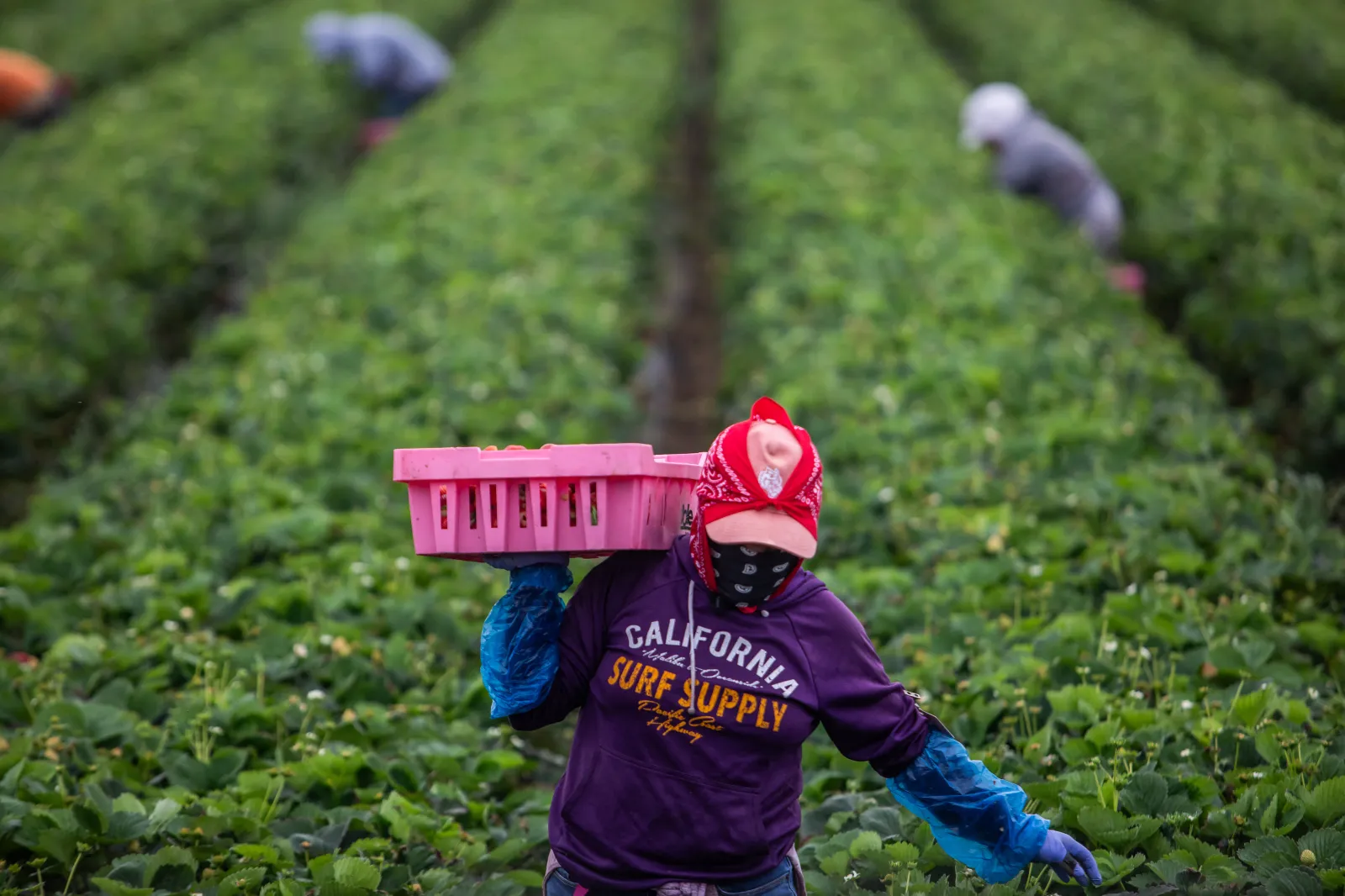
According to the DOL, agricultural employers face uncertainty due to increased ICE enforcement actions on farms around the country, with not enough workers at the ready, particularly U.S. citizens, to step into empty roles. That, in turn, would push up food prices for American shoppers.
In efforts to tackle the problem, the department suggests farmers be allowed to pay legal, temporary H-2A workers less than they are legally required to right now, lowering their costs. The filing essentially acknowledges that many farmers opt to hire undocumented workers, who they can pay less already, instead of paying the current prevailing average wage of around $17.74 an hour.
The DOL said that figure had risen exponentially in recent years, with the latest U.S. Department of Agriculture (USDA) data showing a roughly $3.75 hourly increase in the last five to six years.
“In a sector where profits margins are already thin, such increases place agricultural employers at a competitive disadvantage, particularly when compared to growers in Mexico paying approximately $1 to $2 per hour,” the filing read.
The DOL proposes a new system that outlines entry-level and experience-level wages for each state.
In California, the first tier of workers would be paid $16.45 an hour, while the second tier would be compensated $18.71, down roughly $3. The changes differ from around $1 to $3 depending on the state, but would overall lower yearly costs for employers across the country by around $24 billion over the next decade.
The push to address concerns around migrant farmworkers is part of a series of moves by the Trump administration, despite calls to cut out the reliance on foreign workers, as industry leaders have continued raising concerns about food security, grocery prices and their effects on farming communities.
The president himself has said on at least two occasions that he wants to find a solution for American farmers who rely on immigrants, while the State Department recently reversed a policy change requiring H-2A holders to attend in-person interviews in their home countries for visa renewals.
What People Are Saying
Stuart Anderson, executive director of the National Foundation for American Policy, told Newsweek: “A government agency must justify why it has published a rule as ‘interim final,’ which allows a rule to go into effect immediately. As a result, the Labor Department conceded in writing that the Trump administration’s immigration policies were leading to fewer available farm workers, causing a crisis for many farmers.
“While liberalizing some H-2A rules can help, farmers really want protections for workers who may not be authorized to work and industries, such as dairy, which can’t use H-2A visas, need even bigger fixes due to administration policies that have reduced the supply of available workers.”
Rebecca Shi, chief executive officer at the American Business Immigration Coalition, on LinkedIn: “Food security IS national security. Many of the farmers and agriculture industry leaders American Business Immigration Coalition (ABIC) works with have been saying this for months, as we call for urgent legal work permits for our essential workers, including on farms and in food processing facilities.
“Now, the Department of Labor itself is calling out the immediate dangers to our food supply from mass immigration enforcement, as well as the risk of food prices increasing. If the U.S. doesn't have a stable workforce, we risk our food security AND our national security.”
Mark Krikorian, director of the Center for Immigration Studies, told The Washington Post: “I think the administration has been doing good work on immigration, but in this instance what they’re doing is reducing the incentive for farmers to move away from relying on cheap immigrant labor.”
What’s Next
The DOL said the policy went into effect early this month, but the public has until December to voice opinions on the plan. Whether this has a long-lasting effect on America’s farms remains to be seen.
View 0 Comments
Submit Correction
View Editorial & AI Guidelines