...

By Ellie Cook
Senior Defense Reporter
0
Share
Newsweek is a Trust Project member
See more of our trusted coverage when you search.Prefer Newsweek on Googleto see more of our trusted coverage when you search.
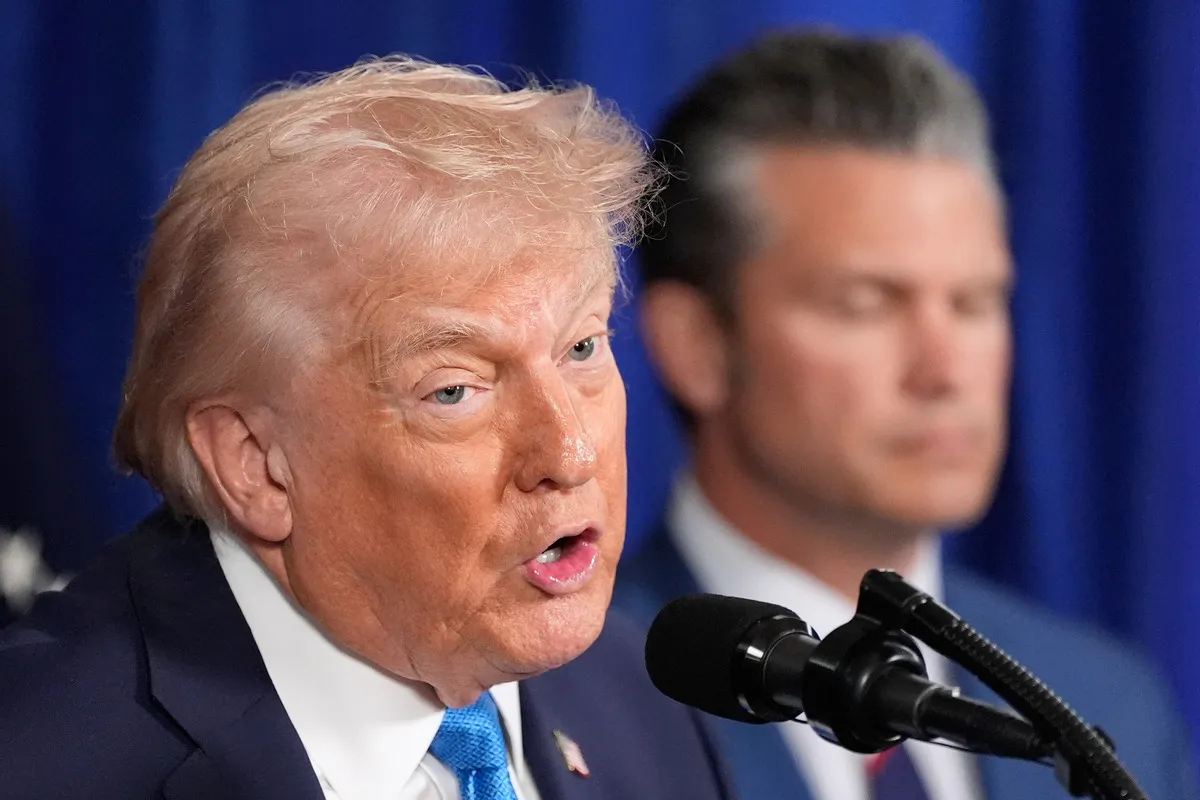
President Donald Trump declared on Saturday the U.S. had "superseded" centuries-old American foreign policy, replacing the 19th century Monroe Doctrine with a new stance: the "Donroe Doctrine."
"The Monroe Doctrine is a big deal, but we’ve superseded it by a lot, by a real lot," Trump said during a press conference at his Mar-a-Lago Club in Florida, in the wake of the U.S.'s extensive operations against Venezuelan leader Nicolás Maduro in the early hours of Saturday. "They now call it the 'Donroe Doctrine.'"
"We sort of forgot about it — it was very important, but we forgot about it. We don't forget about it anymore," the President added. "American dominance in the Western Hemisphere will never be questioned again."
Read More on World
This isn't the first time the term "Donroe Doctrine" has popped up. A headline from a New York Post front page in early January 2025 rendered the phrase in bold letters, and the U.S.'s official National Security Strategy, published in November, explicitly referenced an intention to "assert and enforce" a Trump-style addition to the Monroe Doctrine.
...
What Is The Monroe Doctrine?
Back in 1823, then-U.S. President James Monroe set out a new vision for U.S. foreign policy: European countries would leave Latin America alone, while the U.S. would cement itself as the dominant power in the Western Hemisphere.
President Theodore Roosevelt broadened out the Monroe Doctrine in 1904 — this became known as the Roosevelt Corollary. This change meant the U.S. would now intervene in Latin America if the leaders of individual countries in Washington's perceived sphere of influence couldn't manage their own affairs.
The Monroe Doctrine and its early twentieth-century addition then became the basis for U.S. involvement in countries like Nicaragua, Cuba and the Dominican Republic.
The Trump administration summed up its intentions in its National Security Strategy just weeks ago: "In other words, we will assert and enforce a “Trump Corollary” to the Monroe Doctrine."
This means the U.S. will make sure the Western Hemisphere "remains reasonably stable and well-governed enough to prevent and discourage mass migration to the United States," according to the document, and that governments falling within America's sphere of influence would cooperate with the administration's controversial strike campaign on alleged drug boats in the southern Caribbean and eastern Pacific.
More than 100 people have been killed in strikes on suspected narcotrafficking vessels since early September, as per the administration's numbers.
"We want a Hemisphere that remains free of hostile foreign incursion or ownership of key assets, and that supports critical supply chains," the administration said. "We want to ensure our continued access to key strategic locations."
“We’re restoring a needed focus on defeating threats in the Western Hemisphere,” Trump told the U.S. military's most senior officials in September.
Unlike the Roosevelt Corollary, "this is a very partisan agenda," said Christopher Sabatini, a senior fellow with British think tank Chatham House.
"There is a Donroe doctrine, but it's not necessarily just about resources," Sabatini told Newsweek. "It's also about controling the U.S.'s backyard, but also endorsing conservative figures beyond the U.S. borders," he said.
Operation Absolute Resolve
The White House shared footage late on Saturday showing Maduro accompanied by Drug Enforcement Administration (DEA) officials in New York. He is being held at the Metropolitan Detention Center in Brooklyn and arrived art the facility shortly before 9 p.m. ET on Saturday, according to CBS News.
Maduro is facing multiple charges relating to drugs, narco-terrorism and possessing weapons. His wife, Cilia Flores, as well as Maduro's son and senior Venezuelan politicians, have also been indicted. The U.S. indicted Maduro back in 2020.
A Justice Department indictment accused Maduro of presiding over "a corrupt, illegitimate government that, for decades, has leveraged government power to protect and promote illegal activity, including drug trafficking."
General Dan Caine, the chairman of the Joint Chiefs of Staff, said more than 150 U.S. aircraft were involved from 20 different bases in providing cover for ground-based U.S. forces in downtown Caracas.
Caine said "months of planning and rehearsal" had gone into the "unprecedented" operation, dubbed Absolute Resolve. Intelligence gathering had looked at Maduro's location, his travel patterns, what he ate and wore, as well as his pets.
"Failure of one component of this well-oiled machine would have endangered the entire mission," Caine said. "Failure is never an option."
Trump gave the go-ahead for the mission at 10:46 p.m. ET on Friday, Caine said. U.S. aircraft involved in the operation included fifth-generation F-22 and F-35 stealth fighters, F/A-18s, EA-18 electronic warfare aircraft, E-2 aircraft, B-1 bombers and drones.
U.S. forces had "maintained totally the element of surprise" as helicopters swooped low and arrived at Maduro's compound at just past 1 a.m. ET. on Saturday, Caine said. The helicopters came under fire and responded "with overwhelming force in self-defense," Caine said. One aircraft was hit but was able to fly to the end of the mission, he added.
Maduro and his wife "gave up" and were taken into U.S. custody without any U.S. personnel being killed, Caine said. Fighter aircraft provided cover for the helicopters extracting the Venezuelan leader and his wife from the area.
"There were multiple self-defense engagements as the force began to withdraw," Caine said. The chairman said U.S. personnel were over the water away from Venezuela at 3:29 a.m. ET.
Trump posted an image of Maduro on the U.S. Navy's USS Iwo Jima warship to his Truth Social platform on Saturday.
Footage widely circulating on social media on Saturday showed helicopters hovering in the skies above Caracas and explosions rocking the city.
Update 4/1/2026 at 1 p.m. ET: This article was updated with comments from Christopher Sabatini.
The news cycle is loud. Algorithms push us to extremes. In the middle—where facts, ideas and progress live—there's a void. At Newsweek, we fill it with fearless, fair and fiercely independent journalism.
Common ground isn't just possible—it's essential. Our readers reflect America's diversity, united by a desire for thoughtful, unbiased news. Independent ratings confirm our approach: NewsGuard gives us 100/100 for reliability, and AllSides places us firmly in the political center.
In a polarized era, the center is dismissed as bland. Ours is different: The Courageous Center—it's not "both sides," it's sharp, challenging and alive with ideas. We follow facts, not factions. If that sounds like the kind of journalism you want to see thrive, we need you.
When you become a Newsweek Member, you support a mission to keep the center strong and vibrant. Members enjoy:
Help keep the center courageous. Join today.


View 0 Comments
Submit Correction
View Editorial & AI Guidelines