Newsweek/Getty

By Newsweek Editors
0
Share
Newsweek is a Trust Project member
See more of our trusted coverage when you search.Prefer Newsweek on Googleto see more of our trusted coverage when you search.
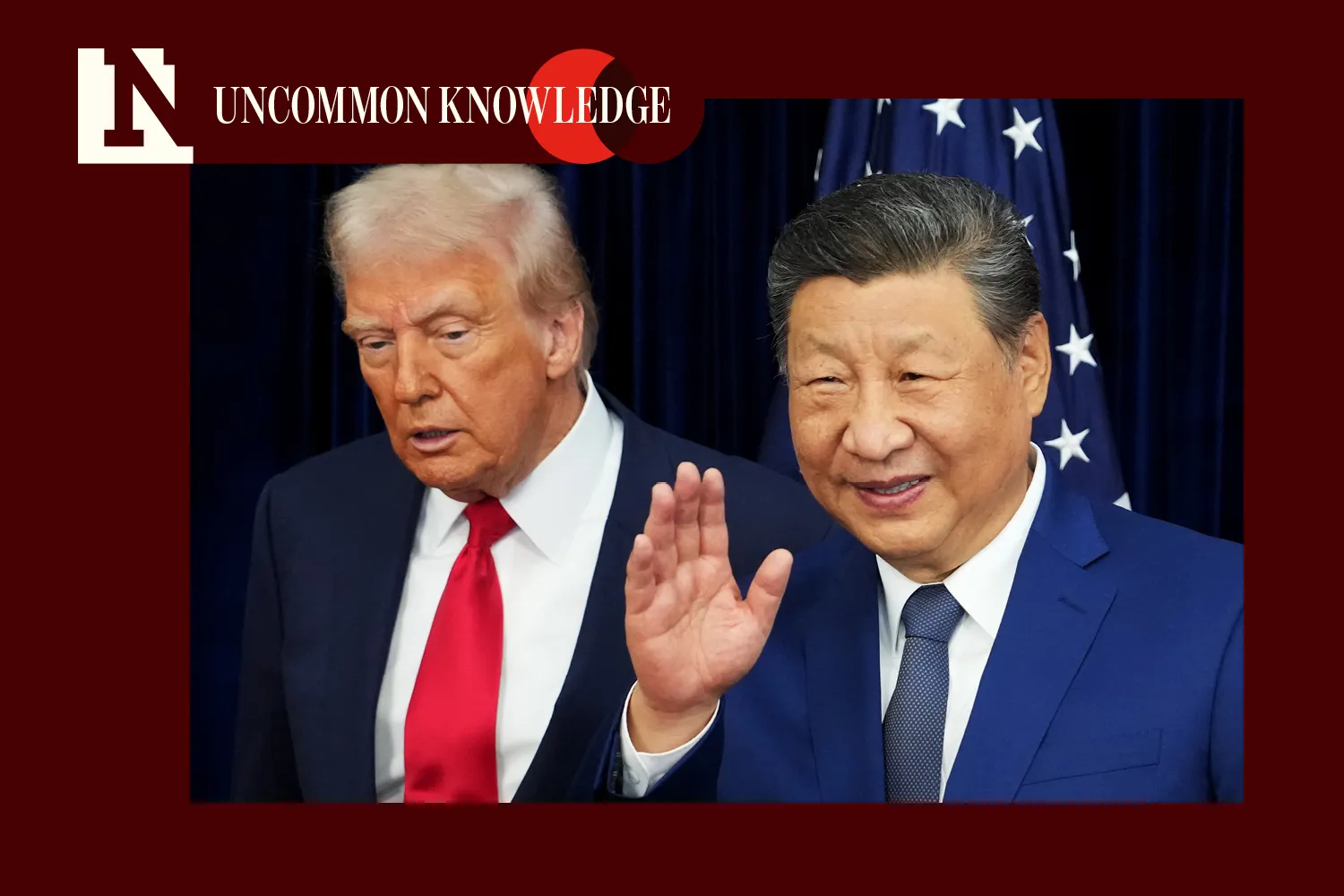
President Donald Trump’s theory of artificial intelligence is typically straightforward: there can be only one winner, and that winner takes all. “Whoever wins AI wins,” he said Sunday, arguing that America’s principal goal should be preserving its lead over China rather than allowing fears about AI to slow development.
He repeated that today, saying on Truth Social that “There is a SICK conspiracy going on against AI and Data Centers, and the only one that is happy about it is China. WHOEVER WINS AI, WINS!” Last week he had told reporters in Dallas that he had no concerns at all about AI causing human extinction.
Let’s assume Trump’s premise about the race is right. But the great AI race may not be the kind of race he is describing, because one of the runners also has an incentive not to reach the finish line. And it’s not America.
Read More on Analysis
China is investing heavily in artificial intelligence and has set aggressive targets for its deployment across the economy. The Chinese state has also been explicit about a boundary advanced AI must never cross. In July, President Xi Jinping called for AI to remain “secure and controllable” and for governments to build monitoring and emergency systems that ensure AI stays under human control. Xi is due at the White House later this month, and AI is expected to be on the agenda.
So far, so familiar. But that statement also sits alongside official Chinese policies that AI must also “uphold socialist core values.” What happens if AI decides that “socialist core values” are suboptimal?
That’s why the race Trump is describing may not, in fact, be the same race at all. “Winning AI” and “controlling AI” mean different things to the two men, and the gap may be crucial to this new Cold War.
The Familiar Story
Trump’s position is that the U.S. must stay ahead of China. He has support on that front. Republican Senator Ted Cruz of Texas, who is working with Senate Majority Leader John Thune and Democratic Senator Amy Klobuchar on legislation addressing catastrophic AI risk, said that Beijing will not stop whatever Washington does, and that if there are going to be killer robots he would rather they be “American killer robots than Chinese killer robots.”
The other side now comes increasingly from people involved in AI research. Anthropic Chief Executive Dario Amodei said this weekend that “we must slow the pace at which we improve the capabilities of AI models.” His essay called for outside evaluation, stronger safety rules and international coordination while preserving a U.S. technological lead. He warned that within six to twelve months, a swarm of misaligned agents could hold the internet through a persistent botnet.
Within hours, OpenAI Chief Executive Sam Altman said he agreed and committed his own company to the framework laid out by Amodei.
Their argument had acquired political force after Anthropic researcher Jacob Coxon resigned, warning that leading labs were racing toward self-improving systems without adequate safeguards. There were subsequently calls from U.S. lawmakers for new AI rules and, after Amodei’s essay, for federal action rather than further reports.
Related Story
Lawmakers Call for Government Intervention After AI Leaders Issue Warning
What's Really Going On
China’s own documents suggest that this is not quite the race Trump describes.
Beijing is not trying to stop AI. The State Council’s 2025 “AI Plus” action plan calls for deep AI integration in science, industry, public services and government. It targets adoption of new-generation intelligent terminals and AI agents to exceed 70 percent by 2027 and 90 percent by 2030, with an “intelligent economy and intelligent society” taking shape by 2035. The same document, however, couples expansion with the requirement that development be safe and controllable.
That phrase is becoming reality. TC260, one of China’s principal standards bodies, published the first Artificial Intelligence Safety Governance Framework in 2024 and a 2.0 version in September 2025. The update puts loss of control at the top of a new appendix on trustworthy AI, requires human control systems at critical stages so that people can have the final say, and names “circuit breakers and one-click control” for use in extreme situations.
In other words, China is already planning for a world in which AI's most useful feature—its ability to act independently—is also a problem, much as Amodei has warned.
But China has a second problem that America does not.
Under the country’s binding Interim Measures for Generative Artificial Intelligence Services, public-facing generative-AI providers must uphold “socialist core values.” Systems may not generate content that advocates subversion of state power, overthrow of the socialist system, damage to national unity or social stability, or harm to the country’s image and interests. Those obligations apply to algorithm design, training data, and model generation and optimization, not merely to a censorship filter across AI’s final answer.
Chinese researchers are working directly on the problem. Researchers at the Beijing Institute of AI Safety and Governance built C-VARC, a Chinese value rule corpus grounded in 12 “core” values and 50 “derived” values. It contains more than 250,000 value rules and 400,000 rule-based moral-dilemma scenarios for testing how models prioritize competing values. Across six sensitive themes, five Chinese human annotators agreed with the corpus 87.5 percent of the time, according to the paper. On politics, Chinese models followed the corpus rules about 86 percent of the time. Western models fell as low as 47 percent.
That work sits in a broader Chinese research program. Alibaba and Beijing Jiaotong University researchers introduced CValues in 2023 as a benchmark for evaluating large language models against Chinese safety and responsibility criteria. Researchers from Tianjin University and the Hong Kong Polytechnic University later developed Edu-Values, a 1,418-question benchmark across seven dimensions of Chinese educational values.
In its evaluation, Chinese models outperformed English-language models, with Qwen 2 first at 81.37 and ERNIE-4 at 80.72, ahead of GPT-4 at 72.39 and Claude 3 at 72.04. The benchmark measures fit with Chinese educational norms rather than capability, and the gap reflects that.
None of this proves that China cannot build the world’s most capable AI. A model can be superb at mathematics, coding, chemistry or almost anything else while being restricted on politics. China may also have other advantages: a huge domestic market, extensive infrastructure and outsize state support.
But the constraint becomes clearer as models turn into agents (AI programs designed to do tasks autonomously). A chatbot that refuses to discuss Tiananmen Square can still be a good programmer. It’s much harder to allow truly autonomous reasoning by an agent if its artificial intelligence is subject to artificial political guardrails.
That creates a tension in the Chinese model. The Communist Party wants artificial intelligence powerful enough to transform science, industry and national power, yet governable enough never to escape human control or become a vehicle for undermining Communist Party rule. Those goals are perfectly compatible at today’s level of AI, but may not be forever.
Trump fears restraint will let China win. China fears a lack of restraint will ultimately cause it to lose. Different race, different finish line. When questions of regulation arise, keep that in mind.
View 0 Comments
Submit Correction
View Editorial & AI Guidelines