
...


By Billal Rahman and Dan Gooding
0
Share
Newsweek is a Trust Project member
See more of our trusted coverage when you search.Prefer Newsweek on Googleto see more of our trusted coverage when you search.
The Trump administration moved Wednesday to expand access to the H-2A visa program for dairy producers, easing a long-standing restriction that had largely shut the industry out of the foreign farmworker system.
The change, outlined in a U.S. Citizenship and Immigration Services policy memorandum, allows dairy employers to seek temporary agricultural workers under the H-2A program if they can demonstrate a seasonal or otherwise limited labor need.
The H-2A visa program permits U.S. employers to hire foreign workers for agricultural jobs when domestic labor is unavailable, but historically has required that the work be temporary or seasonal. Dairy operations, which typically require year-round labor, have often struggled to qualify under that standard.
Read More on Politics
"This guidance helps ensure that petitioners filing H-2A petitions on behalf of dairies are held to the same legal standards with respect to temporariness and seasonality as all other H-2A petitioners," the memorandum reads.
What DHS Is Doing: Key Points
- The memo clarifies that dairy jobs can qualify for H‑2A visas, even though dairy work often happens year‑round.
- It does not create new rules or requirements—instead, it tells adjudicators how to interpret existing law.
- USCIS will review each application on a case-by-case basis, just like other H‑2A petitions
...
New Migrant Worker Rules: What To Know
The new guidance clarifies that dairying is an agricultural activity eligible for consideration under the program and instructs immigration officials to evaluate petitions on a case-by-case basis based on an employer’s demonstrated need, rather than excluding the industry outright.
Federal officials said the change does not create a new visa category or alter statutory requirements; rather, it provides additional guidance on how existing law should be applied to dairy-related work. Employers must still show that their need for workers is limited in duration and that they meet all other H-2A requirements, including efforts to recruit U.S. workers.
The U.S. Department of Agriculture welcomed the move, saying it provides dairy operators with greater certainty about how they may access the program while maintaining existing labor protections. In a statement, the department said dairy businesses would be subject to the same rules as other H-2A employers and that applications would continue to be reviewed individually.
"For many dairy farmers, labor availability remains a significant challenge. The clarification provides additional certainty regarding the circumstances under which dairy operations may access the H-2A program while maintaining existing protections for U.S. workers and ensuring compliance with applicable federal law," the department said.
Who Uses H-2A Visa?
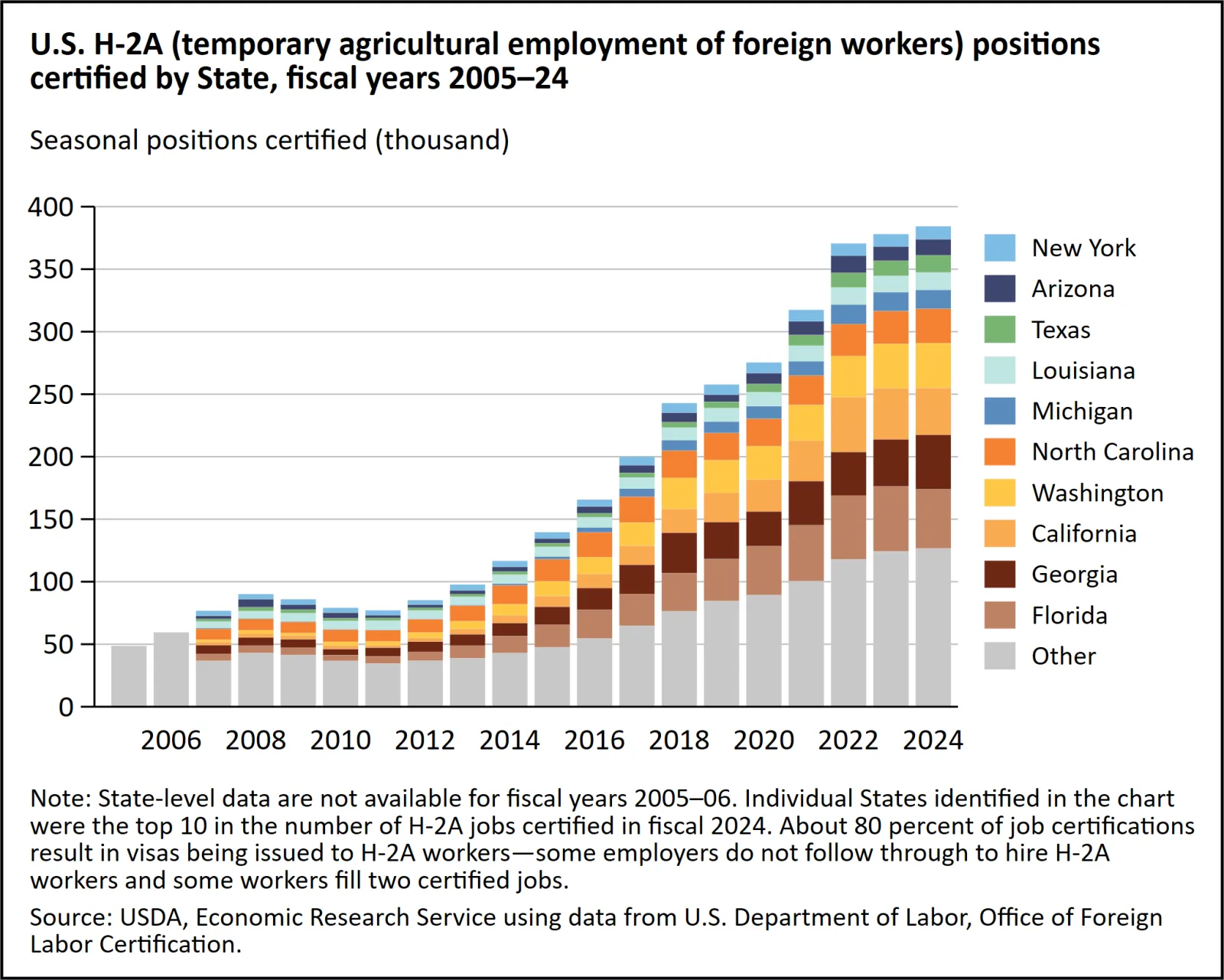
The H‑2A visa program has surged to nearly 400,000 positions a year, but because it was built for seasonal crop work, dairy farms, which rely heavily on immigrant labor, have largely been left out, a gap the new guidance only partially addresses.
...
"The policy highlights a long-standing tension in U.S. agricultural labor law. Many agricultural sectors rely on labor needs that are effectively permanent, while H-2A was designed for temporary and seasonal work," Adam Klein, a former Department of Homeland Security official and co-founder of Globali.ai, told Newsweek.
"This guidance may provide relief for some dairy producers, but it also underscores Congress’ continued failure to create a modern agricultural workforce program that reflects the realities of today’s labor market."
How Trump Is Reshaping Work Visas
The change by the Trump administration comes as part of various moves to alter the legal immigration system while still allowing immigrant workers into the U.S.
While the administration has ramped up deportations and tightened legal pathways for many migrants, officials have simultaneously moved to make H‑2 visa programs more accessible and flexible for employers in key industries, alongside other efforts, such as the H-1B high-skilled visa program.
In agriculture and seasonal labor markets, this has included expanding visa availability, streamlining application processes, and issuing sector-specific clarifications, such as the new dairy memo, to help employers navigate eligibility rules.
At the same time, the administration has reshaped the underlying structure of temporary worker programs in ways that critics say tilt toward employers. A series of rule changes taking effect in early 2025 expanded worker mobility and grace periods, while other policy moves, such as suspending prior worker-protection rules and revising wage calculations, reduced regulatory requirements on businesses and, in some cases, lowered pay floors for H‑2A workers.
The dairy guidance fits squarely within that framework: it does not create a new visa or alter statutory requirements; rather, it broadens how existing rules are applied, allowing a major segment of the agricultural industry to access foreign labor while maintaining the program’s core requirement that work be temporary or seasonal.
View 0 Comments
Submit Correction
View Editorial & AI Guidelines