...


By Daniel Orton and Hugh Cameron
0
Share
Newsweek is a Trust Project member
See more of our trusted coverage when you search.Prefer Newsweek on Googleto see more of our trusted coverage when you search.
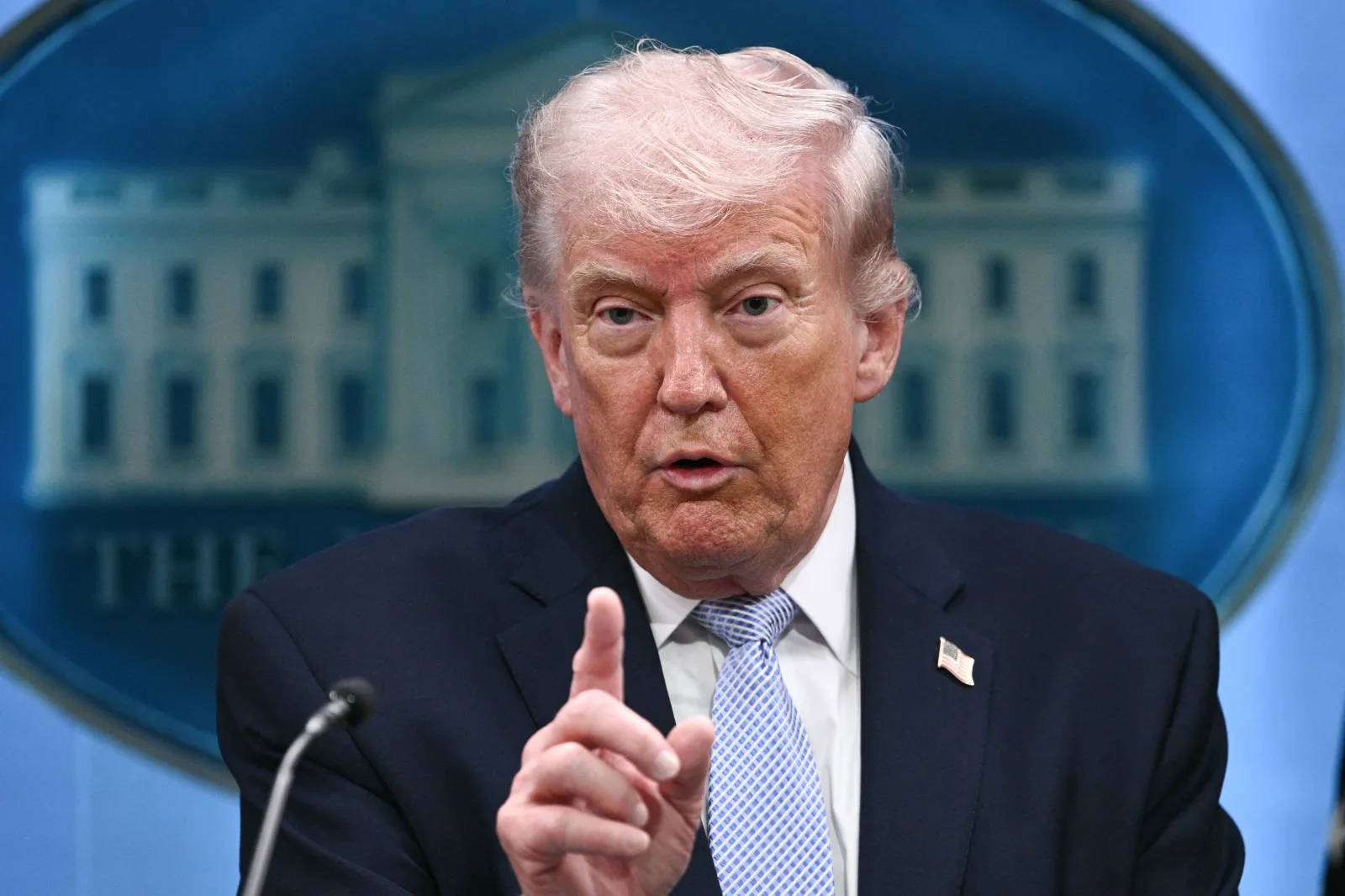
President Donald Trump warned on Wednesday that any country supplying weapons to Iran would face an immediate 50 percent tariff on all goods sold to the United States, issuing the threat in an early morning post on his Truth Social platform.
In the post, Trump said the sweeping tariff would take effect “immediately” and would include “no exclusions or exemptions." The warning came in the wake of the president announcing that the U.S. and Iran had agreed on a two-week ceasefire, provided that Tehran allows ships to pass through the vital Strait of Hormuz, a key global shipping route that had been disrupted during the conflict.
Newsweek has contacted the White House via email for comment.
Read More on News
Why It Matters
Trump did not outline which countries could be subject to his latest threat, nor which legal authority his administration would rely upon to levy new duties against those nations.
The U.S. Supreme Court struck down the majority of Trump’s global tariffs in February, ruling that he could not impose these using emergency powers and without consulting Congress. However, the administration has since turned to other statutory authorities to impose lower tariffs temporarily while determining how to fully carry out the president’s trade agenda.
...
What To Know
Trump’s comments came shortly after the U.S. and Iran agreed to terms of a temporary ceasefire, following five weeks of hostilities that have rattled markets and sent global oil prices soaring.
The president on Tuesday announced a two-week suspension of attacks on the country in exchange for the “COMPLETE, IMMEDIATE, and SAFE OPENING of the Strait of Hormuz.” Iran’s conditional agreement came minutes before Trump’s deadline of 8 p.m. ET, after which he said the U.S. would launch an aggressive campaign of attacks on the country’s energy and transportation infrastructure.
Iran has said that ships will be permitted to travel through the Strait of Hormuz during the two-week truce, provided these transits are coordinated by its military and “with due consideration of technical limitations.”
Vice President JD Vance has dubbed the ceasefire “fragile,” while social media accounts linked to Iran's Islamic Revolutionary Guard Corps (IRGC) have said that Israel’s ongoing strikes against targets in Lebanon violate one of the conditions of its 10-point peace plan.
Among the other conditions on its 10-point proposal—which Trump called a “workable basis on which to negotiate”—was the “lifting of all primary and secondary sanctions” on the country.
Before making his tariff threat against countries arming Iran on Wednesday, Trump said that the U.S. would be working “closely” with the country following the ceasefire announcement. Trump said that “there will be no enrichment of uranium,” that Iran would “dig up and remove” all of its nuclear materials, and that the country had already agreed to many of the 15 points in the U.S. peace plan.
“We are, and will be, talking Tariff and Sanctions relief with Iran,” his Truth Social post continued.
Aimed at reducing its capacity to develop a nuclear weapon and to limit its regional and military influence, the U.S. currently has one of the most comprehensive sanctions regimes in place against Iran. This includes a near-total trade embargo, energy sanctions on buyers and shippers of Iranian oil, as well as those targeting various officials and firms within the country.
No tariffs are in place on the Iran directly, given the effective absence of trade between the two countries, though Trump in February signed an executive order imposing additional duties on countries that “directly or indirectly purchase, import, or otherwise acquire any goods or services from Iran.”
Iran is largely self-sufficient when it comes to armaments, producing the majority of its missiles, drones, rockets and conventional weapons domestically, according to conflict-focused think tanks. However, the country has in recent years relied upon imports from China and Russia, increasingly through the supply of dual-use technologies—those that can be employed for both civilian and military purposes.
What People Are Saying
President Donald Trump, in a post to Truth Social on Wednesday morning, wrote: “The United States will work closely with Iran, which we have determined has gone through what will be a very productive Regime Change! There will be no enrichment of Uranium, and the United States will, working with Iran, dig up and remove all of the deeply buried (B-2 Bombers) Nuclear ‘Dust.’ It is now, and has been, under very exacting Satellite Surveillance (Space Force!). Nothing has been touched from the date of attack. We are, and will be, talking Tariff and Sanctions relief with Iran. Many of the 15 points have already been agreed to. Thank you for your attention to this matter.”
Vice President JD Vance, speaking at an event in Hungary, said: “If the Iranians are willing in good faith to work with us, I think we can make an agreement. If they’re going to lie, if they’re going to cheat, if they’re going to try to prevent even the fragile truce that we’ve set up from taking place, then they’re not going to be happy. Because what the president has also shown is that we still have clear military, diplomatic and, maybe most importantly, we have extraordinary economic leverage.”
What Happens Next
Both countries have celebrated the ceasefire and said that this opens the door for further negotiations. However, many experts doubt the durability of the truce and whether either side will be able or willing to meet the conditions the other has outlined for a lasting peace.
View 0 Comments
Submit Correction
View Editorial & AI Guidelines