10
Loading video...

By Gabe Whisnant
News Editor
0
Share
Newsweek is a Trust Project member
See more of our trusted coverage when you search.Prefer Newsweek on Googleto see more of our trusted coverage when you search.
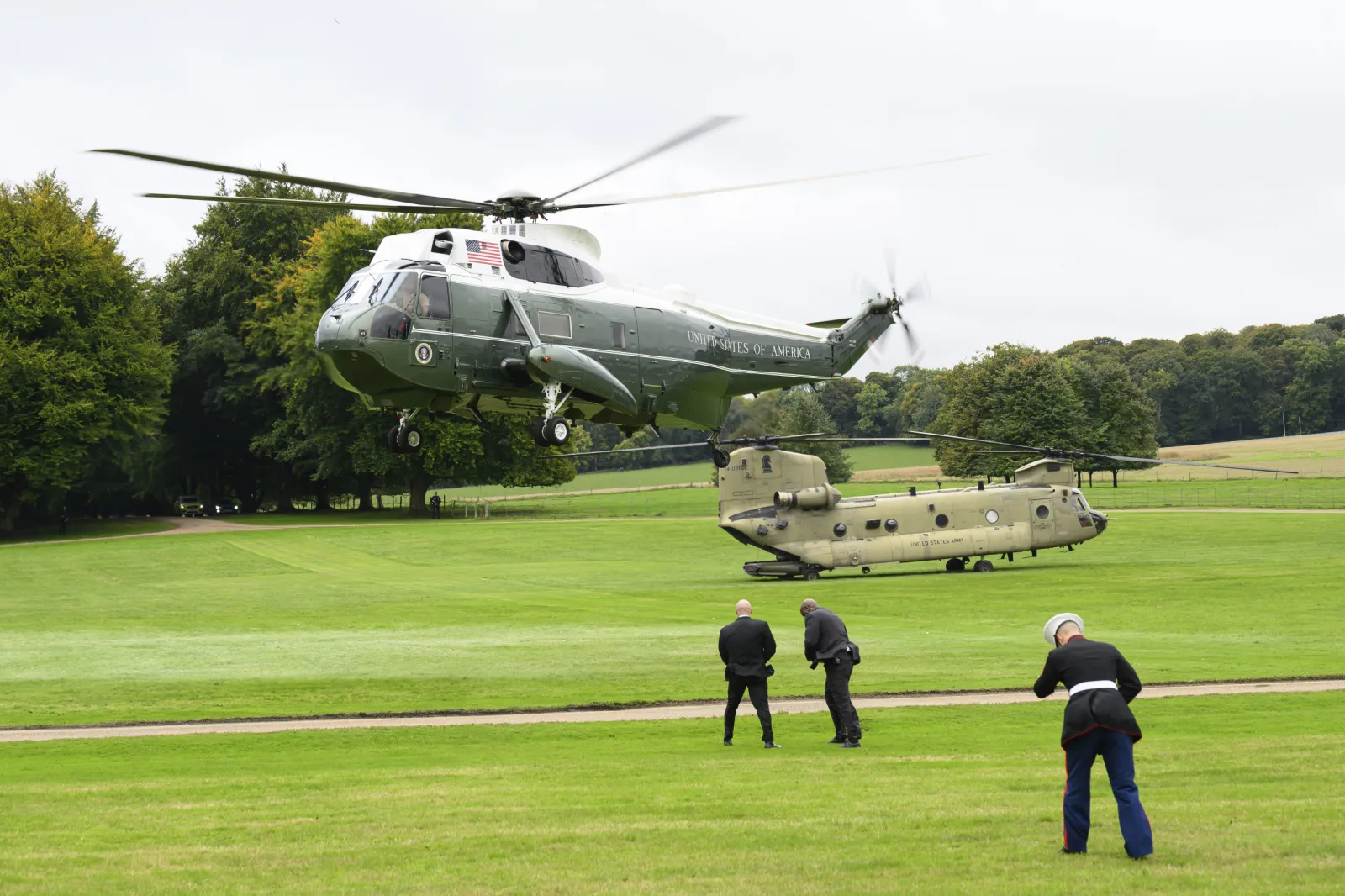
A minor hydraulic problem forced President Donald Trump's helicopter to make an unscheduled landing in Britain before his departure for the United States, the White House said Thursday.
White House press secretary Karoline Leavitt said the issue briefly delayed Marine One's return to London Stansted Airport after leaving the prime minister's country residence. Pilots landed the helicopter at a nearby airfield, where Trump and his wife, Melania, transferred to a backup aircraft that completed the short trip.
The Trumps later boarded Air Force One without incident for their flight back to the U.S. No injuries were reported.
Read More on Politics
Newsweek has reached out to the White House via email on Thursday night for comment.
Trumps Wrap UK Trip
Trump said Thursday he was "tremendously thankful" for the pageantry and warm welcome he received during his second state visit to the United Kingdom, a trip that avoided public clashes over thorny trade and foreign policy issues.
The royal family and Prime Minister Keir Starmer rolled out an elaborate charm offensive that appeared to resonate with Trump, who repeatedly praised his hosts even as little progress was made on key disputes.
Trump and Starmer signed what both governments called a historic agreement on science and technology, touting it as a potential engine for job creation during a roundtable with global business leaders. Behind closed doors, they also discussed Russia's war in Ukraine, the conflict in Gaza and ongoing disagreements over U.S. tariffs on British steel.
Where is Stansted Airport?
London Stansted Airport is located in Stansted Mountfitchet, Essex, about 42 miles northeast of central London, according to the U.K. Civil Aviation Authority. It is one of Britain's busiest international airports, handling more than 28 million passengers a year, and is a major hub for low-cost carriers such as Ryanair. Because of its size and location outside London's most congested airspace, Stansted is often used by U.S. presidents and foreign dignitaries when traveling to the United Kingdom.
...
How Does Marine One Get to the UK?
Marine One—the call sign for any U.S. Marine Corps helicopter carrying the president—does not cross the Atlantic under its own power. Instead, helicopters such as the VH-3D Sea King and VH-60N White Hawk are dismantled and flown aboard large U.S. Air Force cargo planes, including the C-17 Globemaster III or the C-5 Galaxy, according to reporting by Business Insider. Once in-country, Marine Corps crews reassemble and test the helicopters to make sure the president has secure and reliable transportation abroad, with backup aircraft and maintenance teams deployed as well, according to AeroCorner.
How Far Can Marine One Fly?
Marine One helicopters are built for short- to medium-range trips. The Sikorsky VH-3D Sea King, one of the models in the fleet, has a top speed of about 160 mph and can fly roughly 450 miles on a single tank of fuel, according to Military.com and Aero-Web. That range is adequate for trips between airports, city centers, and residences such as the White House and Camp David, but it makes transatlantic or intercontinental flights impossible without heavy logistical support—one reason the helicopters must be transported by cargo plane when presidents travel overseas.

...
Update: 9/18/25, 2:58 p.m. ET: This article was updated with new information and remarks.
Update: 9/18/25, 4:05 p.m. ET: This article was updated with new information.
Update: 9/18/25, 7:12 p.m. ET: This article was updated with new information and remarks.
This article includes reporting by the Associated Press.
View 0 Comments
Submit Correction
View Editorial & AI Guidelines