
10
Loading video...

By Jesus Mesa
Reporter
0
Share
Newsweek is a Trust Project member
See more of our trusted coverage when you search.Prefer Newsweek on Googleto see more of our trusted coverage when you search.
Senate Democrats spent two hours behind closed doors last week rehearsing how they would respond if the Trump administration tried to interfere with the November midterm elections.
Senate Minority Leader Chuck Schumer, a New York Democrat, convened nearly a dozen senators for the second in a series of tabletop exercises examining scenarios that could disrupt the vote. They included AI-generated videos designed to spread disinformation on and after Election Day, as well as the possibility of National Guard troops or immigration agents being stationed near polling places.
"We have to prepare for it," Schumer told MS NOW after the session. "What these so-called tabletop exercises teach us is when you're prepared in advance, you can stop a lot of bad, bad things from happening, a lot of the stealing that he will do."
Read More on Politics
Trump has never accepted his 2020 loss to former President Joe Biden, and his supporters stormed the U.S. Capitol on January 6, 2021, in an effort to block certification of the election results. Schumer's office said Trump's primetime address last week on election integrity prompted the latest exercise, the second Schumer has convened this year.
Marc Elias, a longtime Democratic election lawyer who participated in the closed-door session, said the exercises were not intended to stoke fear.
"What we're doing is preparing for the fact that Donald Trump, in 2020, lied about the election in advance, lied about it in the aftermath, went to court and then he instigated a violent insurrection in this very building," Elias told MS NOW. "So I think we need to take these threats in the 2026 midterm run-up both seriously and literally."

...
One scenario examined how local authorities might respond if federal immigration agents were deployed near polling places in red states such as Texas.
"What we would do is work with the local Houston Police Department, Dallas Police Department, Bexar County, San Antonio Police Department and figure out ways to stop this ahead of time," Schumer said.
In a joint statement issued through the Democratic Governors Association, all 24 sitting Democratic governors, including Kentucky Governor Andy Beshear, the DGA chair, and Michigan Governor Gretchen Whitmer, its vice chair, responded to Trump's address.
"It's deeply alarming that President Trump continues to try to undermine free and fair elections," the governors said in a statement obtained by Newsweek. "No amount of lies and conspiracy theories can change the fact that our country's elections have repeatedly been proven to be safe and secure. These attacks are intended to intimidate and silence voters."
"Democratic governors stand ready to fight back against the Trump administration and stop any and all unlawful attacks on every American's constitutional right to vote," the statement said.
Related Story

Polling Flips Against Republicans in Four Critical Midterms Races
Constitutional Limits on Election Interference
The U.S. Constitution assigns the time, place and manner of federal elections to the states. Rick Hasen, a University of California, Los Angeles law professor who directs the school's Safeguarding Democracy Project, has said the president has no legal authority to cancel or postpone a federal election.
Democratic officials have pointed to other avenues short of cancellation, including pressure on state officials to alter election results. In a January 2021 phone call, Trump asked Georgia Secretary of State Brad Raffensperger to "find" additional votes that would have overturned his loss in the state. Officials have also raised the prospect of National Guard troops or immigration agents being stationed near polling places, an action multiple Trump administration officials have declined to rule out.
Ari Mittleman, executive director of Keep Our Republic, a nonpartisan group focused on election trust, said his organization was not involved in the congressional tabletop exercises but has studied similar scenarios independently.
"The most realistic threats are those that can create confusion, trigger litigation, delay certification, or further undermine public confidence," Mittleman told Newsweek.
No single actor controls the outcome of an American election, Mittleman said, because voting is administered locally and every jurisdiction runs its process somewhat differently.
"Actually changing a certified outcome would require overcoming multiple independent safeguards, including local election officials, paper records, canvassing boards, audits, courts, and state certification procedures," Mittleman said. "Delaying an outcome may take fewer actors, but any obstruction would almost certainly produce immediate and extensive litigation."

...
Asked whether he was more or less confident that those guardrails would hold in 2026, given developments such as an FBI raid on election offices in Fulton County, Georgia, and staffing cuts at the Cybersecurity and Infrastructure Security Agency (CISA), Mittleman said his organization remained confident in the professionalism of local officials but described the current environment as unprecedented.
"The guardrails are real, but they depend on courts acting promptly, officials following the law, and political leaders refusing to promote claims without factual evidence," he said.
Barbara McQuade, a University of Michigan law professor and former United States attorney, said she considers voter suppression, rather than outright fraud, the greatest risk heading into November.
"I think the most likely scenario is voter suppression, that is, using rhetoric, lawsuits, and public pressure to change the rules and make voting more difficult for likely Democratic Party voters, such as students, people of color, transient voters, people who work multiple jobs, women, and people who can't get to the polls on Election Day," McQuade told Newsweek.
McQuade said changing the actual outcome of an election would be difficult because voting is administered at the state and local levels.
"As a result, actually changing votes would be very difficult," she said.
Still, she cautioned that uncertainty remains.
"I have some concerns that we don't know what we don't know, but unless the SAVE Act is passed, I think it will be difficult for anyone to interfere with the actual outcome of the election," McQuade said, referring to legislation that would impose new proof-of-citizenship and voter identification requirements nationwide.
Absent that, she said, the more likely effect of Trump's rhetoric is to erode trust in the process itself.
"I expect more rhetoric to cast doubt on the legitimacy of elections, which, in turn, could cause more people to disengage from politics, leaving us more vulnerable to the tyranny of the minority," she said.
Real Failures in State Election Systems
The debates over election integrity have been fueled, in part, by genuine failures in state record-keeping and voter registration systems that election officials from both parties have had to acknowledge and correct.
Republicans and the White House argue that these documented problems, disclosed by state officials themselves, justify calls for stronger safeguards like those in the SAVE Act.
New Jersey Governor Mikie Sherrill, a Democrat, said last week that a software error in the state's Motor Vehicle Commission system had registered roughly 6,600 people who indicated on state identification applications that they were not United States citizens. The registrations occurred between June 2023 and June 2024, under her predecessor. Fewer than 400 of those registered cast ballots, according to a preliminary state analysis.
Sherrill said she ordered an independent investigation, directed the removal of ineligible registrations from the rolls and moved to replace the vendor operating the system.

...
The disclosure came days after Homeland Security Secretary Markwayne Mullin wrote to New Jersey, California, Nevada and Pennsylvania alleging the four states could have as many as 250,000 noncitizens on their voter rolls. Sherrill's office said it did not know how the department arrived at its figure of 35,152 for New Jersey.
White House spokesperson Abigail Jackson said the error demonstrated the "absolute necessity" for Congress to pass the SAVE Act. The measure passed the House in February and remains stalled in the Senate.
Similar registration errors traced to motor vehicle agencies have surfaced elsewhere. Oregon paused its automatic registration system in 2024 after a data-processing error improperly registered more than 1,700 people. Arizona found the same year that a long-running error had misclassified 218,000 people as having provided proof of citizenship.
In Pennsylvania, then-Philadelphia city commissioner Al Schmidt, now the state's top election official and a Republican, identified 220 noncitizens who had registered and cast 227 votes over a period of years before a programming flaw was corrected in 2017.
What Happened in Fulton County
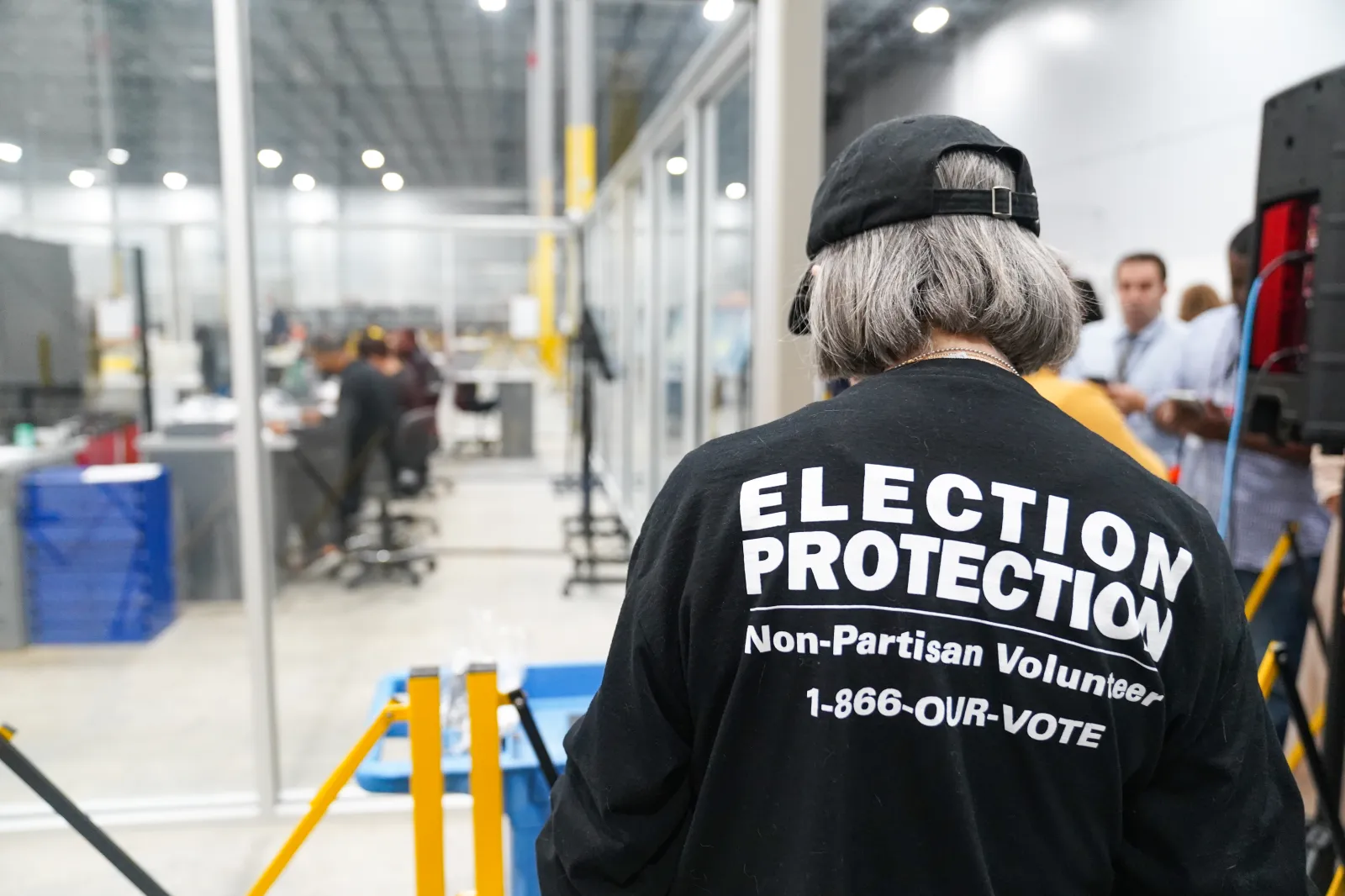
Republicans have also pointed to Georgia, where a record-keeping failure in the state's largest county drew federal agents to its election offices in January.
Fulton County acknowledged in December that more than 130 tabulator tapes from the 2020 election went unsigned, a lapse involving roughly 315,000 ballots. Georgia rules require a poll manager and two witnesses to sign each tape certifying it is a true copy of the machine's output.
Ann Brumbaugh, an attorney for the Fulton County Board of Registrations and Elections, told the Georgia State Election Board in December that the county did not dispute the tapes were unsigned and called it a violation of the rule. She said training and procedures have since been changed. The board referred the matter to the state attorney general in January.
...
Multiple reviews, including a statewide hand recount, affirmed Georgia's 2020 results. Georgia Secretary of State Brad Raffensperger, a Republican whom Trump asked in a January 2021 phone call to "find" additional votes, wrote on X in December that all voters had been verified with photo identification and had lawfully cast their ballots.
"A clerical error at the end of the day does not erase valid, legal votes," Raffensperger wrote.
Federal agents seized roughly 700 boxes of 2020 election records from the county's election hub on January 28 under a warrant citing federal statutes on the retention of election records and the procurement of fraudulent votes. Fulton County Commission Chairman Robb Pitts said the ballots had been secure before the seizure. No charges have been filed.
Americans Divided on Election Integrity Threats, Widely Support Voter ID
Americans broadly support voter ID requirements even as confidence in the integrity of elections has declined.
A Yahoo News and YouGov survey conducted in February found that just 23 percent of Americans were confident the midterms would not be "rigged." Thirty-three percent believed the vote would be rigged, while 44 percent were unsure. A separate NPR, PBS News and Marist poll in March found that 66 percent of adults were confident their state or local government would run a fair election in November, down from 76 percent in October 2024.
Yet Americans broadly oppose greater federal control over election administration. Fifty-nine percent disagreed with Trump's suggestion that Republicans should "nationalize the voting" by taking control of elections in 15 states. A YouGov and CBS News poll found that 71 percent said states, rather than the federal government, should have the final say over how elections are administered.
At the same time, voters broadly support the verification requirements at the center of the SAVE Act debate. A Fox News poll conducted July 17 to 20 found that 83 percent of registered voters favored requiring photo identification to register to vote, while 77 percent supported requiring it to cast a ballot. A Pew Research Center survey in August 2025 found that 83 percent of adults favored government-issued photo identification to vote, including 71 percent of Democrats.
The SAVE Act's most contested provision, however, is its requirement for documentary proof of citizenship during voter registration. Voting rights groups say the provision could burden voters whose current legal name does not match the name on their birth certificate, a group that includes many married women. Election law experts have also said the measure would not necessarily have prevented motor vehicle errors in New Jersey, Oregon or Arizona, which involved state systems rather than the documents applicants provided.
The broader debate comes as candidates who have questioned the legitimacy of the 2020 election continue to seek positions with direct authority over elections. States United Action, a nonpartisan group that tracks election deniers, found in an analysis published this spring that at least 53 such candidates were running for statewide office in 24 states, including 35 candidates for governor. Two were incumbents.

...
Governors, secretaries of state and attorneys general play direct roles in overseeing or certifying elections in many states.
"The election denial movement, which began in 2020, is more powerful than ever, embedded in the White House, our federal agencies, and beyond," Joanna Lydgate, the group's chief executive, said when the analysis was released. "Trump and his allies are hard at work to undermine this year's midterm elections, and their playbook once again includes trying to take control of the state offices that serve as a critical check on Trump's power."
Contact Newsweek editors on this story: Jason Lemon and Sam Wilson.
View 0 Comments
Submit Correction
View Editorial & AI Guidelines