...

By Newsweek Editors
0
Share
Newsweek is a Trust Project member
See more of our trusted coverage when you search.Prefer Newsweek on Googleto see more of our trusted coverage when you search.
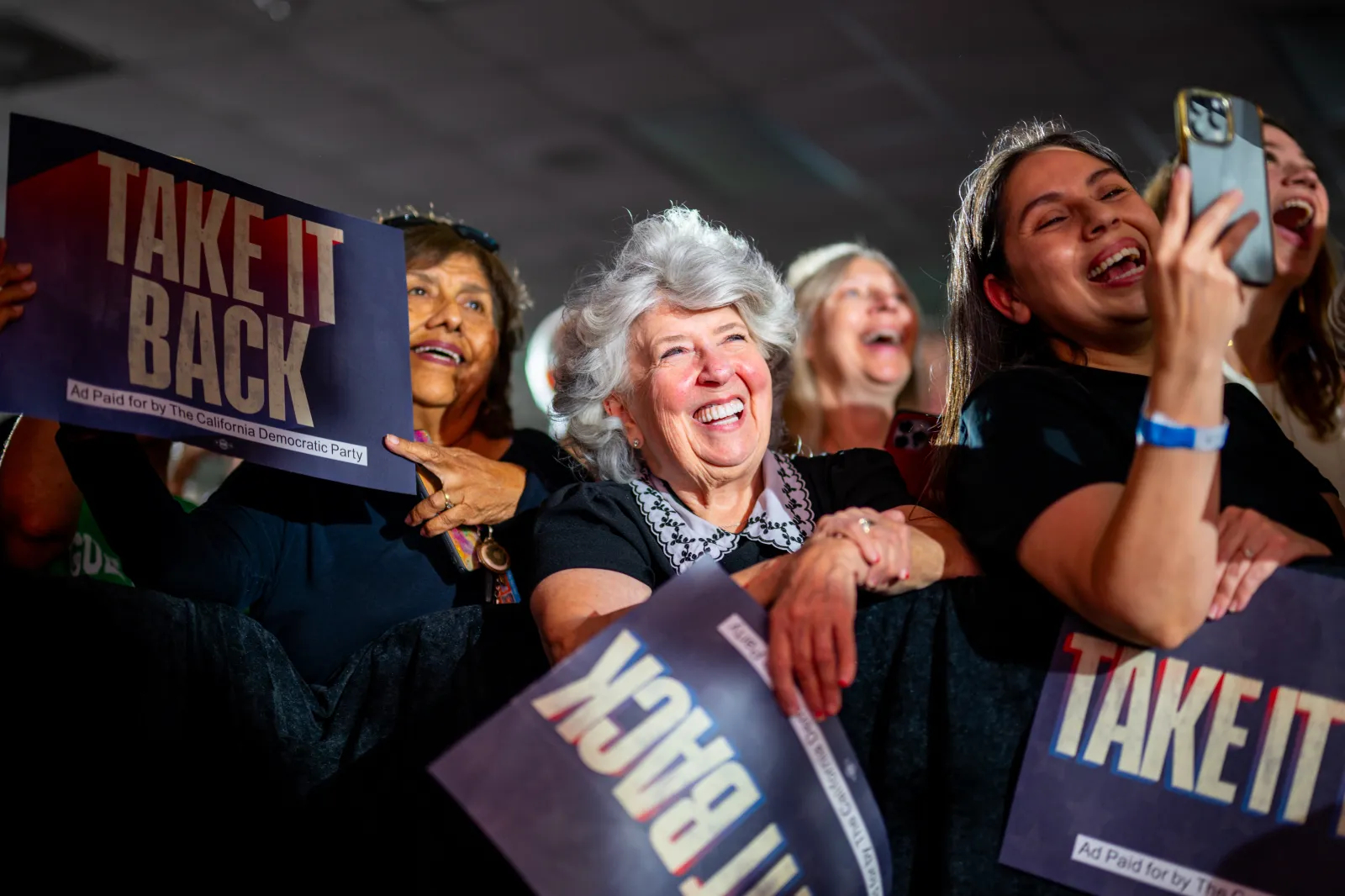
On Wednesday, Democrats toasted a victory: the Supreme Court said California can use its new, voter-approved congressional map this November, a map that could net Democrats as many as five House seats. Governor Gavin Newsom crowed that Donald Trump "started this redistricting war," but would "lose" in November.
Democrats should put the champagne on ice. The country’s population is still marching south and west, and that points to a 2030 reapportionment that likely shifts House seats toward red states and away from blue ones. In other words, whatever advantage Democrats wring from California this fall could be overwhelmed in a matter of years.
There’s a second twist to this "war." Trump now says Republicans should "take over" and "nationalize" elections and his former adviser Steve Bannon suggests putting immigration agents near polling places. America’s decentralized election machinery—more than 10,000 local jurisdictions, each with its own rules—makes a true federal takeover both constitutionally and administratively farcical. But it shows the war is far from over.
Read More on News
Common Knowledge
Both sides claimed vindication from the Court’s late-night order. Newsom exulted that Trump "started this redistricting war"—and that Californians would answer in November.
Republicans countered that the map is an unconstitutional racial gerrymander. "We will continue to vigorously argue for Equal Protection under the law for all of California’s voters," said Michael Columbo, counsel to the California GOP, which filed the federal suit. Analysts pointed out that the Court did the same for Texas two months ago, letting the GOP’s mid-decade map stand for 2026 despite a lower-court ruling of likely racial discrimination.
On the left, election-law scholars emphasized that California’s gambit is a political response to a political tactic after the Supreme Court’s 2019 decision in Rucho v. Common Cause declared federal courts out of the partisan-gerrymandering business. UCLA’s Rick Hasen has described Proposition 50 as part of "a national arms race."
On the right, some conservatives want more muscular federal action on "election integrity," arguing Washington has authority to set national rules like ballot-receipt deadlines. That argument is now echoed in Trump’s rhetoric about "nationalizing" elections. In a Monday interview, Trump told Dan Bongino that "Republicans oughta nationalize" voting and the federal government should "take over" in "at least 15 places."
Bannon went further, calling on his podcast for ICE officers near polling sites this fall, framing it as common-sense enforcement. Voting-rights groups called that a blueprint for intimidation.
Uncommon Knowledge
Maps and demography matter for elections. Using the Census Bureau’s Vintage 2025 state totals, analysts at the Brennan Center conclude that population trends since 2020 point to a 2030 reshuffling of House seats toward high-growth Sun Belt states and away from slower-growth coastal states. Election Data Services’ modeling (summarized by The Census Project) is specific: if apportionment were run on recent counts, Texas and Florida would each pick up two seats, Arizona and Idaho would each gain one, California would lose two, and Illinois, Minnesota, New York and Oregon would each lose one. That doesn’t mean those exact numbers will hold in 2030, but the direction of travel is hard to miss.
That clearly matters for California, too. The Supreme Court’s order allows Proposition 50’s map for 2026. But by design, all states redraw lines after each decennial census. 2030 may shrink the Golden State’s delegation again.
Anyway, some California "gains" are more optical than structural. The Public Policy Institute of California’s side-by-side of the old commission plan versus Proposition 50 found that the number of majority-Latino districts is the same under both (16), with the Prop 50 plan adding one more so-called "influence" district (meaning over 30 percent Latino citizen voting-age population).
The Supreme Court has largely accepted the status quo on redistricting measures by accepting both California and Texas, countering claims that it would do Trump's bidding.
That's where the "nationalize the elections" talk comes in. Trump’s rhetoric sounds alarming, but America does not have a national election bureaucracy. It runs elections through a patchwork of county, city and township offices totaling more than 10,000 local jurisdictions. Even if Congress could set new dates or minimum standards (as it sometimes does), the manpower, equipment, funding, and procedures live at the local level. You can’t "take over" what doesn’t exist.
The "ICE at the polls" idea is equally shaky. Federal and state law prohibit voter intimidation, and federal statutes—including Section 11(b) of the Voting Rights Act and provisions of the Ku Klux Klan Act—bar threats or coercion around voting. Trying to flood precincts with federal immigration officers is overwhelmingly likely to invite lawsuits, and losses.
Could Washington still influence election administration? Of course. The Constitution may let the federal government set and tighten national rules on things like receipt deadlines or voter-ID standards. But even sweeping federal statutes ride on local implementation by thousands of clerks, boards, and poll workers—not on a presidential order to "take over" 15 states.
So yes, Democrats won a battle this week: California can use a friendlier map in 2026. But the war is longer, fought on two fronts that cut against simple victory speeches. One is demographic: unless migration patterns reverse, the post-2030 map will likely shift power back, forcing another redraw that could blunt blue-state gains. The other is institutional: the Court’s even-handed use of the shadow docket (Texas in December, California now) and the sheer complexity of American elections together make talk of "nationalizing" voting or stationing ICE likely bluster. What is clear, however, is that there will be no truce in redistricting wars.
If you’re enjoying Uncommon Knowledge, please share. If you have suggestions for future editions or feedback, email subscriber.feedback@newsweek.com. We want to hear your voice.
View 0 Comments
Submit Correction
View Editorial & AI Guidelines