...

By Andrew Stanton
Reporter
0
Share
Newsweek is a Trust Project member
See more of our trusted coverage when you search.Prefer Newsweek on Googleto see more of our trusted coverage when you search.
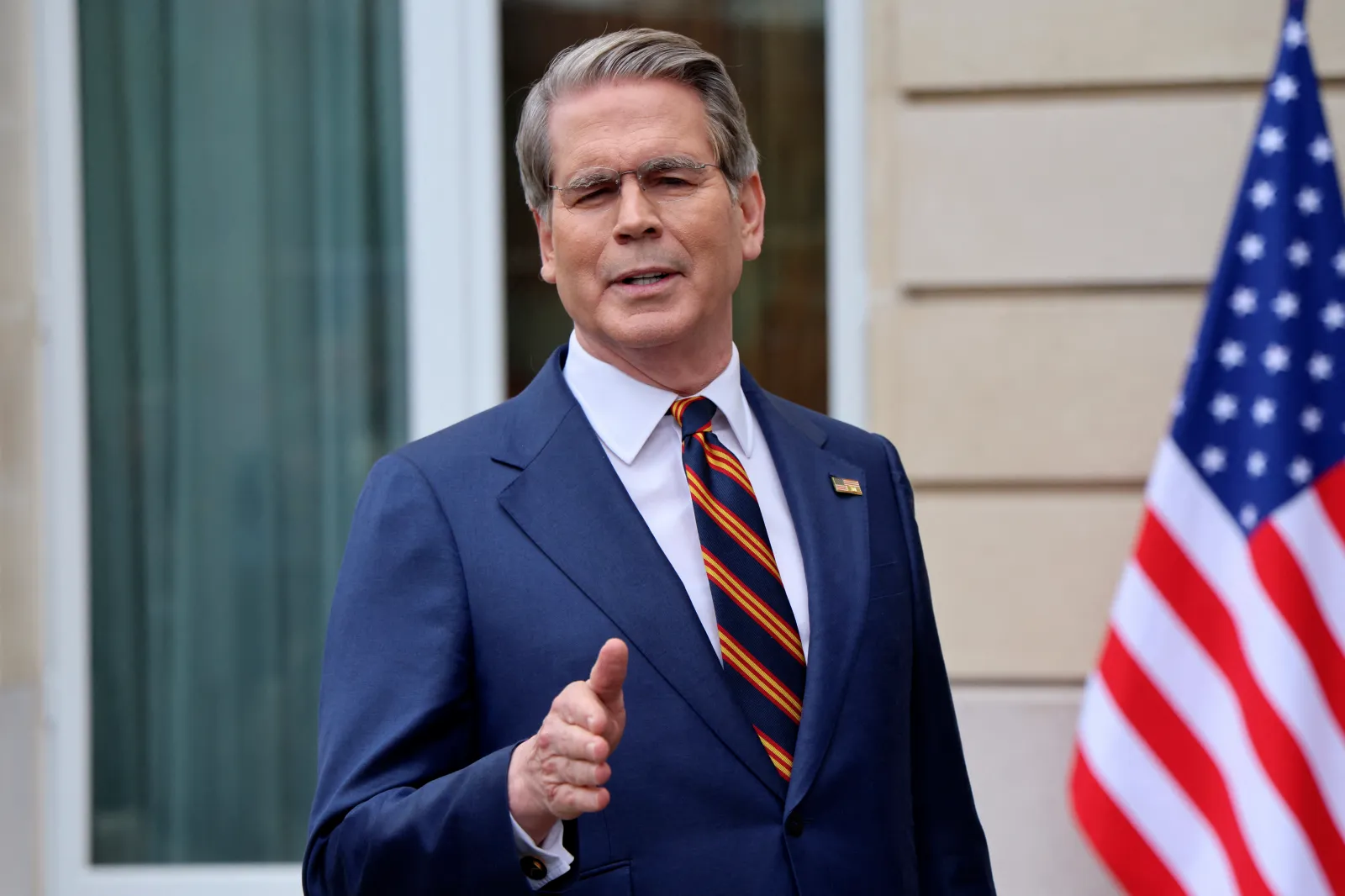
Treasury Secretary Scott Bessent’s comments about the United States potentially lifting sanctions on some Iranian oil shocked social media on Thursday.
A source familiar with the situation not authorized to speak publicly told Newsweek on Thursday the move was "a short-term measure limited to oil already stranded at sea and confined to a narrow time frame. A potential waiver could accelerate the diversion of oil already destined for China into global markets more broadly, helping ensure adequate supply and blunting Iran’s leverage over the Strait of Hormuz."
Why It Matters
Bessent’s comments come as Americans continue facing rising gas prices amid the Iran war. Gas prices were $3.884 per gallon on Thursday, up from $3.598 one week ago and $2.929 a month ago, according to the American Automobile Association. The increase in energy costs has created a political challenge for Trump, who has sought to address affordability and inflation in his first year, ahead of the 2026 midterms.
Read More on News
What to Know
Bessent discussed the possibility of lifting sanctions on some Iranian oil, during an interview on Fox Business on Thursday. Video of his remarks was shared by the Trump administration’s @RapidResponse47 account on X.
The administration has a "break the glass plan" to lift sanctions on Russian oil to address rising prices, he said.
"In the coming days, we may un-sanction the Iranian oil that's on the water. It's about 140 million barrels. So depending on how you count it, that's ten days to two weeks of supply that the Iranians had been pushing out. That would have all gone to China. In essence, we will be using the Iranian barrels against the Iranians to keep the price down for the next 10 or 14 days as we continue this campaign," he said.
...
His comments were met with questions and pushback on social media.
"Remember when Republicans ridiculed Obama for lifting some sanctions because Iran agreed to limits on its nuclear program? Now, Trump is enriching the Iranian regime that is attacking our partners and us. Let's see if those same critics voice their objection now to lifting sanctions on Iran. I'm expecting crickets," former U.S. Ambassador to Russia Michael McFaul wrote on X.
Bloomberg journalist Annmarie Hordern asked on X, "So we can see the regime selling oil legally at a much higher price?"
CNN anchor Jim Sciutto wrote that "one strategic result of the Iran war will be lessening economic leverage on both Russia and Iran."
Senator Andy Kim, a New Jersey Democrat, accused the administration of "actively putting more money into the pockets of Putin and the Iranian regime, but taking away money from American families with higher gas and grocery prices."
"What an absolute mess," he wrote.
Trump Admin Seeks to Curb Rising Gas Prices
Lifting sanctions on Iranian oil would be the latest effort from the administration to address gas prices. The White House announced this week that Trump would issue 60-day waivers to the Jones Act, a century-old law requiring goods shipped between American ports to be on ships built, owned and operated in the United States. Proponents of the Jones Act waiver believe that opening domestic shipping routes to foreign-flagged vessels may provide some relief by expanding transportation options.
Also on Wednesday, the Treasury Department eased sanctions to allow U.S. companies to do business with Venezuela’s state-owned oil and gas company. And the Trump administration has announced it will temporarily free up Russian oil from U.S. sanctions, too.
The U.S. is releasing 172 million barrels from its strategic reserves, as the Paris-based International Energy Agency (IEA) said it will release 400 million barrels of oil from its members’ emergency reserves to help curb rising oil prices amid the war.
Why Are Gas Prices Rising Amid the War With Iran?
Oil prices have surged as the war involving Iran widened, sparking uncertainty across global energy markets.
The Strait of Hormuz, a critical chokepoint for global oil transport, has been a point of concern, with fears that any prolonged instability could significantly constrain supply.
The strait lies between Iran to the north and Oman to the south, with shipping lanes passing through the territorial waters of both countries, but the strait is governed by international maritime law. Iran exerts significant influence because of its long northern coastline and control of nearby islands overlooking the narrow lanes, while Oman oversees the southern side.
The United States and allied navies also operate in the area to protect freedom of navigation, though Iran’s military posture has given it leverage during periods of conflict.
Roughly 20 million barrels of oil per day, about one‑fifth of global petroleum consumption, normally pass through the Strait of Hormuz, according to U.S. Energy Information Administration data. The waterway is also a critical route for liquefied natural gas, carrying about 20 percent of global LNG trade, largely from Qatar. Most of the oil shipped through the strait is bound for Asian markets, making disruptions especially significant for global energy prices.
Shipping has declined due to Iranian threats, missile and drone attacks near the waterway and U.S. military strikes on suspected Iranian minelaying vessels. Many shipping companies and insurers have pulled back because of safety risks and soaring insurance costs, effectively halting commercial traffic even without a formal blockade.
What People Are Saying
Journalist Max Blumenthal wrote to X: "The sanctions on Iran are so effective that we must lift the sanctions to harm Iran Then we will steal the unsanctioned oil from China."
Anthony Scaramucci, who briefly worked as White House communications director during Trump’s first term, wrote on X: "Let me get this straight: We attack Iranian oil facilities to hurt the regime, then we unsanction Iranian oil in hopes they sell it to our allies, so that we can continue to bomb the regime. It's a bold strategy Cotton, let's see how it pays off for 'em."
Amir Handjani, partner at Karv Global, wrote to X: "I didn’t believe this until I watched the clip. I didn’t have the U.S. dropping oil sanctions after launching a war with Israel on Iran on my bing card two weeks ago. It tells me and the energy markets that we are in a world of trouble and the U.S. has no contingency plan to deal with it."
What Happens Next
Bessent did not provide more details about plans to lift sanctions on Iranian oil or give a timeline about when the administration may do so.
View 0 Comments
Submit Correction
View Editorial & AI Guidelines