10
Loading video...

By Anna Skinner
Associate News Editor
0
Share
Newsweek is a Trust Project member
See more of our trusted coverage when you search.Prefer Newsweek on Googleto see more of our trusted coverage when you search.
President Donald Trump's decision to rename Lake Ontario as "Lake America" has reignited questions about how much power a president has to reshape maps, geographic names and even long-standing international conventions.
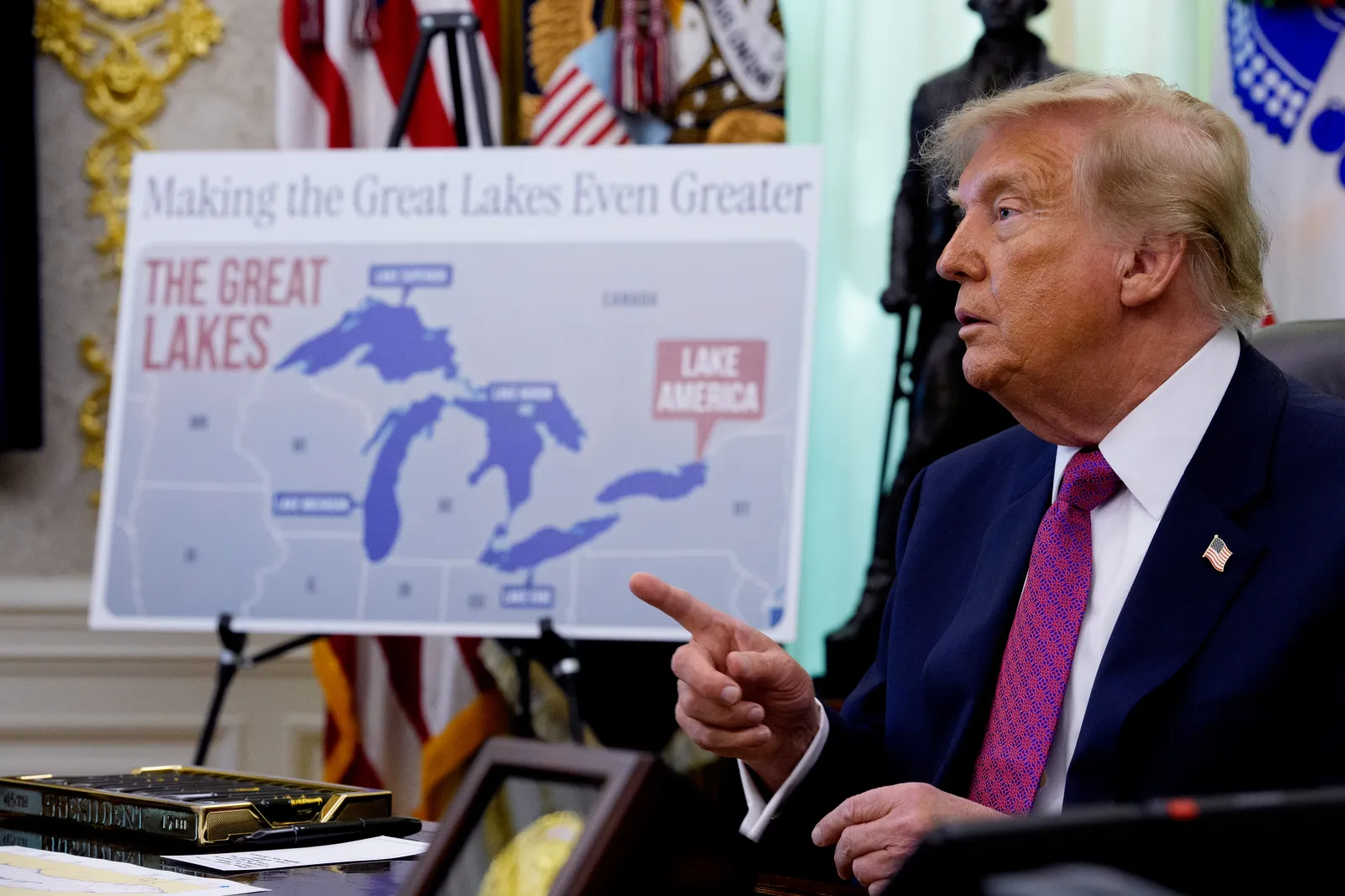
Trump signed an executive order on August 27 directing the federal government to rename Lake Ontario "Lake America," marking the latest in a series of efforts to change how prominent geographic features are labeled in official U.S. records. The order took effect immediately and instructs Interior Secretary Doug Burgum to update the Geographic Names Information System, the federal database used to standardize place names across government agencies. While the change applies to federal usage, it does not require Canada, international organizations or private mapmakers to adopt the new name.
The move comes nearly two years after Trump ordered the federal government to replace "Gulf of Mexico" with "Gulf of America" in official records, and Thursday's order was accompanied by remarks suggesting that even larger targets, including the Atlantic and Pacific oceans, could one day be considered.
Read More on U.S.
Newsweek reached out to the White House by email for comment.
...
Could the Atlantic or Pacific Oceans Be Renamed by Trump?
Speaking after signing the Lake Ontario order, Trump joked that the United States now had a gulf and a lake, adding that perhaps the Atlantic Ocean, the Pacific Ocean or both could be renamed next.
When it comes to renaming oceans, a president could likely direct federal agencies to use a different name in government documents, maps and databases, much as Trump did with the Gulf of America and Lake America designations. The U.S. Board on Geographic Names exists to standardize names used by the federal government, and its decisions are intended to create consistency across agencies.
But renaming an ocean would be largely symbolic outside the United States because no country owns either the Atlantic or Pacific Ocean. Under international law, coastal nations exercise sovereignty over territorial waters extending roughly 12 nautical miles from shore and have resource rights within Exclusive Economic Zones that typically extend 200 nautical miles offshore. Beyond those areas lie vast stretches of international waters shared by the global community.
Even if Washington adopted a new name, foreign governments, international organizations, mapmakers and shipping operators would not be required to use it.
Why Did Donald Trump Rename Lake Ontario?
Trump signed the executive order Thursday directing the federal government to treat Lake Ontario as "Lake America" and ordered Interior Secretary Doug Burgum to update the Geographic Names Information System accordingly. The move followed days of comments from the president amid an escalating trade dispute with Canada.
The president had previously suggested on social media that the United States was seriously considering changing the lake's name and later announced the decision in the Oval Office. Asked what message he was trying to send to Canada, Trump insisted there was "no message," while also criticizing the country's trade relationship with the United States.
The change mirrors Trump's earlier effort to rename the Gulf of Mexico and reflects a broader willingness to use executive authority to reshape federal naming conventions. However, the order's practical reach is limited. Lake Ontario is shared by the United States and Canada and forms part of an international boundary. While federal agencies can use the new name, Canada is under no obligation to adopt it, nor are international organizations or foreign governments.
That distinction is central to understanding presidential naming authority. A president can influence how the federal government refers to a place, but that does not automatically redefine it for the rest of the world.
Who Has Authority over the Gulf of Mexico?
Trump's 2025 executive order renaming the Gulf of Mexico as the "Gulf of America" sparked similar questions about ownership, sovereignty and naming rights. Despite the new federal designation, the gulf remains bordered by the United States, Mexico and Cuba, with each country exercising authority over portions of the surrounding waters under international law.
The executive order did not transfer control of the gulf to the United States or expand American maritime claims. Instead, it instructed federal agencies to use the name Gulf of America in official publications, regulations and government databases. The National Oceanic and Atmospheric Administration (NOAA) later updated regulatory references where legally possible, while noting that statutory references enacted by Congress could not be changed by executive action alone.
The episode illustrates the distinction between naming a place and exercising authority over it. Governments can often decide how they refer to a geographic feature in official documents, but names do not determine ownership. Jurisdiction in the Gulf of Mexico continues to be governed by maritime boundaries and international agreements, not by what any single country chooses to call it.
The same principle would likely apply if Trump attempted to rename an ocean. A president may have substantial influence over federal nomenclature, but altering globally recognized geographic names is far more difficult than changing a government database. Oceans, unlike federal landmarks or domestic geographic features, are shared spaces that exist beyond the authority of any one nation.
For that reason, Trump's renaming powers stretch only so far. He can tell the federal government what to call a place. Whether the rest of the world follows is another question entirely.
Contact Newsweek editors on this story: Samantha Beech and Gray R. Thomas
View 0 Comments
Submit Correction
View Editorial & AI Guidelines