10
Loading video...

By Amanda Castro
Associate News Editor
0
Share
Newsweek is a Trust Project member
See more of our trusted coverage when you search.Prefer Newsweek on Googleto see more of our trusted coverage when you search.
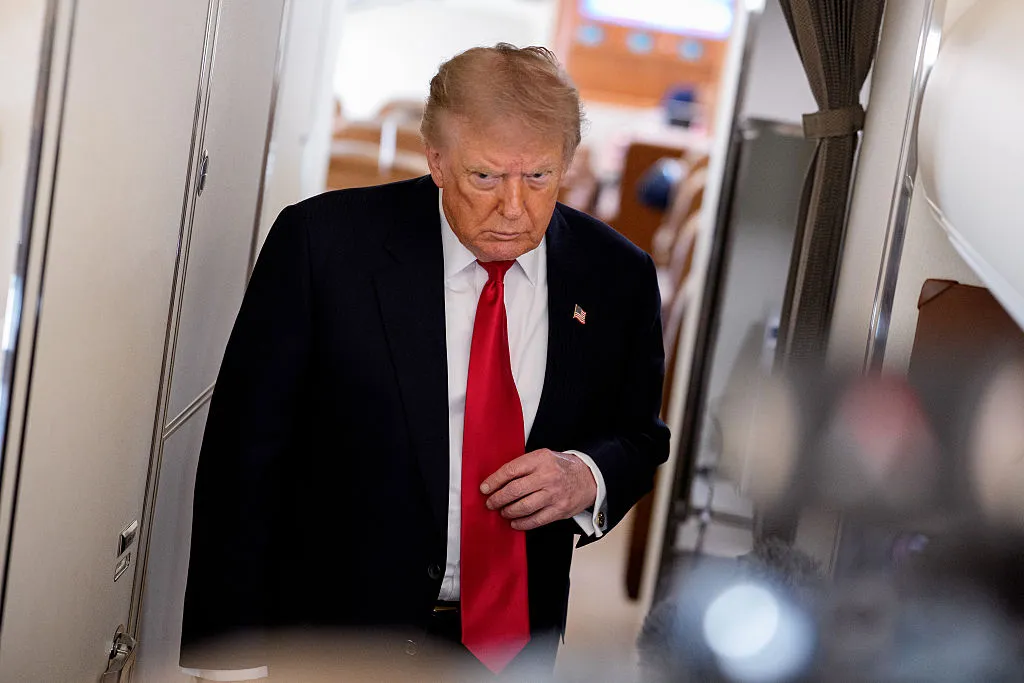
President Donald Trump on Monday lashed out at a female reporter aboard Air Force One while on his way to Michigan, calling her question “stupid” after fielding a rapid‑fire series of inquiries on weapons stockpiles, Iran, Venezuela funds and his escalating pressure campaign on the U.S. Senate.
The exchange comes as Trump is demanding that Senate Majority Leader John Thune keep the chamber in session until Republicans pass his stalled Safeguard American Voter Eligibility (SAVE) Act, a voting restrictions bill he has made a top priority ahead of November's midterms. The clash highlights rising tensions within the GOP conference and signals potential fallout for U.S. foreign policy, military posture, and the Senate’s August recess plans.
Newsweek has reached out to Thune's office for comment.
Read More on News
During the gaggle, Trump blamed former President Joe Biden for depleted U.S. weapons stockpiles, said he would “ask [Russian President Vladimir] Putin” about reports Russia is helping Iran target U.S. troops, refused to say where billions the U.S. is “taking in” from Venezuela are going, and distanced himself from Israeli Prime Minister Benjamin Netanyahu's caution on Washington potentially selling F‑35s to Turkey.
...
Trump Calls Reporter Question on SAVE Act ‘Stupid’ as Pressure on Thune Mounts
The confrontation came when the reporter, which The Daily Beast reported was CBS News' Jennifer Jacobs, asked why senators should remain in Washington to pass the SAVE Act rather than campaign ahead of the 2026 midterms. Trump said: “What a stupid question for you to ask me.”
The SAVE Act would require proof of citizenship and voter identification to vote in federal elections while sharply limiting mail‑in voting. The bill has stalled in the Senate, where all Democrats oppose it and several Republicans—Susan Collins, Mitch McConnell, Lisa Murkowski and Thom Tillis—voted against adding it to a GOP budget package in June.
Trump has demanded that Thune keep the Senate in session until the bill passes, even urging Republicans to “terminate the filibuster” to approve it with a simple majority. The Senate is scheduled to recess on August 7 and return September 14.
Despite the pressure, Trump told reporters he has a “good relationship” with Thune and has not considered replacing him as leader. However, White House press secretary Karoline Leavitt said last week that Trump’s “patience is running out” with the Senate leader.
GOP House Speaker Mike Johnson has advanced a $95 billion budget framework that includes elements of the SAVE Act, hoping to pass it via reconciliation—a process that requires only a simple majority. But the Senate parliamentarian could rule that a voting overhaul cannot be passed as a budget measure, leaving the bill’s future uncertain.
Trump has urged the Senate to adopt the resolution before leaving town, writing last week, “We are ready to work side-by-side with the Senate to get this done for the American People!”
Trump’s Long Pattern of Clashing With Female Reporters
The exchange aboard Air Force One is the latest in a years‑long pattern in which Trump has responded to questions from female journalists with personal remarks rather than policy answers. While Trump frequently clashes with the press more broadly, his confrontations with women reporters have repeatedly stood out for their tone, often involving comments about intelligence, demeanor or appearance, and have been condemned by some media‑rights organizations.
Across his second term, these moments have unfolded in nearly every press setting: South Lawn gaggles, Oval Office sprays, campaign stops and Truth Social posts. In May, Trump berated a female reporter who asked about the rising cost of his ballroom expansion, telling her she was “not a smart person.” He then turned to another woman in the press corps and called her “a stupid person,” remarks that circulated widely online and reignited debate about his treatment of journalists.
During a visit to the Lincoln Memorial in May, Trump dismissed a question from ABC News correspondent Rachel Scott as “stupid” and labeled her “one of the worst reporters” after she pressed him on renovation spending during the Iran conflict. Earlier in the year, he told CNN’s Kaitlan Collins that she was “the worst reporter” and commented on her demeanor, a moment critics said reflected a pattern of focusing on women’s tone rather than the substance of their questions.
Other exchanges have been even more pointed. In late 2025, Trump told ABC’s Mary Bruce she was a “terrible person and a terrible reporter” during an Oval Office spray. Days later aboard Air Force One, he interrupted Bloomberg’s Catherine Lucey with “Quiet, quiet piggy,” when she attempted a follow‑up question. He also targeted New York Times reporter Katie Rogers in a Truth Social post, calling her “a third‑rate reporter” and attacking her appearance. The next day, he confronted CBS News’ Nancy Cordes, asking her, “Are you stupid? Are you a stupid person?”
Press‑freedom groups say these incidents form a clear pattern that disproportionately affects women in the press corps. The International Women’s Media Foundation has warned that public attacks from political leaders can fuel online harassment and create additional risks for female journalists, many of whom already face higher levels of abuse. Media scholars note that while Trump also clashes with male reporters, his comments toward women often include gendered language or personal insults that go beyond typical political sparring.
The cumulative effect, experts say, is a chilling environment for women covering the White House. Some journalism educators worry that repeated public confrontations could discourage young reporters—particularly women and journalists of color—from pursuing political reporting or White House assignments. The concern echoes findings from industry surveys showing that harassment and online abuse have pushed some women to avoid certain stories or consider leaving the profession entirely.
Related Story

Donald Trump Keeps Exploding at Female Reporters
What to Know About Where the SAVE Act Stands
Trump’s demand that the Senate remain in Washington until the SAVE Act passes comes as a bloc of Republican senators is publicly urging Thune to scrap the August recess altogether. Senators Mike Lee, Rick Scott, Jim Banks and Ashley Moody have each said they will oppose leaving town until the bill reaches the floor, arguing that election security outweighs the traditional summer break. Lee went as far as posting a formal objection on X, warning Thune: “Do not assume you have my consent. You do not.”
But even if the Senate remained in session, the core obstacle would remain unchanged: the SAVE Act does not currently have the votes to advance. The bill would require documentary proof of U.S. citizenship to register for federal elections and impose strict voter ID rules — measures Republicans say are necessary to prevent noncitizen voting, and Democrats argue would erect barriers for eligible voters. The Senate’s 60‑vote filibuster threshold means Republicans would need at least seven Democratic or independent senators to join them, assuming full GOP unity. That unity does not exist. Four Republicans—Susan Collins, Lisa Murkowski, Mitch McConnell and Thom Tillis—opposed the bill’s most recent attempt to hitch a ride on a GOP immigration and border‑security package in June.
Thune has repeatedly said the problem is arithmetic, not timing. He has pushed back against criticism from Trump and the White House, noting that even a prolonged session won’t change the fact that Republicans currently cannot reach 50 votes on the budget resolution needed to unlock reconciliation. “You’ve got to get to 50,” Thune told reporters last week. “And I can’t count to 50 right now.”
Some Republicans have floated alternative strategies, including attaching SAVE Act provisions to other must‑pass bills or breaking the legislation into smaller components such as standalone voter ID requirements. Others have suggested using budget reconciliation to bypass the filibuster entirely. But reconciliation rules strictly limit what can be included, and Senate parliamentarians have historically rejected attempts to shoehorn voting‑law changes into fiscal legislation. Even if a reconciliation vehicle survived procedural scrutiny, it is unclear whether Republicans could muster the simple majority needed to pass it.
Thune has also publicly responded to Trump’s demand that the chamber remain in Washington until the SAVE Act passes, signaling that time alone won’t solve the bill’s core problem. “If somebody can show me how we get an outcome, how we get a result, how we get an answer to this, I'm all for it,” Thune told reporters, adding that keeping senators in the Capitol without a viable path forward would mean “endless quorum calls,” a scenario he said is “not in anybody’s best interest.”
Trump, meanwhile, has continued to escalate his demands. At a rally in Georgia last week, he urged supporters to “call John Thune” and pressure him to move the bill. On Monday, he wrote on Truth Social that the Senate should not “leave town” until the SAVE Act passes — or until Republicans “terminate the filibuster” and approve it with a simple majority. GOP leadership has shown no appetite for eliminating the filibuster, and several Republicans have publicly defended Thune’s approach.
Contact Newsweek editors for this story: Gabe Whisnant and Anthony Murray.
View 0 Comments
Submit Correction
View Editorial & AI Guidelines