
...

By Tom O'Connor
Deputy Editor, National Security and Foreign Policy
0
Share
Newsweek is a Trust Project member
See more of our trusted coverage when you search.Prefer Newsweek on Googleto see more of our trusted coverage when you search.
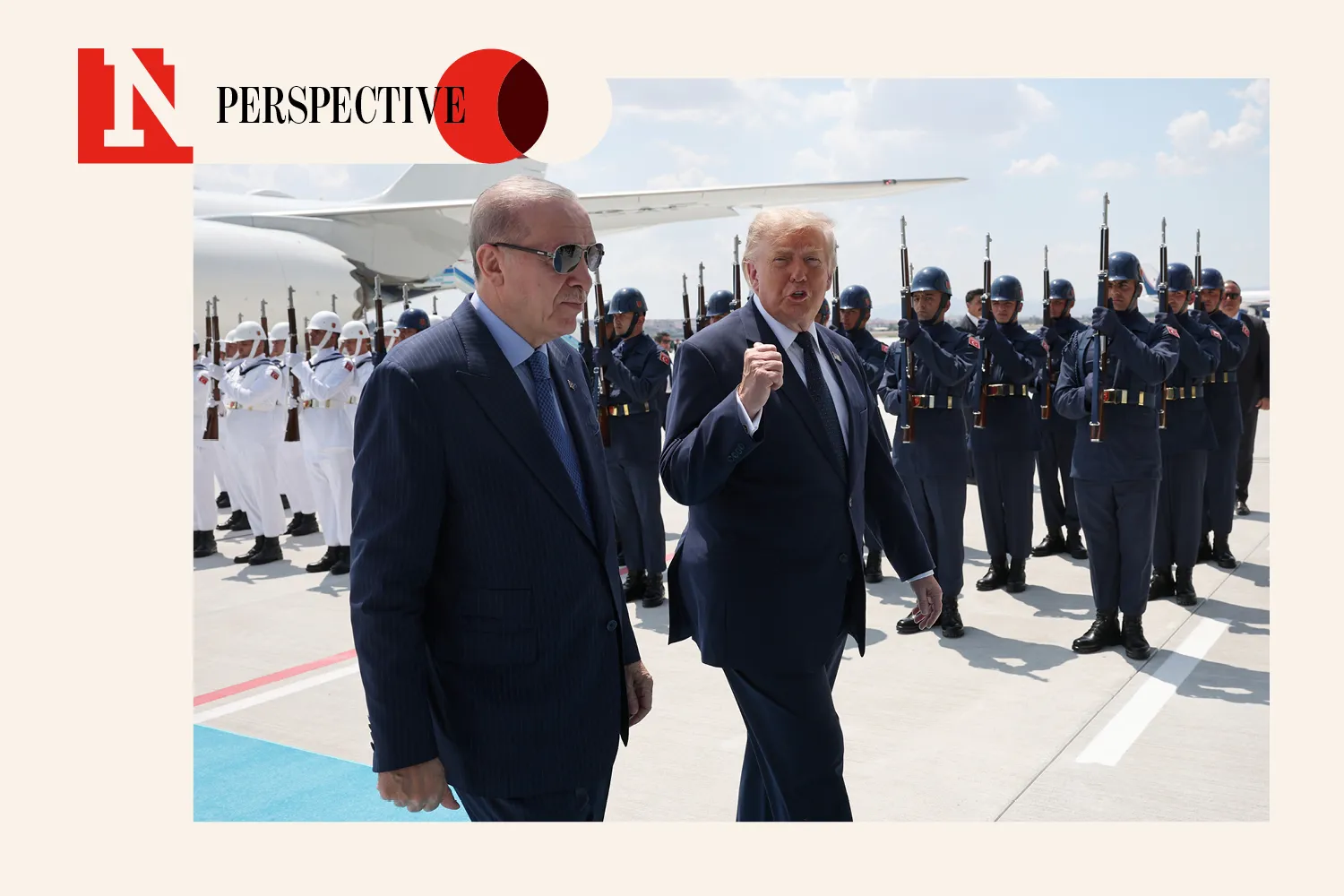
President Donald Trump's bolstering of ties with Turkish counterpart Recep Tayyip Erdogan at the NATO summit hosted in Ankara marks the latest sign of the White House's embrace of the United States' ally's strategic position across two continents.
Turkey, officially known as Türkiye, is located geographically between ongoing conflicts in Ukraine and the Middle East and has emerged as a key player on both fronts. That role has drawn criticism from other U.S. allies, namely European states that accuse Erdogan of authoritarian tendencies at home, and Israel, which views growing Turkish influence in the Middle East as a threat to its own designs.
But Trump has repeatedly sidelined such concerns, often declaring his admiration for the man who has led Turkey for some 23 years.
Read More
Syria Is Caught Between Trump and His Two Best Friends in the Middle East8 min read

Why US Bases in the Persian Gulf Are Doomed9 min read

Is the War in Gaza Over? Why Hamas Really Just Dissolved Its Government9 min read

"As everyone knows, it's been very much reported, we are great friends," Trump said Tuesday, seated beside Erdogan upon his arrival in Ankara. "The president has done an incredible job."
Beyond the praise, however, lies a valuable alignment.
"Of course, leadership matters, and good communication between leaders can make a real difference. But what we’re seeing goes beyond personal diplomacy," Murat Yesiltas, the director of foreign policy studies at the Foundation for Political, Economic and Social Research (SETA), told Newsweek.
"The bigger story is that Washington is once again recognizing Türkiye’s strategic importance," Yesiltas said. "The reason is actually quite simple. The world has changed."
...
Turkey at the Center
Turkey's history in NATO dates back to 1952, when the nation, which had remained neutral throughout World War II, chose to align with the Western bloc amid fears of potential Soviet hostility across the strategic straits linking the Mediterranean and Black Seas.
The addition established the Turkish Armed Forces as the second largest military in the alliance after the U.S. and granted a new foothold in Asia. Turkey's importance only grew with the end of the Cold War as U.S. attention shifted to the Middle East, with the 9/11 attacks marking the only time NATO has ever invoked its core Article 5 mutual defense clause.
Since first coming to power in Turkey as prime minister in 2003, the same year of the U.S.-led invasion of neighboring Iraq, Erdogan has sought to elevate Ankara's geopolitical influence in various theaters, all while amassing a powerful military-industrial base.
Evidence of Turkey's heightened position in recent years in particular has been demonstrated by its role in aiding allies engaged in conflicts in Libya, Syria and the Caucasus region, notably Azerbaijan's successive victories over Armenia. Turkish drones have proven to be powerful assets in these conflicts, as they have in Ukraine's defense against Russia's February 2022 invasion.
Turkish diplomacy has proven similarly potent. Even as Erdogan has found himself at odds with Russian Vladimir Putin in much of these battlefields, the Turkish leader has also managed to maintain crucial contacts with the Kremlin, establishing himself as a broker for elusive contacts between Moscow and Kyiv long before Washington's foray in mediating Europe's deadliest conflict since World War II.
"Today, almost every major security issue that NATO is dealing with intersects with Türkiye in one way or another," Yesiltas said. "Whether we’re talking about the Black Sea, the Middle East, the Eastern Mediterranean, the Caucasus, or even Europe’s future security architecture, Türkiye sits right at the center of these developments."
"That makes it increasingly difficult for any U.S. administration to build a coherent regional strategy without Türkiye," he added.
The Turkish role in the Middle East has become especially significant amid regional turmoil sparked by the Hamas-led attack against Israel in October 2023 and the associated conflict that has erupted in Lebanon, Syria, Iraq, Yemen and, most recently, Iran.

...
The fallout of the U.S.-Israeli war against Iran, which weathered the battle and exerted pressure through control over the Strait of Hormuz and strikes against regional nations hosting U.S. military bases, has upended the regional security order, with Turkey poised to play a leading part in what comes next.
"We know the old regional balance is fading, but the new one hasn’t fully taken shape yet. That creates both uncertainty and opportunity," Yesiltas said. "What makes Türkiye different is that it can engage with almost everyone."
"It has strengthened its ties with Gulf countries, it remains a key NATO ally, it maintains dialogue with different regional actors, and at the same time it has built a strong indigenous defense industry that gives it greater room to act independently," he added. "There are not many countries in the region that combine all of those advantages."
Quarrels Among Allies
Turkey's strategy has also faced backlash.
A European Parliament report published last month slammed Erdogan and his administration for allegedly pursuing repressive policies, including the arrest of opposition leader and Istanbul Mayor Ekrem İmamoğlu last March.<
However, public criticism from European Union leaders has been notably muted since Trump's return to office, a trend on full display at the NATO summit in Ankara. Yet Trump's tough talk against Europe has only ramped up, with the U.S. leader castigating transatlantic allies for a perceived lack of support on the Iran war and pursuing "funny math" to meet his defense spending demands.
Meanwhile, Trump directed further praise toward Turkey for not participating in the Iran conflict, teasing he may have played a role in the decision. And in another sign of recognition toward Ankara's importance, Trump indicated he may lift sanctions he imposed during his first term to prevent Turkey from participating in the F-35 fighter jet program.
Related Story
Donald Trump’s Hidden Allies at the NATO Summit: Ranked
The 2020 restrictions were put in place under the Countering America's Adversaries Through Sanctions Act (CAATSA) in response to Turkey's acquisition of Russia's S-400 surface-to-air missile system. But Trump dismissed these concerns on Tuesday, telling reporters, "We don’t want to sanction friends."
The news has riled another traditional friend of Trump. Israeli Prime Minister Benjamin Netanyahu told Fox News on Monday that such a move would "upset the power balance in the Middle East, which is ultimately guaranteed by Israeli air superiority, and also by, I think...America’s posture in the Middle East."
Netanyahu and Erdogan have already been engaged in a deepening rivalry amid the chaos that has swept the Middle East. This includes Syria, where Trump credited Erdogan for aiding the rebel offensive that toppled longtime President Bashar al-Assad and brought to power President Ahmad al-Sharaa, a former Islamist insurgent with whom Trump has cultivated direct ties despite Israeli criticism.
Jim Townsend, a former U.S. Deputy Assistant Secretary of Defense for European and NATO Policy who serves today as adjunct senior fellow in the CNAS Transatlantic Security Program, argued that Trump's recent setbacks in Iran may only further deepen the divide with Netanyahu.
"I think Trump realizes that the goals that he has set out for himself with Iran, and maybe regionally, are easily thwarted by Netanyahu, who's got his own way and own approach and own goals," Townsend told Newsweek. "They don't necessarily share the same approach and the same goals in the region.
"And I think it's something where right now Trump is finding that working with Erdogan, he feels more comfortable doing that," Townsend said, "and he feels that with Netanyahu, he's got to always keep his eye on him."
But Townsend noted that the U.S.-Turkey relationship far predates both Trump and Erdogan, and that there are real advantages to a renewed push for tighter relations given Ankara's capacity to navigate treacherous diplomacy in the Middle East, Europe and beyond.
"There are times when having the Turks in your camp can really be helpful, and I think those times are increasing," Townsend said. "And so, this is a time, because we're in flux. There is this kind of fluid power sharing going on in the region, where having Turkey on your team, if you will, can bring pluses."
"And if things get particularly tight with the Russians, that's another area where Erdogan can work Putin behind the scenes," he added. "That's dealing with Ukraine, or anything else. So, having more of a trusted relationship with Erdogan than they've had in the past, given the situation in the region, given the situation of Russia, is not a bad thing for the United States to have."
Contact Newsweek editors on this story: Frances Mao and Sam Wilson.
View 0 Comments
Submit Correction
View Editorial & AI Guidelines