10
Loading video...


By Dan Gooding and Gabe Whisnant
0
Share
Newsweek is a Trust Project member
See more of our trusted coverage when you search.Prefer Newsweek on Googleto see more of our trusted coverage when you search.
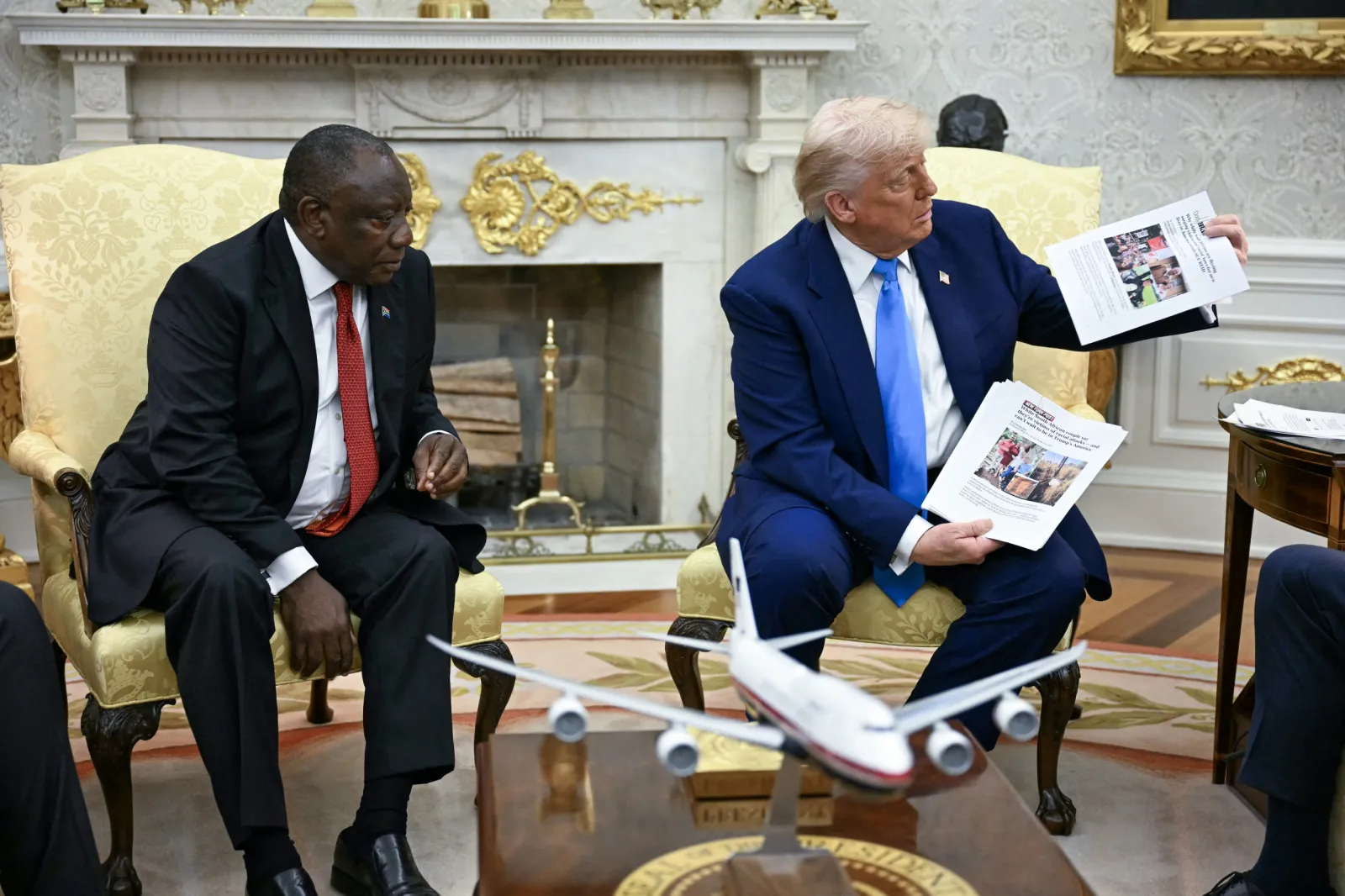
President Donald Trump presented videos and articles to South African President Cyril Ramaphosa alleging violence against white farmers in his country during White House talks on Wednesday.
During the meeting, which at times turned tense, Trump sharply criticized South African authorities over claims of violence targeting the country's minority white farmers. During the conversation, held amid strained relations between the two nations, the president paused and had an aide present a video to Ramaphosa that alleges the "white genocide."
"We've had tremendous complaints about Africa, about other countries too, from people. They say there's a lot of bad things going on in Africa," Trump said. "That's what we're going to be discussing today."
Read More on Politics
Why It Matters
Ramaphosa met Trump at the White House at a time when tensions between the countries are high.
Trump last week granted refugee status to 49 Afrikaners who were said to be fleeing "white genocide," despite Ramaphosa's insistence than there is no such thing happening in South Africa.
What To Know
The meeting between the two leaders began cordially, with Trump welcoming his South African counterpart to the White House and spoke of his pleasure at Ramaphosa bringing major-winning golfers Ernie Els and Retief Goosen as part of his South African delegation to the White House.
Ramaphosa then told Trump he had brought a gift: a 14-kilogram (30-pound) book on his country's golf courses, before thanking the U.S. President for his assistance during the COVID-19 pandemic.
Following some questions from the press, the conversation took a turn when Trump was asked about the program to accept white South African refugees over other groups. He directed those in the crowded Oval Office to watch a video on a TV screen, which showed pictures and videos allegedly proving the genocide Trump says white farmers face.
The footage, which included aerial shots of grave sites and speeches from opposition party leaders in South Africa calling for the killing of white people, appeared to cause confusion among the South African delegation, in particular for Ramaphosa.
"These are burial sites, over a thousand of white farmers, and those cars are lined up to pay love on a Sunday morning. Each one of those white things you see is a cross," Trump said.
Ramaphosa would not watch most of the footage, becoming more agitated as it went on. Trump said afterwards that this clearly showed the violence Afrikaners were enduring.
"Have they told you where that is, Mr. President?" Ramaphosa asked Trump. "No. I would like to know where that is, because this I have never seen."
...
Trump said it was in South Africa, with Ramaphosa repeating he needed to confirm that. His delegation also denounced the footage, saying that there was crime in the country, but violence was across the board.
"What you saw, the speeches that were being made, that is not government policy," Ramaphosa said.
The South African government has repeatedly denied that white farmers are facing a mass genocide, or having their land taken from them.
"There is criminality in our country. People who do get killed, unfortunately through criminal activity, are not only white people. The majority of them are black people," Ramaphosa told Trump.
The U.S. President repeated his claims, however, adding that thousands of people wanted to seek refugee status in the U.S. as a result.
Elon Musk, himself South African, was in the Oval Office while the meeting played out, but did not contribute. Trump said he did not want to draw Musk into the issue, as he already had enough going on.
What People Are Saying
South African Minister of Agriculture John Steenhuisen, speaking in the Oval Office: "We have a real safety problem in South Africa, I don't think anyone wants to candy-coat that. It requires a lot of effort to get on top of. It's going to require more policing resources, it's going to require a different strategy to be able to deal with it. But certainly the majority of South Africans, commercial and small farmers, really do want to stay in South Africa and make it work."
Golfer Ernie Els, of South Africa, speaking in the Oval Office: "We want to see things get better in our home country, that's the bottom line."
Johann Rupert, a South African billionaire, in the Oval Office: "We have too many deaths, but it's across the board. It's not only white farmers, it's across the board...
"Remember, sir, you and I lived in New York in the seventies. We never thought New York would become what it became. Two commissioners, a duff mayor. We need your help to stop this awful killing," Rupert said to Trump.
At one point, Ramaphosa called on Zingiswa Losi, the president of a group of South African trade unions, who told Trump it is true that South Africa is a "violent nation for a number of reasons.": "The problem in South Africa, it is not necessarily about race, but it's about crime. We are here to say how do we, both nations, work together to reset, to really talk about investment but also help ... to really address the levels of crime we have in our country."
What's Next
After the tense on-camera exchange, President Trump hosted Ramaphosa for a private lunch and additional discussions. Speaking to reporters afterward, Ramaphosa downplayed Trump's accusations, suggesting the U.S. president harbored "doubt and disbelief" about the alleged genocide against white farmers.
He emphasized that the topic was not a focal point during their closed-door meeting. Ramaphosa sought to shift attention toward broader diplomatic priorities rather than the controversy.
"You wanted to see drama and something really big happening," Ramaphosa told reporters following his White House visit. "And I'm sorry that we disappointed you somewhat when it comes to that."
Update: 5/21/25, 1:33 p.m. ET: This article has been updated with additional information and remarks.
Update: 5/21/25, 2:05 p.m. ET: This article has been updated with additional information and remarks.
Update: 5/21/25, 5:56 p.m. ET: This article has been updated with additional information and remarks.
View 0 Comments
Submit Correction
View Editorial & AI Guidelines