...

By Newsweek Editors
0
Share
Newsweek is a Trust Project member
See more of our trusted coverage when you search.Prefer Newsweek on Googleto see more of our trusted coverage when you search.
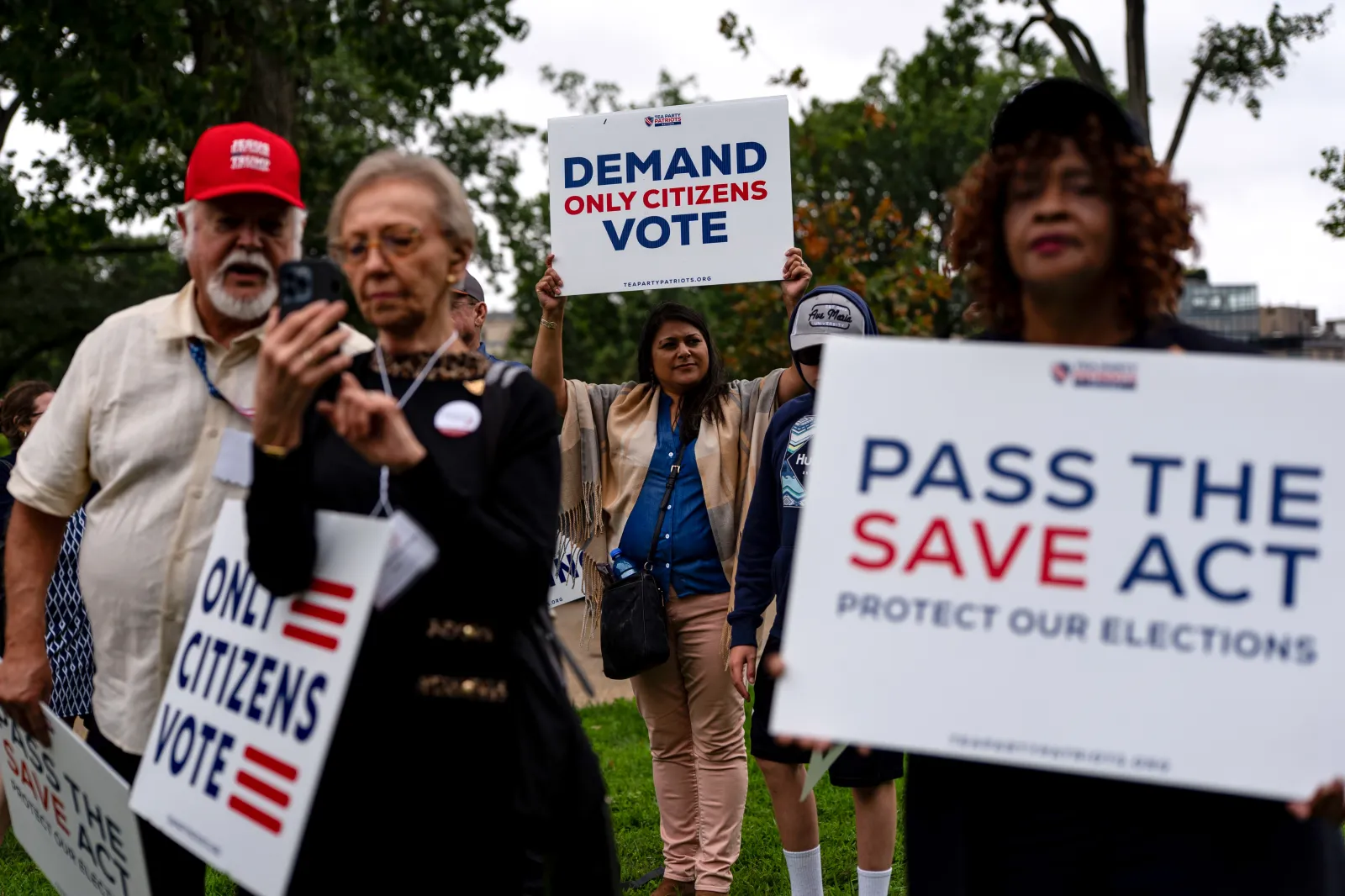
Yesterday, President Donald Trump took voter ID straight into the Republican internecine quarrel. Standing outside the White House, he jabbed at Senate Majority Leader John Thune over the Safeguard American Voter Eligibility (SAVE) Act and said, without a trace of irony, that Thune "has to be a leader." The backdrop was Trump’s threat to withhold his signature from other legislation until the bill moved. Thune has resisted changing Senate rules to force it through.
The argument over voter ID is often staged as a morality play: Republicans as guardians of election integrity, Democrats as defenders of election access. But the real collision is not that. It is a fight between a public that likes the idea of verification and a bureaucracy that was never designed to make it work.
That's why both sides are wrong. Republicans are wrong to talk as if proving citizenship is a detail. Democrats are wrong to talk as if the country finds the idea outrageous. The facts don't flatter either view.
Read More on News
Common Knowledge
On the right, the case is clear. The SAVE America Act would require documentary proof of U.S. citizenship at registration and photo identification at voting. Trump and his allies present that as common sense: if citizenship is a legal condition of voting, then citizenship ought to be shown. If Democrats (or anyone else) resist, it implies they prefer gerrymandering to trusted elections.
On the left, the case is equally clear. Senate Minority Leader Chuck Schumer has called the measure "not about securing our elections" but "about suppressing voters," and critics of the bill say its demands could snare people whose current legal names do not neatly match older records. The legislation tells states to create a process for voters whose legal name differs from their birth certificate, but there is ambiguity over what extra documents states would accept.
Uncommon Knowledge
Democrats are plainly kidding themselves on public opinion. A February 2026 Harvard CAPS/Harris poll found that 85 percent of voters say only U.S. citizens should be allowed to vote, 71 percent support the SAVE America Act, 75 percent support proof of citizenship, 81 percent support voter ID, and 80 percent support states removing noncitizens from voter rolls. Pew’s August 2025 survey found similarly broad backing: 83 percent of Americans favor requiring government-issued photo identification to vote, including 95 percent of Republicans and 71 percent of Democrats. Significantly, Pew also found that at least seven in 10 adults across racial and ethnic groups support photo-ID requirements. On the politics, the right is on firmer ground than the left likes to admit.
Case closed? Not so fast. The Republican line—that birth certificates are not mystical artifacts, but easily attainable—is directionally true. Americans can obtain a certified copy of a birth certificate through their relevant state or territorial vital-records office online, by mail, or in person. If someone has lost all forms of identification, most states provide another route to verify identity, such as a sworn statement or a notarized letter from a parent listed on the birth certificate. VitalChek is the exclusive online partner for more than 450 government agencies and processes official certificates that are printed and shipped directly from the appropriate government location. So yes: for many people, this is not impossible.
But "possible" is not the same as "frictionless," and this is where Republicans are kidding themselves. Applicants need to know where they were born, including the city and county, and fees vary by state. VitalChek says some requests require a valid government-issued ID, some require proof of entitlement, and payment is typically by credit or debit card. It also notes that the underlying government agency controls the issuance timeline. So the reality is not zero hassle, zero cost, and zero mismatch problems.
That distinction matters because the evidence suggests the burden is not some activist fantasy. The Brennan Center and its research partners found that 21.3 million voting-age American citizens do not have proof of citizenship readily available, and at least 3.8 million do not have those documents at all. Their standard for "readily available" was simple: could you quickly find it if you had to show it tomorrow? The same research found a racial gap: just over 8 percent of white citizens lacked ready access, versus nearly 11 percent of Americans of color. Independents were more likely than Democrats or Republicans to lack the documents or ready access to them, and that adults aged 18 to 24 were also less likely to have access.
The bill’s reach is also wider than some Republicans suggest. Under the SAVE America Act, most voters could not register with a driver’s license alone because licenses generally do not indicate citizenship; they would need a passport, birth certificate, or another qualifying document. A voter updating a registration after changing address or political party would have to provide those documents again. The National Conference of State Legislatures says the proposal is stricter than the voter-ID rules used in most states. And the Bipartisan Policy Center says citizenship is already required by federal law, instances of noncitizen voting are rare, and there may be easier, more cost-effective ways to verify citizenship that place more responsibility on government rather than individual voters.
All this means two things. Democrats are wrong about the country: the public is far more comfortable with voter verification than liberal rhetoric suggests. Republicans are wrong about the burden: the public may like the rule, but the administrative machinery behind it is far from universal in practice. The best case against Democratic messaging is the polling. The best case against Republican messaging is the paperwork. And the real lesson of the SAVE Act fight is that America has spent years arguing about election morality when much of the dispute is actually about bureaucracy, and whether a modern democracy should lean this hard on old paper.
Hey gang, Carlo Versano here. I hope you enjoyed this article. As Newsweek's Director of Politics and Culture and editor of the 1600 newsletter, I'm keen to hear what you think. Now, Newsweek is offering a new service to allow you to communicate directly with me in the form of a text message chat. You can sign up and get a direct line to me, as well as the reporters who work for me. You can shape our coverage, and even get your own Uncommon Knowledge article.
As a Newsweek member, we're offering this service to you for free. You can sign up below, or read more about how it works here. Let's talk!
View 0 Comments
Submit Correction
View Editorial & AI Guidelines