
10
Loading video...

By Tom O'Connor
Deputy Editor, National Security and Foreign Policy
0
Share
Newsweek is a Trust Project member
See more of our trusted coverage when you search.Prefer Newsweek on Googleto see more of our trusted coverage when you search.
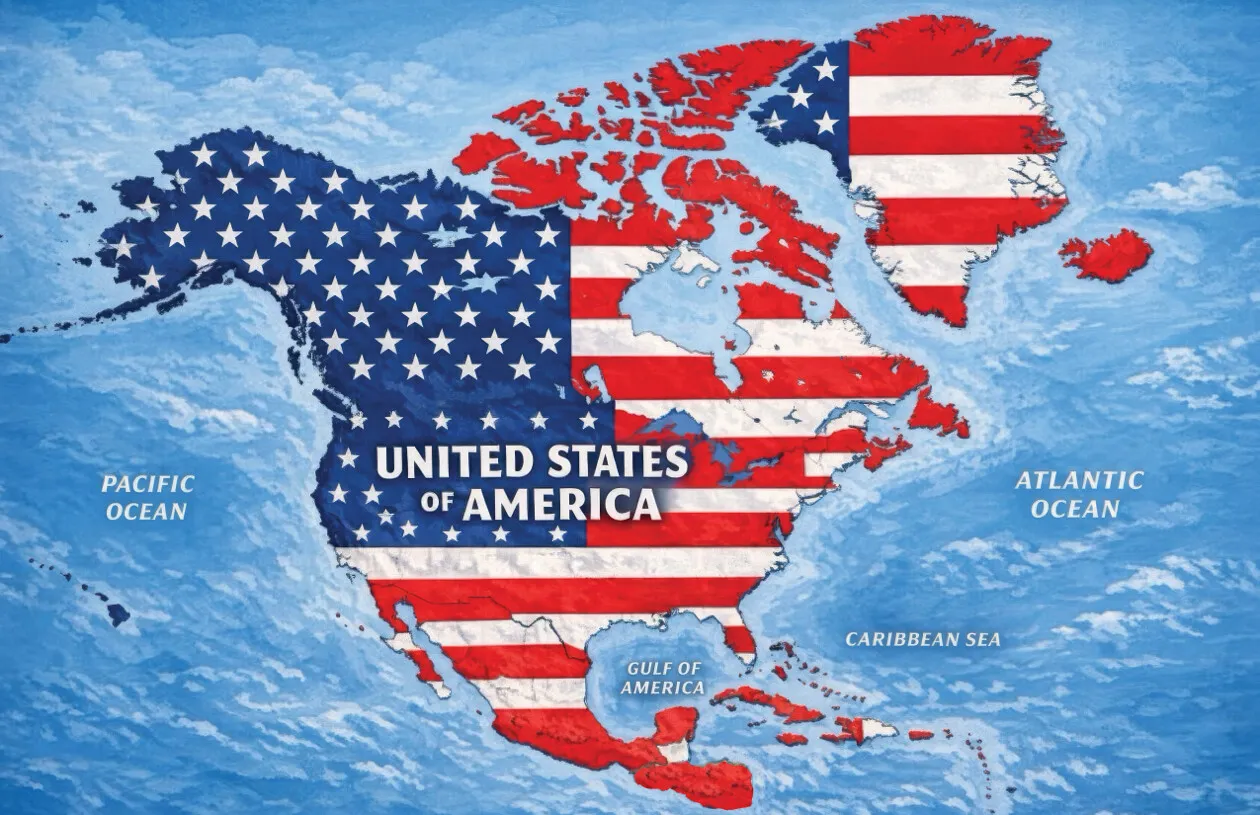
President Donald Trump appeared to proclaim all of North America to be part of the United States with a map posted Monday to Truth Social.
While the AI-generated image may be read by many as a tongue-in-cheek message regarding the White House's "America First"-imbued pivot to a more assertive hemispheric posture, dubbed the "Donroe Doctrine" after the two-century-old Monroe Doctrine, Trump's intensification of a deepening trade war with Canada on Monday underlined real-world tensions emerging between Washington and its northern neighbor.
The disputes are not limited to the economic realm, either.
Read More on World
Trump has repeatedly made passing reference to Canada as the 51st state and has in the past expressed ambitions to take control of Cuba, Greenland, Mexico and the Panama Canal. Official U.S. documents and mapping services reflect his decisions to rename the Gulf of Mexico as the Gulf of America last year and, just last month, rename Lake Ontario to Lake America.
...
Beyond these moves, however, there remains several active disagreements over territory with Canada, all of which long predate Trump's leadership yet persist unresolved in an era of growing tensions between two neighbors and fellow NATO members.
"We have always been able to work out agreements that have allowed us to accommodate differing perspectives on these boundary issues to focus on the greater issues," Rob Huebert, director of the University of Calgary's Center for Military Security and Strategic Studies, told Newsweek.
"The problem that we're facing now is that we are facing with the second term of the Trump administration a presidency that seems to not care or understand the strength of that unity. Many Canadians are uncertain as to what the Trump administration is actually trying to achieve with its very dangerous and disruptive policies towards Canada."
He warned that "it has been so unthinkable" that the level of unity achieved between the U.S. and Canada throughout two world wars and the Cold War "could be so thoughtlessly thrown away that there has been little preparation or thought given to responding to a direct U.S. territorial challenge."
That said, he argued, the current Canadian government is already "giving great attention to improving its defense capabilities on a much more unilateral basis."
"There is no question that Canada would respond with its best efforts to meet a direct American challenge," Huebert said. "The question is, of course, what is the territorial intent of Trump regarding Canada."
Related Story

Map Posted by Donald Trump Hints at Adding Numerous Countries to the US
Relations Ice Over in the Arctic
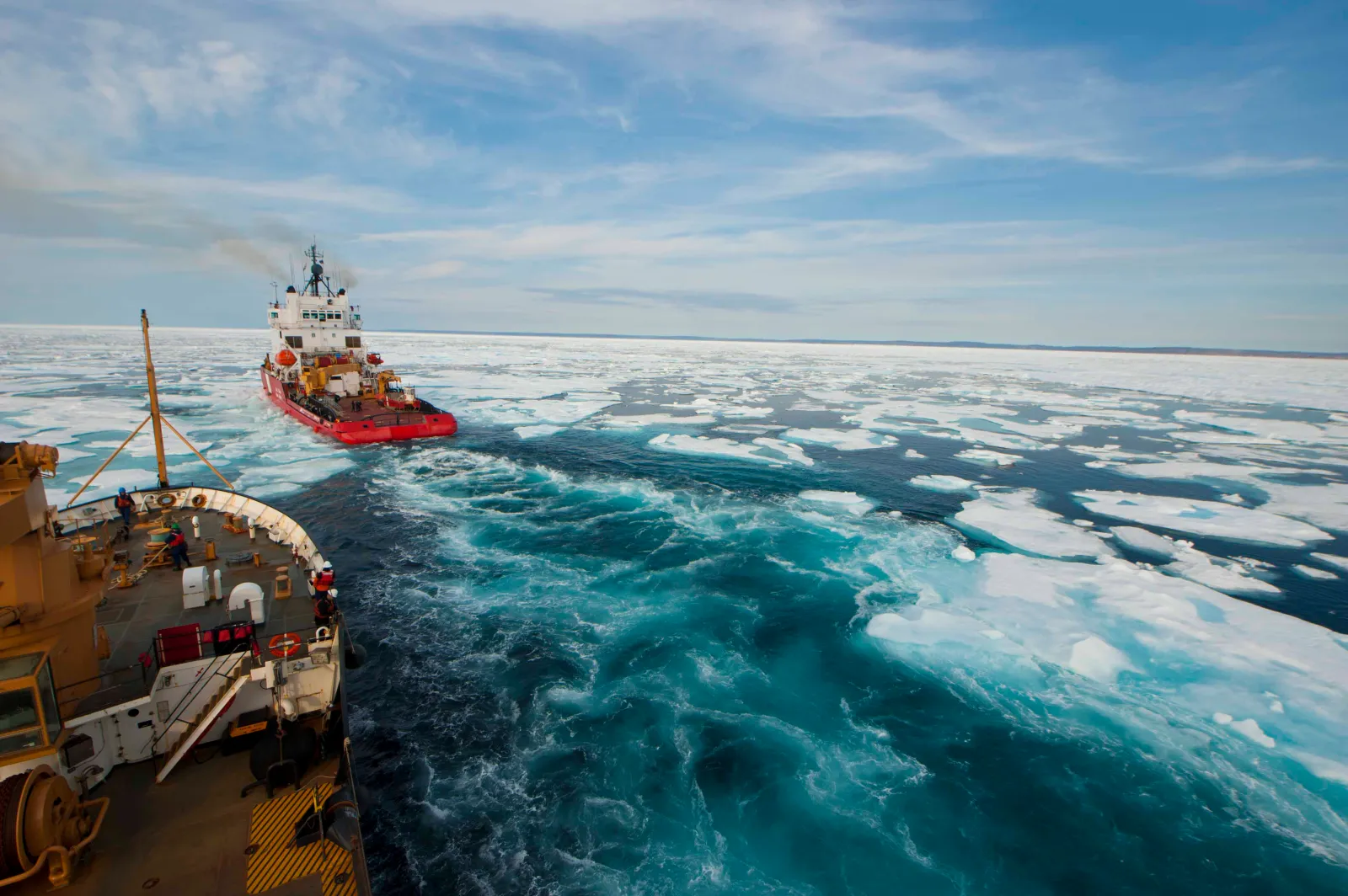
One of the most significant unresolved disputes involves a large swath of Arctic waters in the Beaufort Sea, an area believed to contain substantial oil and gas resources. The U.S. and Canada have long disagreed over the maritime boundary north of Alaska and Canada's Yukon and Northwest Territories, with the disputed area spanning roughly 270,000 square kilometers.
The dispute dates to differing interpretations of an 1825 treaty between two other powers, Russia and Great Britain, which established a boundary along the 141st meridian in the region. Canada maintains that the treaty's boundary should continue northward along that line, while the U.S. has adopted an alternative interpretation of how the boundary should extend offshore.
The disagreement also encompasses overlapping claims to the continental shelf farther into the Arctic Ocean, adding questions over seabed rights and potential resource development to the boundary dispute.
In September 2024, Washington and Ottawa announced a joint task force to negotiate the maritime boundary and resolve the continental-shelf overlap. The two sides held initial negotiations in November 2024, but Canada said in October 2025 that no subsequent meeting had been scheduled.
A second dispute in the Arctic is less about the U.S. asserting control but rather questioning Canada's exclusive rights. The Northwest Passage is a series of Arctic sea routes linking the Atlantic and Pacific oceans through the Canadian Arctic Archipelago, and while Washington says it's an international strait, Ottawa argues it's all Canadian.
After flare-ups in 1965 and 1985, the two sides came to a 1988 compromise through which the U.S. notifies Canada before making transits and Canada routinely accepts. But tensions today raise questions over the arrangement governing a corridor whose value has risen drastically with climate change and growing interest in the Arctic as an arena of geopolitical competition.
Much of the U.S. and Canada's concern on this front has been shared regarding intensified activity from Russia, with China also expressing greater interest in the Arctic. However, Trump's threats to assert direct control over Greenland—an autonomous territory of NATO member Denmark that lies along the Northwest Passage's eastern gateway—has cast new light on the United States' and Canada's respective investments in greater Arctic security investments.
Adam Lajeunesse, research chair in Arctic and Marine Security at St. Francis Xavier University's Brian Mulroney Institute of Government, said that "Canada has pretty significant capabilities in the Arctic now."
And while he would not envision such capabilities being used to target the U.S. military directly, a total breakdown in coordination would mean "the U.S. military would probably lose access to these waters, at least certainly easy access, because any transits by Coast Guard or Navy would now be through effectively hostile territory," Lajeunesse told Newsweek.
But he warned that even a misstep on this Arctic artery could "cause just an epic disaster to unfold in the continental defense dynamic," with serious ramifications for the U.S., as well. After all, he argued, should the U.S. successfully assert its claim of the Northwest Passage as an international strait, that "now the Chinese and the Russians can use it at their leisure."
"Right now, the United States effectively has unlimited use of passage and has since the '50s," Lajeunesse said. "So, winning this dispute would mean gaining nothing but giving that access to the Russians and the Chinese. So that is why it's never been fought before, and I'm curious to see if the current U.S. government recognizes that."
...
Problems Drawing the Line
Meanwhile, the U.S. and Canada have one long-standing dispute over sovereignty involving two small features near the entrance to the Bay of Fundy that lies between Canada’s Nova Scotia and New Brunswick provinces and the U.S. state of Maine: Machias Seal Island and nearby North Rock. Their status was never definitively resolved by the boundary arrangements that followed the American Revolution 250 years ago, and both countries continue to maintain competing claims.
The U.S. points to post-war treaties signed with Great Britain as evidence of that the islands fall under U.S. territory, but Canada counterclaims they were inherited from Great Britain, which established a permanent lighthouse in 1832. The Canadian Coast Guard continues to maintain a staffed lighthouse there today, while a migratory bird sanctuary is overseen by Fisheries and Oceans Canada, which referred to the issue as a "Grey Zone" dispute in a July 2025 report.
To the west, two additional disputes persist in Pacific waters that link the U.S. mainland to Alaska.
The first deals with questions over the line between the two countries in the Dixon Entrance, a strait between southern Alaska and the eastern shores of British Columbia. Canada considers the so-called northern “A-B Line,” established by the 1903 Alaska Boundary Tribunal, to be the maritime boundary, while the U.S. disputes that interpretation and asserts a boundary farther south.
The disagreement has left the status of four areas of water unresolved, the largest spanning over 800 square nautical miles along the Inside Passage, with implications for transit as well as commercial and military activity.
The second area of contention lies farther west, where the Strait of Juan de Fuca opens into the Pacific between Washington state and Vancouver Island. The boundary through the strait itself is settled, but the two countries have yet to agree on the precise extension of that maritime boundary into the Pacific.
Neither dispute has approached the level of confrontation seen in some other international territorial disputes, and both have largely been managed through long-standing arrangements. But the deterioration in U.S.-Canada relations could make even these relatively technical boundary questions more difficult to resolve.
Such concerns were previously raised when Trump, beginning last year, began to refer to the U.S.-Canada land border, the longest international border in the world at roughly 5,525 miles, as an "artificially drawn line."
Michael Byers, a professor at the University of British Columbia whose areas of expertise include the law of the sea and Canadian defense policy, explained that "there are no legal disputes between the U.S. and Canada over territory on land, with the last such dispute having been resolved by the Alaska Boundary Arbitration in 1903."
He acknowledged, however, that the Beaufort Sea and Northwest Passage disputes remain particularly active, even if both countries had so far proved more than capable of agreeing to disagree without incident.
"There is no good reason for reviving either of these disputes, because they are well-managed," Byers told Newsweek. "But if the U.S. government wished to revive them, I am certain the Canadian government would be willing to negotiate."
"That is what good neighbors do," Byers said.
Newsweek has reached out to Canada Global Affairs, the U.S. State Department and the White House for comment.

...
Neighbors React to Trump Threats
Canadian Prime Minister Mark Carney has continued to rally his country in the face of Trump's latest jabs, including the expanded U.S. territory map and a separate post Monday depicting a cartoon of Trump besting Carney in a hockey match with the caption "Get Up, Governor"—another indication of the White House questioning Canada's sovereignty.
Perhaps his strongest counterattack has been on the economic front, however, proceeding Tuesday with tariffs against roughly $20 billion worth of U.S. goods.
“Canada is a nation forged in adversity, a country that prides itself on doing what’s right, not what’s easy, a nation that knows we’re always stronger together," Carney said during a 15-minute video message released Monday. "Canada came to life in many ways in response to American aggression."
Throughout his remarks, Carney referenced the historic threat of "an expansionist United States" and past instances in which "Americans have tried to use tariffs to break us."
Trump hit back Tuesday with threats to ban the sale of Canadian aircraft company Bombardier products unless they were manufactured in the U.S.
"Buy American. Fly on American airliners. Enjoy American liquor and beverages. Sail on lake America. America First!" Trump wrote in all caps on Truth Social.
Trump later followed up with a series of executive orders restricting the sale of Canada-origin alcohol, dairy products, some motor vehicles and other products in the U.S. and expanding the scope of the existing 50 percent tariff regime that went into effect last month.
He also threatened on social media to limit the access of Canadian goods to U.S. government procurement programs, accusing Canada of not living up to the principle of "reciprocity" in bilateral trade after the Carney administration's latest measures and earlier restrictions put in place by Canadian provinces targeting certain U.S. goods.
"This should have been cut off years ago, by other Administrations, like it was by mine, only to [be] reinstituted by Sleepy Joe Biden," Trump wrote.
The new salvo comes a week after Carney expressed an unwillingness to accede to U.S. trade demands or engage in online battles.
"When the Americans stop doing memes, stop throwing shade and stop trying to be tough, and start being serious about having those discussions, we can have those discussions," Carney said at the time. "It's not constructive, but that's their democracy."
Carney wasn't alone in asserting his country's sovereignty. Mexican President Claudia Sheinbaum wrote, without directly addressing Trump's map, that "Mexico is neither nor will be a colony or protectorate of any foreign country" in an X post published Monday.
The Foreign Ministry of Iceland, not considered to be part of North America though included in Trump's map, summoned the U.S. ambassador, while Prime Minister Kristrún Frostadóttir warned: "There is nothing funny or normal about making fun of the sovereignty of states, especially today when it is not a given.”
Danish Prime Minister Mette Frederiksen reiterated her country's position that Greenland did not wish to become a part of the U.S. Her top diplomat, Foreign Minister Lars Løkke Rasmussen, saw the "disturbing" map as evidence that Trump "still harbors some kind of maximalist vision in his own mind."
"We need to rein that in," Rasmussen said.
Contact Newsweek editors on this story: Samantha Beech, Dave Siminoff, Gray R. Thomas
View 0 Comments
Submit Correction
View Editorial & AI Guidelines