10
Loading video...

By Rich Percival
Associate News Editor
0
Share
Newsweek is a Trust Project member
See more of our trusted coverage when you search.Prefer Newsweek on Googleto see more of our trusted coverage when you search.
The Trump administration plans to invest between $25 million and $32 million in an expanded consulate in Nuuk, Greenland, capital of the self-governing Danish territory, with room for a staff of 17.
Documents issued by the department’s Bureau of Overseas Buildings Operations (OBO), viewed by Newsweek, showed that the planned capacity will be significantly larger than Canada’s one representative and the European Union’s four staff members in Nuuk.
It comes as President Donald Trump seeks greater American influence over Greenland, which he called the greatest gift the United States had ever received in a call to Fox News on Tuesday.
Read More on News
“Remember, [Europe] just gave the United States the greatest gift we were ever given," he said. "Do you know what it was? Greenland. We just got Greenland, you know that, right?”

...
Key Details About the Plan
The work would cover three floors totaling 29,969 gross square feet in the Ole’s Varehus development, a mixed-use building completed in 2023.
The floors occupy the lower commercial levels, beneath a residential tower, according to the State Department contract. Four staff members currently work at the site.
The location is roughly a quarter-mile from Nuuk’s City Hall, in a district of shops, cultural buildings and public squares along a pedestrian promenade.
The consulate was inaugurated earlier this year with speeches, Hawaiian music and musk ox hot dogs, although most of it remains empty, Newsweek understands.
Philadelphia architectural firm KieranTimberlake has been appointed by the State Department to undertake the renovation project.
As part of its functions, the consulate would be able to issue visas to Greenlanders wishing to visit the United States.
Related Story
Trump Refers To ‘Our’ Greenland As He Touts Oil Drilling
Before moving to the current location, the United States reopened its smaller consulate in Nuuk in 2020 in a small red wooden building at Nuuk’s harbor. Its previous diplomatic office in Greenland closed in 1953.
Newsweek has approached the State Department for more details on the proposal.
U.S. Ambassador to Denmark Ken Howery, who attended the May opening of the new consulate, said the move reflected “a long-term commitment” to Greenland.
He wrote in the Greenland newspaper Sermitsiaq: “Buildings matter in diplomacy. Not just because of their architecture, but because of what they signal. Permanent, purpose-built diplomatic facilities communicate something words cannot: They are an investment in our presence, in seriousness of purpose and in an intention to stay.”
At the opening, he added: “The Arctic is clearly a region of global importance. We will always be neighbors and be with you into whatever future you choose as allies and partners."

...
Nuuk Opposition Felt Clearly
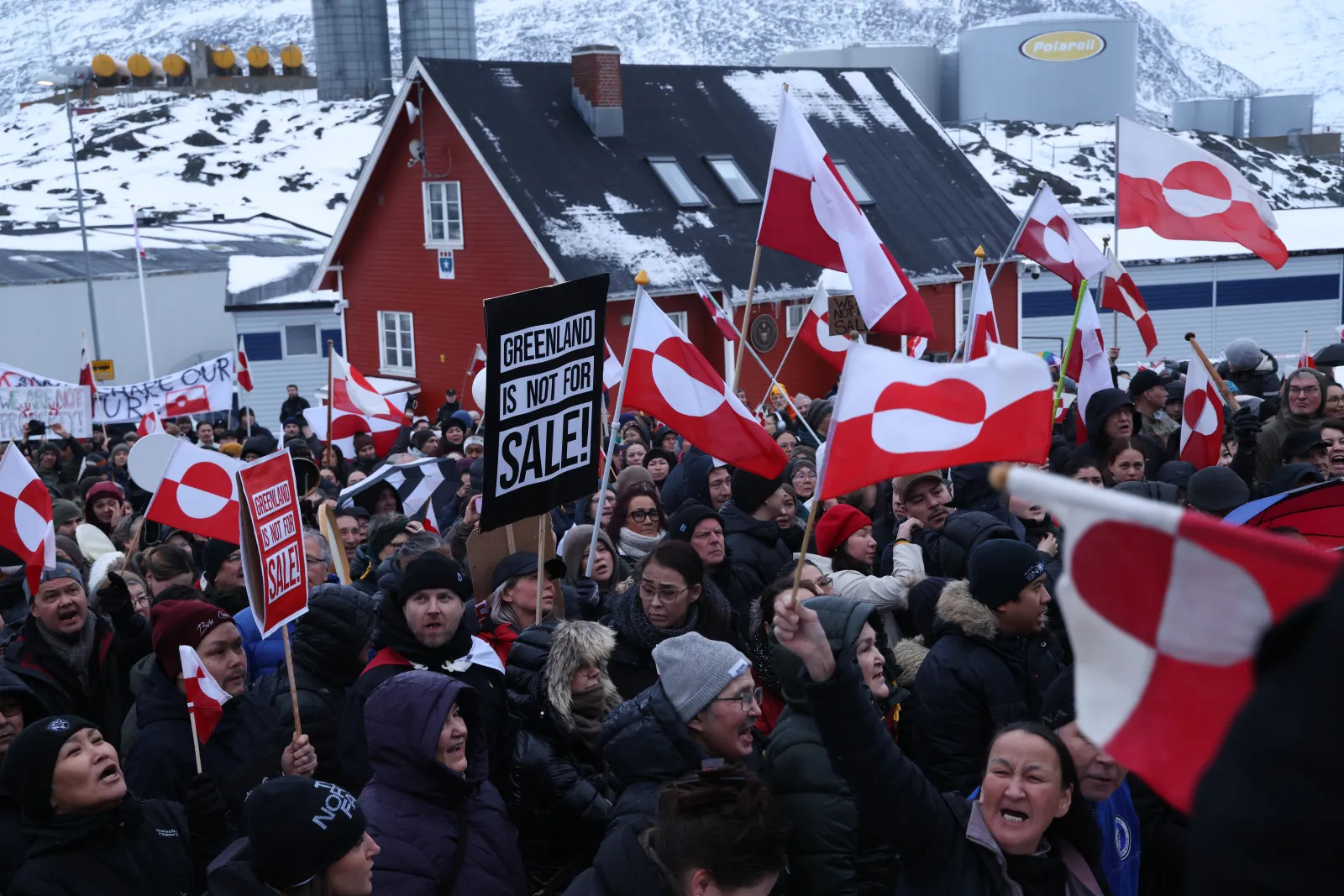
Hundreds of Greenlanders protested the opening of the larger U.S. consulate in Nuuk in May.
Demonstrators marched through Nuuk before standing silently with their backs to the building while Greenland’s political leadership largely stayed away, including Prime Minister Jens-Frederik Nielsen, who declined an invitation from U.S. officials.
Aqqalukkuluk Fontain, who organized the demonstration and lives in Nuuk, has followed developments closely.
“I’m very concerned about it. The United States has big plans for Greenland, and Donald Trump already talks as though he owns Greenland,” he told Danish news outlet Politiken—in remarks translated from Danish—which first reported the plans for the expanded consulate.
“When you consider that there are 57,000 of us, it is completely excessive. If they expand in that way, I think there will be more demonstrations. It is not something we want.
“I think most people are pleased that the Greenlandic and Danish governments secured Greenland’s sovereignty and right to self-determination. But many are still worried about what will happen [after the midterm elections]. As I see it, that was only the beginning. It is not the end.”
Naaja Nathanielsen, one of two Greenlandic MPs in the Danish parliament and a former Greenlandic energy minister, told Newsweek that there were two takes on the issue.
Firstly, she said, are the feelings of the Greenlandic population, saying: "There is no doubt that the Greenlandic population has distrust of the Americans at the moment; there is a lot of anger. Whatever the aims of the U.S. administration, they should take into account that they rebuild trust with the Greenland community."
On the other hand, the focus was on building diplomatic ties between governments, adding: "The U.S. interests were there prior to Trump and will be after that. They [the Americans] want to engage more with Greenlanders, but now, there is feeling and sensitivity among the Greenlandic population."
Newsweek has approached the Danish Ministry of Foreign Affairs and the Greenlandic government for comment on the proposed plans.
Dr. Rob Huebert, a professor of political science at the University of Calgary, Canada, told Newsweek that Trump's move was like "little boys playing, who's bigger than the other" amid the ongoing diplomatic spat over Greenland.
"One of the greatest challenges we have right now when we talk about Greenland, NATO and the United States is that there is such an element of theatre that Trump has interjected," he said.
But he stressed that after Democrats won control of the House and Senate, Congress would be able to "speak as a voice" and have more "checks and balances" on Trump's moves regarding Greenland.
Dr. Dwayne Ryan Menezes, managing director of the Polar Research and Policy Initiative, told Newsweek: "The planned expansion of the U.S. consulate in Nuuk is further evidence that Greenland has moved from the periphery to the center of American strategic thinking.
"Washington has long recognized Greenland’s military significance, particularly its position between North America and Europe, its importance to missile warning and surveillance, and its proximity to the Arctic Ocean," he said. "But American interests now extend well beyond defense into critical minerals, energy, infrastructure, scientific research, commercial investment and cultural and political relations.
"Washington is not merely investing in a larger diplomatic footprint; it is institutionalizing the capacity to pursue these diverse interests simultaneously and for the long haul. This expansion signals a crucial shift in U.S. posture: transitioning from a volatile spike in strategic interest driven by one president’s personal fixation to a permanent, institutionalized foreign policy priority of sustained engagement."

...
Security Deal Moves Closer
This week, the Inatsisartut, or Parliament, of Greenland backed a trilateral security agreement allowing a larger U.S. military presence while keeping the island within the Kingdom of Denmark.
Signed by Trump, Nielsen and Danish Prime Minister Mette Frederiksen in September at the UN General Assembly in New York, the agreement opens the way for additional American bases. It would remain applicable if Greenland became independent.
The United States currently operates one military base on the island, Pituffik Space Base, in northwestern Greenland.
Lawmakers in Greenland approved the pact on November 3 in a vote of 16-0, with seven abstentions. However, Danish parliamentary procedures must still be completed before the deal goes into effect.
Until the security deal was signed in September, Trump refused to rule out military force to take control of Greenland, arguing that American ownership was vital to U.S. national security, straining NATO relations.
At NATO’s July summit, he said the island “should be controlled by the United States, not by Denmark.” European leaders pushed back, insisting that Greenland was not for sale and that its people should decide its future.
Contact Newsweek editors on this story: Richard Percival and Dave Siminoff.
View 0 Comments
Submit Correction
View Editorial & AI Guidelines