
Photo-illustration by Newsweek/Getty

By Micah McCartney
Reporter
0
Share
Newsweek is a Trust Project member
See more of our trusted coverage when you search.Prefer Newsweek on Googleto see more of our trusted coverage when you search.
As the first year of President Donald Trump’s second term draws to a close, analysts are assessing Washington’s posture in the Asia-Pacific region—who the biggest winners and losers are and what the shifting balance means for the United States’ competition with China.
Great Power Competition
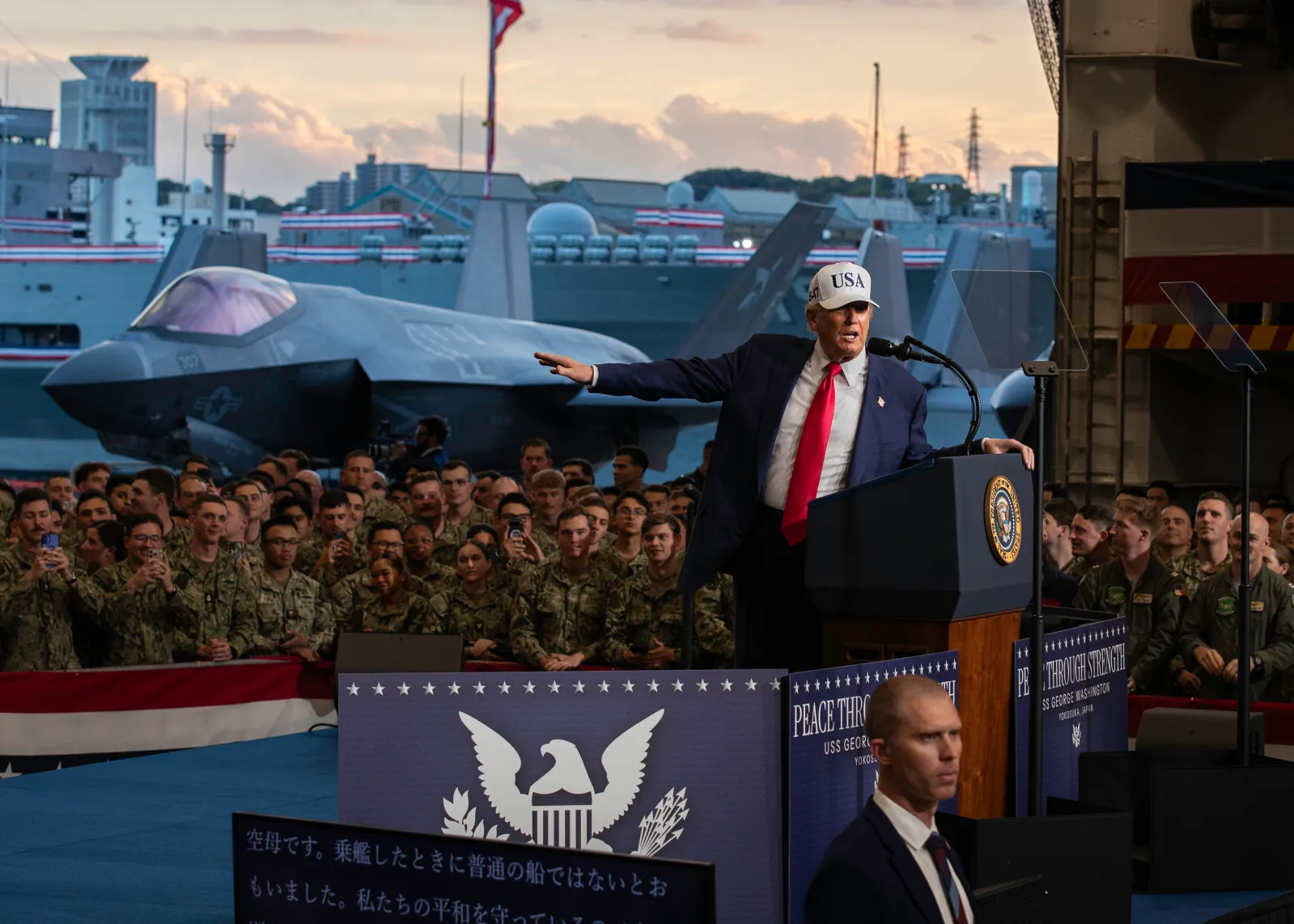
The Asia-Pacific, home to about half of the world’s population and roughly 60 percent of global economic output, occupies an increasingly central role in global trade and influence. For decades, the United States enjoyed near-total military dominance across the region, backed by a network of bases from Japan and South Korea to Guam and the Philippines.
Read More on World
That status quo has been crumbling as China expands its military in both reach and capabilities. It has invested heavily in hypersonic and anti-ship missiles designed to push U.S. forces farther from its coast and fortified artificial islands across the South China Sea. The country also continues to pile pressure on Taiwan, the Beijing-claimed island Chinese leaders say must eventually be brought into the fold, whether by political means or by force if that fails.
Newsweek reached out to the White House, Japan’s Cabinet Office and the Philippine Department of Foreign Affairs by email with requests for comment.
...
Policy Shifts Under Trump’s Second Term
Trump’s return to the White House in January brought expectations of renewed confrontation with Beijing. Yet analysts have now said the tariff hikes and foreign-aid reductions seen earlier this year have largely come at the expense of U.S. influence.
These fell especially hard on countries that are up for grabs in terms of alignment," Rob York, director of Honolulu-based think tank the Pacific Forum, told Newsweek.
"Overall, this administration seems more focused on the benefits of trade and tariff policy. Coupled with aid cuts and other reductions in soft power, that’s worked to China’s benefit—at least for now," he said. "That could change, of course. China has thrown away goodwill in the past through its more aggressive behavior. But over the past year, I’d say things have gone quite well for them."
Meanwhile, Beijing has publicly condemned recent U.S. deployments, including the positioning of a Typhon medium-range missile system in the Philippines and continued major arms sales to Taiwan.
In a statement to Newsweek, Chinese Embassy spokesperson Liu Pengyu accused Washington of “stoking flames and creating tensions in the Asia-Pacific region” through new weapons sales and missile deployments. He said the U.S. was “turning the region into a powder keg” and urged it to “stop inciting confrontation and escalating tensions."
As for Taiwan, which China calls the reddest of its red lines—York questioned the extent of Trump’s support for the self-ruled island, a key U.S. economic partner and the world’s leading producer of advanced chips.
"We’re not seeing the same kind of emphasis on Taiwan’s security," he said, citing reports from earlier this year that Trump denied Taiwan President Lai Ching-te's request for a brief transit stop in the U.S. ahead of a then-planned tour of Latin American allies. The move was widely viewed as a play for more favorable trade terms with Beijing.
Strategic Engagement With Beijing
Henry Huiyao Wang, founder and president of the Center for China and Globalization in Beijing, cited this denial of transit as one of several reasons to be “cautiously optimistic” about the direction of U.S.-China ties, arguing that Trump’s second term could bring greater stability to the relationship than under former President Joe Biden.
The analyst also pointed to the administration’s recently released National Security Strategy, which again identifies China as the United States’ primary strategic competitor, but also emphasizes the importance of maintaining communication and reducing the risk of confrontation.
This more pragmatic tone suggests a recognition that neither side can afford sustained hostility, said Wang, who described both governments as seeking “a new equilibrium" with periodic friction likely but open conflict avoidable.
Wang suggested Trump’s second term could prove more stable than the era of Biden and noted the planned one-on-one summit between Trump and Chinese President Xi Jinping, expected early next year in China, to follow up on the October 30 meeting that resulted in concessions from each side and an easing of trade tensions.
Wang also pointed to earlier remarks by Secretary of State Marco Rubio, who has stressed the need for the two "big, powerful countries" to seek cooperation where possible, despite inevitable disagreements. The State Department referred Newsweek to Rubio’s December 19 remarks to the press, in which he said Washington must manage competition with Beijing “without undermining our very firm commitment to our partners in the Indo-Pacific.”
"I think if there’s a global challenge that China and the U.S. can work together on…I think we can solve it. And there’ll be points of tension. We all recognize that. And our job is to balance these two things. I think both sides understand that," Rubio said.
U.S. Alliances Amid Great Power Competition
Japan, Washington’s most important regional ally, has moved to raise its defense budget to a postwar record of 2 percent of GDP by 2027, a postwar record as, part of a broader military modernization drive that includes new counterstrike capabilities and supply-chain cooperation with the U.S. Yet Japanese officials have pushed back at renewed U.S. pressure for greater allied contributions and concern that Trump’s tariff extensions could strain supply chains linking the two economies.
South Korea and Japan have continued to hold trilateral drills with the U.S., a framework established under Biden, as North Korea advances its United Nations-sanctioned ballistic missile and nuclear programs, a challenge Wang told Newsweek warrants four-party talks between Washington, Beijing, Seoul, and Pyongyang.
The Philippines has continued to bolster security ties with the U.S. and other partners to deter China’s expanding presence within its exclusive economic zone, where Chinese coast-guard and maritime militia vessels have clashed with Philippine ships near disputed features such as Scarborough Shoal.
While Manila’s pushback enjoys broad public support, it has also stirred debate over how far the cooperation should go, with critics echoing Beijing’s charge that Washington is using the Philippines as a proxy in efforts to counter its East Asian rival.
Taiwan, meanwhile, is preparing for its 2026 parliamentary elections, where opposition parties favoring closer ties to Beijing currently hold a majority. The new leader of the main opposition Kuomintang Party, Cheng Li-wen, has suggested she would meet Jinping “100 times” without preconditions if it would advance dialogue—a departure from Lai’s insistence that any talks occur on equal footing.
Update 12/28/25 10:30 a.m. ET: This article has been updated with a comment from the Chinese Embassy and additional information.
View 0 Comments
Submit Correction
View Editorial & AI Guidelines