10
Loading video...


By Alex Backus and Steven Frank
0
Share
Newsweek is a Trust Project member
See more of our trusted coverage when you search.Prefer Newsweek on Googleto see more of our trusted coverage when you search.
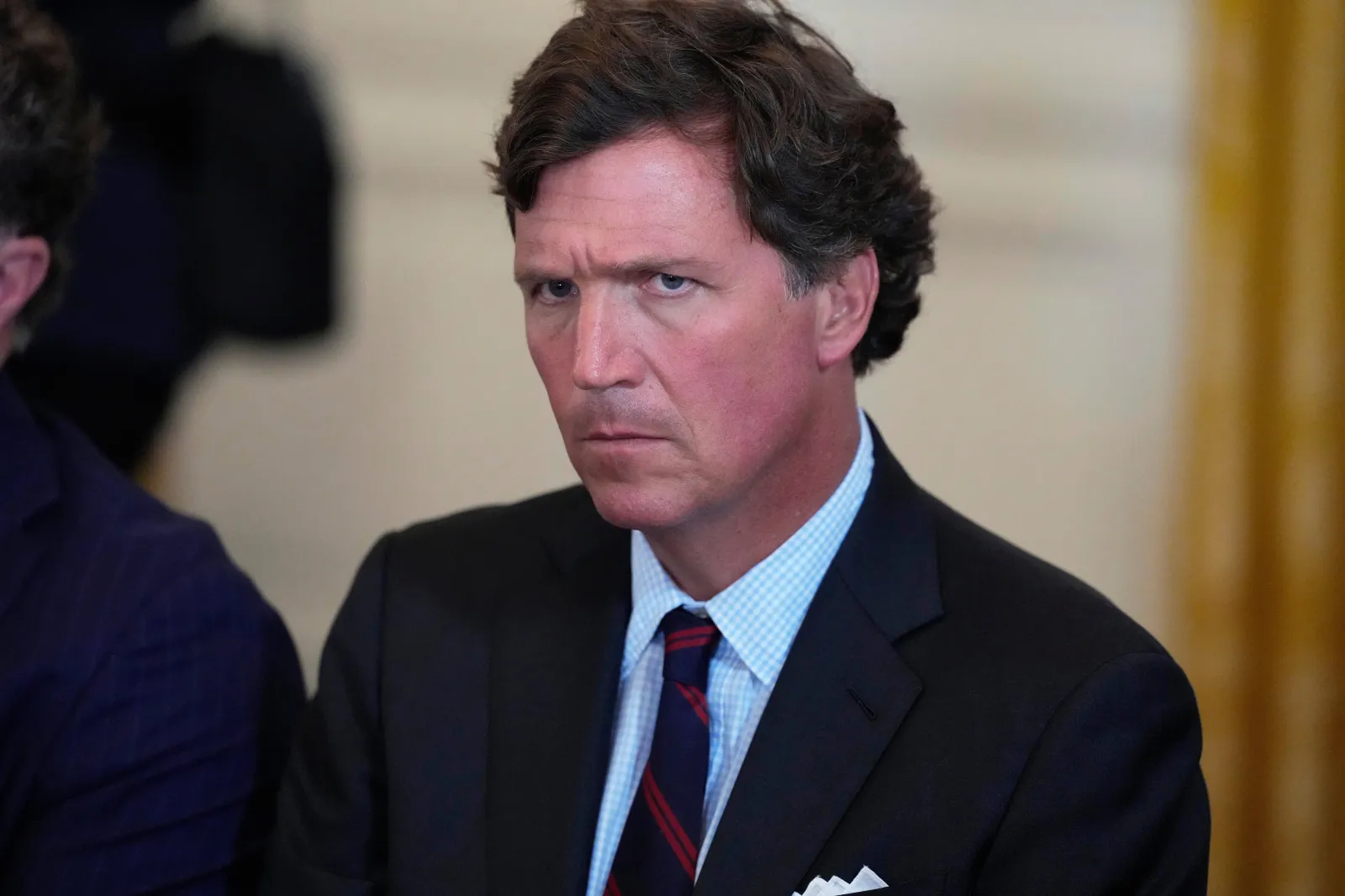
Conservative pundit Tucker Carlson says that presumptive incoming House Speaker Hakeem Jeffries risks hurting his own Democratic Party if he fails to forcefully challenge the U.S.-Israeli war in Iran.
Speaking to The Young Turks on Friday, Carlson said Jeffries now represents a broader coalition that includes former Trump voters who backed Democrats in the midterms. He argued that those voters were responding to the promise of sovereignty.
"He's [Jeffries] gonna hurt his own party, betray his own promises, because the only thing that really matters is keeping this war going," Carlson said.
Read More on Politics
The former Fox News host questioned why lawmakers aren't doing more to challenge President Donald Trump's military actions through congressional war powers.
“He [Trump] doesn’t have the right to initiate war under the Constitution. He doesn't. It needs congressional approval,” Carlson said. “But there's no appetite for that at all, including from the Republicans who just lost their seats because of the war.”
...
Newsweek reached out to Jeffries for comment Friday night.
Carlson Presses Jeffries to Oppose Iran War
Carlson's criticism comes as Jeffries has publicly called for the war to end and has left open the possibility of further congressional action.
When asked whether Democrats would pursue additional War Powers Resolution votes before the current congressional term ends, Jeffries said the matter was ‘under discussion,’ adding that Democrats would ‘take a look at the vehicles we have available to us."
Jeffries, who earlier this week was overwhelmingly nominated by House Democrats to become the next speaker, has called the conflict “reckless” and a “war of choice.”
“It should end today. It's been a disaster for the American people, it's skyrocketed costs,” Jeffries told reporters on Tuesday.

...
Iran has stepped up attacks on neighboring Gulf countries over the past week, striking a U.S. air base in Kuwait and launching several attacks on Bahrain. The escalation followed a U.S. strike on a missile launch site belonging to Iran's Islamic Revolutionary Guard Corps on Qeshm Island in the Strait of Hormuz.
Despite the escalation, oil exports from the Middle East remain about 80 percent of prewar levels, with much of the supply continuing to pass through the strait under U.S. protection.
Trump said Friday that Iran wants a deal to end the conflict but has yet to offer terms he would find acceptable, as concerns grow about a possible return to full-scale fighting.
"We want to make a real deal, not a fake deal that they've been doing for 51 years,” Trump said in the White House briefing room Friday. “They've been, they've been bull*****ing people for 51 years."
Democrats Weigh Using Funding Deadline to Pressure Trump
With Democrats set to take control of Congress in January, some lawmakers want to use the December 11 government funding deadline to pressure the Trump administration to end the war.
Maryland Senator Chris Van Hollen is leading the effort, joined by Senators Bernie Sanders, Michael Bennet and Tammy Duckworth.
“When we vote on appropriations, we intend to fund the government and stop funds for this war. It is what the American people demand, and what they deserve,” the senators wrote in a joint statement on November 12.
However, the strategy has divided Democrats, with some lawmakers concerned that using the funding deadline to force action on the war could complicate negotiations over keeping the government open.
Related Story

Democrats Weigh Shutdown Over Iran War But Some Warn Against the Risk
Carlson Warns of Growing Political Frustration
Carlson was asked about the prospect of Democrats using the funding fight to restrict money for the war. He returned to his argument that Jeffries risks alienating voters who backed Democrats in the midterms if the party does not follow through on its promises.
Carlson broadened his criticism to both parties, arguing that elections have done little to change government policy. "Elections don't have consequences. It doesn't matter who you vote for, you get the same outcome," he said.
He argued that wealthy donors have too much influence over government decisions, while ordinary voters see little response to their concerns. Carlson also criticized what he described as the use of accusations of antisemitism and racism to shut down debate over Israel and the war.
"One side is shut up anti-Semite. The other is shut up racist," Carlson said, arguing that such accusations prevent people from addressing the substance of political disagreements.
He suggested the country's political divisions were creating conditions for revolution, saying it was "begging for 1789," a reference to the French Revolution.
Contact Newsweek editors on this story: Samantha Beech, Edward T. Cummins and Steven Frank.
View 0 Comments
Submit Correction
View Editorial & AI Guidelines