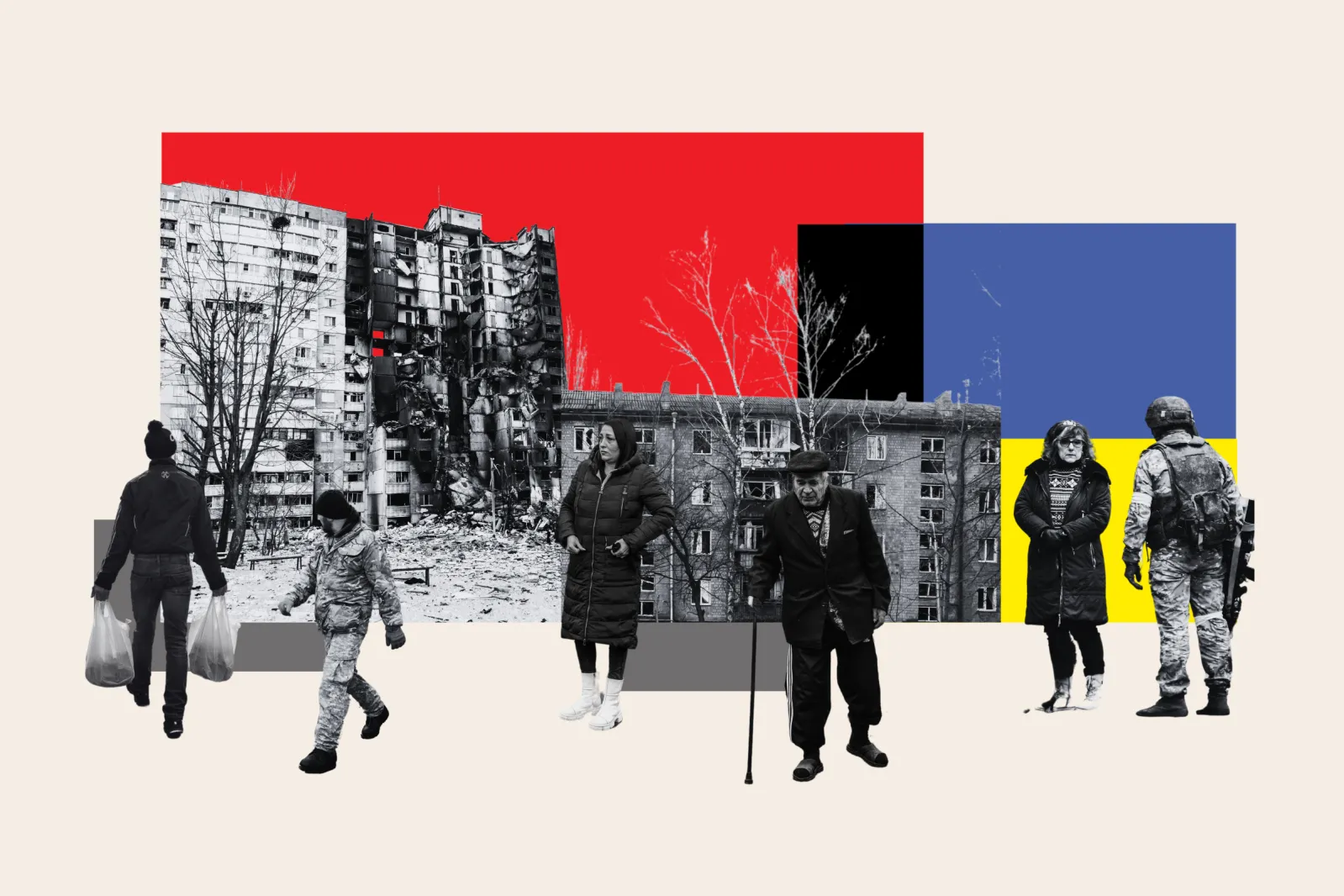
Photo-illustration by Newsweek/Getty/Ukraine Demographic Crisis Death-Rate 'Triple' of Birth-Rate

By Brendan Cole
Senior Reporter
0
Share
Newsweek is a Trust Project member
See more of our trusted coverage when you search.Prefer Newsweek on Googleto see more of our trusted coverage when you search.
Mortality in Ukraine this year is three times higher than the country's birth rate, according to data from Kyiv that shows how a growing demographic crisis worsened by Russia's full-scale invasion could hurt the country's postwar recovery.
Ukraine's population is reeling from the military and civilian casualties of Russian President Vladimir Putin's invasion but the key demographic factor affecting the country is the mass migration of people fleeing the war.
Migration combined with a reluctance among women to give birth during a time of conflict has created a perfect storm for Ukraine's future population. "All these challenges are coming at the same time," Patrick Gerland, the chief of the United Nations' population estimates and projections section, told Newsweek.
Read More on World
In the first half of 2024, 87,655 children were born in Ukraine, a 9 percent decrease from the same period last year, according to the Ukrainian website Opendatabot, which cited figures from Ukraine's Ministry of Justice. Newsweek has contacted the ministry for comment.
...
In the same period, 250,972 deaths were recorded, a few thousand shy of the 258,055 figure reported for all of 2023. "Currently, there are three deaths per newborn citizen," the report said, after translation from Ukrainian.
It added that while more people—349,041—died in the COVID-19-hit year of 2021, the death to birth ratio in Ukraine continues to increase. Between 2018 and 2020, there were two deaths per birth in Ukraine, and the report said the three-to-one ratio it has now reached was "one of the key indicators of a demographic crisis."
Martial law in Ukraine has restricted the release of government statistics, and the Opendatabot figures did not record any births in the partially occupied Luhansk region for the first six half of 2024, suggesting only partial information was available.
However, Gerland said that birth rates in Ukraine, which have been dwindling since the fall of the Soviet Union, have been exacerbated by the war.
"Millions of people are displaced internally, and there are also millions who have left the country," he said. "Many of these people who have left the country are women in reproductive age groups." While birth rates have been steadily going down in Ukraine and across much of Europe, "the conflict has been making the situation worse," he added.
From a prewar level of 43.5 million in 2021, Ukraine's population has shrunk to 37.9 million in 2024, with a large proportion in territories now occupied by Russia. Russian shelling across Ukraine has affected pregnant women and affected maternal and neonatal units struggling to deliver adequate care.
"Before the full-scale invasion, Ukraine was already facing a demographic crisis due to low fertility rates," Massimo Diana, the United Nations Population Fund's representative in Ukraine, told Newsweek. "Fast-forward to the normal impact of the war and its displacement of millions of people, many of whom have sought refuge overseas, this typically overburdens the family as a unit."
The stress of the war has further reduced birth rates by posing greater challenges for would-be mothers and increasing the number of premature births. "Women are the most disproportionately affected by a conflict," he said. "Ukraine is no exception to that reality, particularly for women of childbearing age who are either unable or unwilling to start their families under the conditions of war."
Diana also said the birth rate, which has plummeted below one child per woman, is a barrier to Ukraine's eventual reconstruction. He added that reconstruction would have significant social dimensions, such as the trauma experienced by returning troops and civilians.
"We tend to focus more on the hardware of the physical reconstruction," he said, referring the facilities that need to be rebuilt after a war, "but reconstruction by whom and for whom?"
Diana described Ukraine's demographic crisis as a "very significant challenge" because unlike the rebuilding of a damaged bridge, it would require policies, such as financial incentives and luring back the diaspora, which may not come to fruition for years.
Gerland said: "Hopefully, the conflict sooner or later will end. But then you have the challenge of to what extent the people who have left the country are going to return."

...
View 0 Comments
Submit Correction
View Editorial & AI Guidelines