
Newsweek/Getty/Viktor Hordiienko/Zarina Zabrisky

By David Averre
0
Share
Newsweek is a Trust Project member
See more of our trusted coverage when you search.Prefer Newsweek on Googleto see more of our trusted coverage when you search.
"Unfortunately, we will celebrate this day under drones, under artillery explosions and missiles. But we will definitely celebrate. We’ll grill kebabs."
Few statements could better sum up the perverse sense of joy amid terror experienced by millions of Ukrainians today, their Day of Independence.
These are the words of Viktor Hordiienko, a farmer in the Beryslav district of Ukraine’s embattled Kherson region. His farm, like those of his friends, has been attacked relentlessly by Russian drones. One of them killed his father, Oleksandr, last year.
Read More on World
Yet this is all the more reason to mark Ukraine’s independence with a proper celebration, Hordiienko told Newsweek.
"I believe this holiday is much more valuable than it was five years ago, for me and every Ukrainian," he said. "Before the war, we did not really understand what independence was. Now, we understand: freedom of speech, freedom of action, and free land. Words of independence are not empty to me."
Dancing With Death
On August 24, 1991, modern Ukraine secured its freedom from the Soviet Union with the "Act of Declaration of Independence of Ukraine." Now, its people are locked in another existential struggle against the Russian Federation under Vladimir Putin.
Nowhere is the struggle more apparent than in Kherson, a region divided by the Dnipro River. Russian forces now occupy almost everything south and east of the Dnipro, known as the "left bank."
Those living in the remaining 30 percent of territory north of the river—on the "right bank"—are technically free, but the challenges they face daily are unimaginable.

...
Svitlana, a 52-year-old resident of Kherson city on the edge of the Dnipro, told Newsweek that everyday errands have become a mortal game of chance, with Russian drone squads perched on the opposite side of the river, just a few hundred yards away.
"Every ordinary thing, going for a walk or a trip to get groceries, is a risk," she said. "At any moment you can become a target for a drone. It doesn’t care who you are or what business you are on; every movement is dangerous."
By noon on the day she spoke to Newsweek, Svitlana said at least six civilians had been wounded in drone strikes in Kherson city. The constant threat means even a simple trip to the shops leaves you feeling "like after a week of hard work."
The human mind is nothing if not adaptable, though, and the ubiquity of the Russian threat has forced many Khersonians to undergo a profound psychological transformation.
"The strangest thing is that you gradually begin to treat the abnormal as normal. You learn to work, sleep, plan meetings and even joke within this reality," said Oleksandra Knyha, a costume designer at Kherson’s Mykola Kulish Theater. "The feeling of fear becomes dull."

...
But live in Kherson long enough, and you’ll be served a reminder sharp enough to puncture the illusion of normality.
Zarina Zabrisky, a Ukrainian-American journalist and filmmaker, endured such a reminder the morning she spoke with Newsweek.
"F***, I’m sorry…I’m having a horrible day. People die a lot, but my close friends don’t die every day.
"You know, we have this yoga circle with people who lived through occupation. We go there regularly; it’s like an informal support group, just a circle of friends helping each other. One woman there was killed this morning."
Hunting for Human Game
Even by Khersonian standards, Zabrisky has seen more horror than most. Last year, she directed and produced the documentary film Kherson: Human Safari, which sought to expose the practice of Russian drone operators systematically targeting civilians.
She believes the scale of the atrocity in the occupied regions of Kherson surpasses that of Bucha, where Russian soldiers slaughtered civilians in the weeks following their failed assault on Kyiv. At least in Bucha, Zabrisky said, the dead could be buried once the invaders left.
"We have civilians killed almost every day…There's a burial crisis going on; there are bodies on the side of the road because the Russian drones don’t let Ukrainians approach the bodies. There are dogs eating the bodies."

...
According to the Human Safari Casualties tracker, launched by the Kherson regional government to document the heinous practice, the strike rate is worsening. In the first six months of 2026, the number of victims surpassed the total for all of 2024 and reached almost 70 percent of the total recorded in 2025.
Zarina tries to maintain contact with a few acquaintances in the Russian-controlled left bank, but says the occupiers have almost completely blocked communications and mined all roads in and out of the main settlements.
One person living in the occupied town of Oleshky across the river from Kherson city managed to get a brief message to her last week. It did not make for positive reading.
"There is no food delivery. No meat, no dairy, no eggs, no fish. No humanitarian aid. People eat what grows in the garden. There is no food for domestic animals, dogs and cats.
"Children are malnourished, people are starving."
'Will Ukraine Survive?'
Not every Ukrainian is forced to calculate the risk of a drone strike each time they leave home. But even for those living abroad, there is simply no such thing as out of sight, out of mind.
"Independence Day is very personal for me," Myroslava Gongadze, a policy consultant for the Congressional Ukraine Caucus and a senior fellow at the Atlantic Council, told Newsweek. "I remember once I was giving an interview after Ukraine’s Revolution of Dignity in 2014, when Russia invaded for the first time, and the correspondent asked me: ‘Will Ukraine survive?’
"At the time I couldn’t believe he was asking me this question. Back then, I didn’t understand the full extent of Russia’s malign intentions. Now, I realize just how important it was."
Russia’s full-scale invasion in 2022 was, according to Gongadze, "the culmination of Russia’s imperial ambition to control Ukraine" after the Kremlin was unable to subjugate Ukraine via other means.
"First, they tried by controlling the government through extortion and corruption. They tried to install their own puppet regime via [former Ukrainian President Viktor] Yanukovych. Then they invaded because they simply cannot live with the idea that Ukraine would be an independent state," she said.
"But this war is also the culmination of Ukraine’s efforts to push back and take control over their own destiny."
Related Story
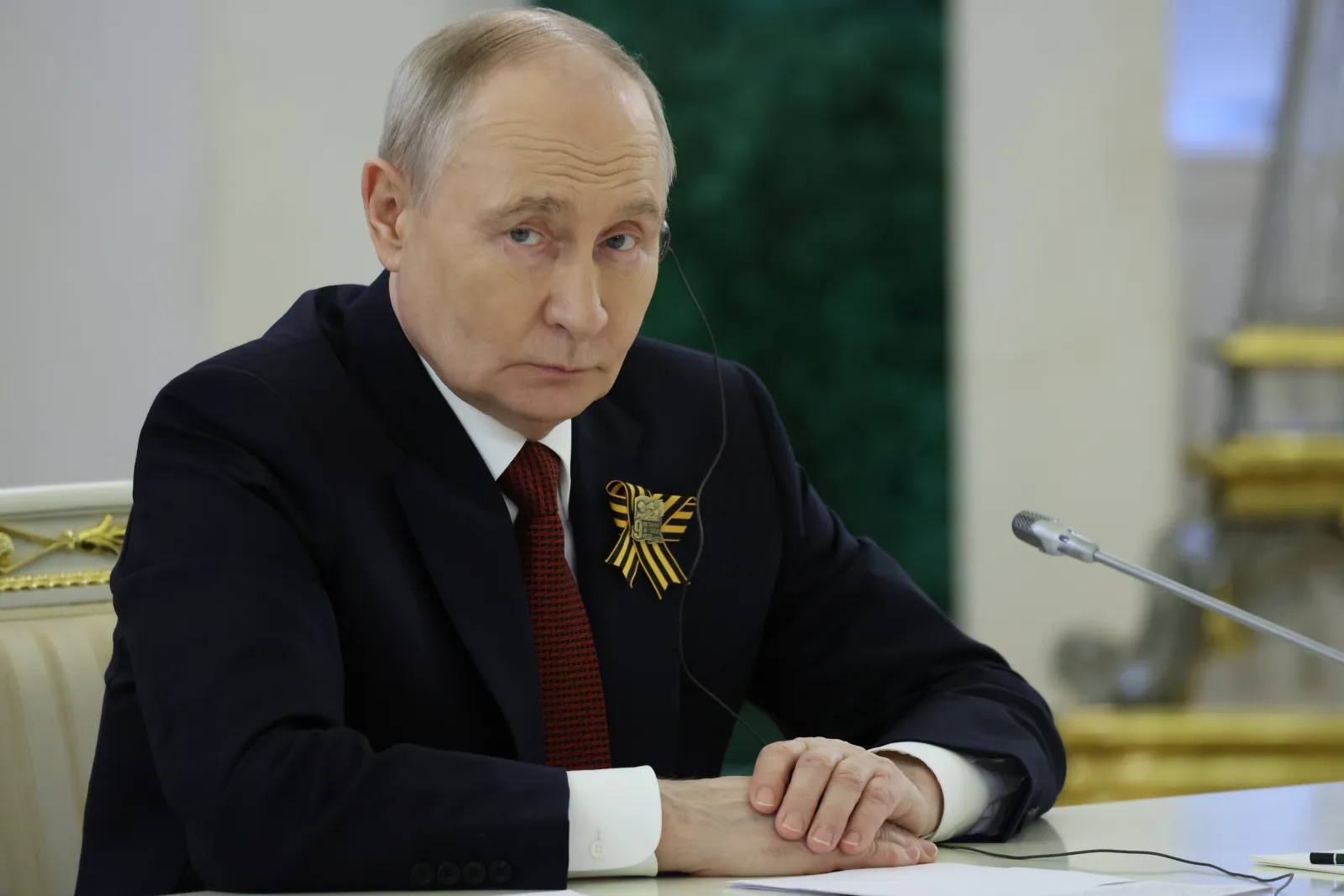
Putin Can’t Stop Russians Peeking Behind the Curtain Forever
Four-and-a-half years into the full-scale invasion, the question Gongadze once found so startling underscores why Ukrainians like Hordiienko feel they have something to celebrate: the state survived.
When Russian tanks first crossed the border in February 2022 and headed for Kyiv, most expected the city to fall in a matter of weeks.
Yet, Kyiv remains the capital of an independent Ukraine. The country has built a broad international coalition behind it and, despite its continuing battles with corruption and institutional weakness, is arguably a stronger state today than at any other point since it gained independence.
Orysia Lutsevych, head of the Ukraine Forum at the Chatham House think tank, said this sentiment is of particular importance for the Ukrainians who remain under Russian occupation.
"If Kyiv was controlled by Russia, there would be no glimmer of hope, but that's not the case, and there is a chance for these occupied territories to be liberated. It's worth having the celebration to remind people, both in Ukraine and beyond, that Ukraine has survived despite being under so much pressure," she told Newsweek.
"It sounds cliché, but nations are forged in fire and resistance against what it is not. Russia is what Ukraine is not, and that's what we're fighting against."

...
'We Breathe the Free, Fresh Air of Ukraine'
Survival alone, however, is not enough. Not for those living on the front line, nor those advocating for Ukraine on Capitol Hill.
"The world can no longer see Ukraine merely as a former Soviet republic," Gongadze said. "Ukraine is actively trying to defend the democratic values that the U.S. and Europe have been trying to instill in the world."
For her, the best way Ukraine’s allies can mark the anniversary is to keep ensuring the country has the means to remain independent. For Hordiienko, back in Kherson, celebrating Independence Day is a simple act of defiance.
"Every day I get up and go to the field and grow bread, now with a weapon," Hordiienko told Newsweek. "I will continue to do this, as my father did, as our boys in Kherson do, no matter what, even though I work with the guys every day in mined fields and under attacks by Russian drones.
"Of course, it is very scary and very painful that the left bank of Kherson is occupied, but we will do everything to return it to Ukraine. I still believe that we will reclaim our territories, because God is with us, our army is with us, the whole world is with us.
"As my father Oleksandr Hordiienko used to say, we breathe the free, fresh air of Ukraine."
Zabrisky had a slightly more pragmatic take.
"Independence is very important, and that's what Ukrainians are fighting so hard for, but it can only be of use if you're alive. If you're dead and the dog is eating you, it doesn't matter whether you're independent.
"Actually, I guess it does still; at least you died independent!"
View 0 Comments
Submit Correction
View Editorial & AI Guidelines