
Newsweek/AP/Getty

By David Averre
0
Share
Newsweek is a Trust Project member
See more of our trusted coverage when you search.Prefer Newsweek on Googleto see more of our trusted coverage when you search.
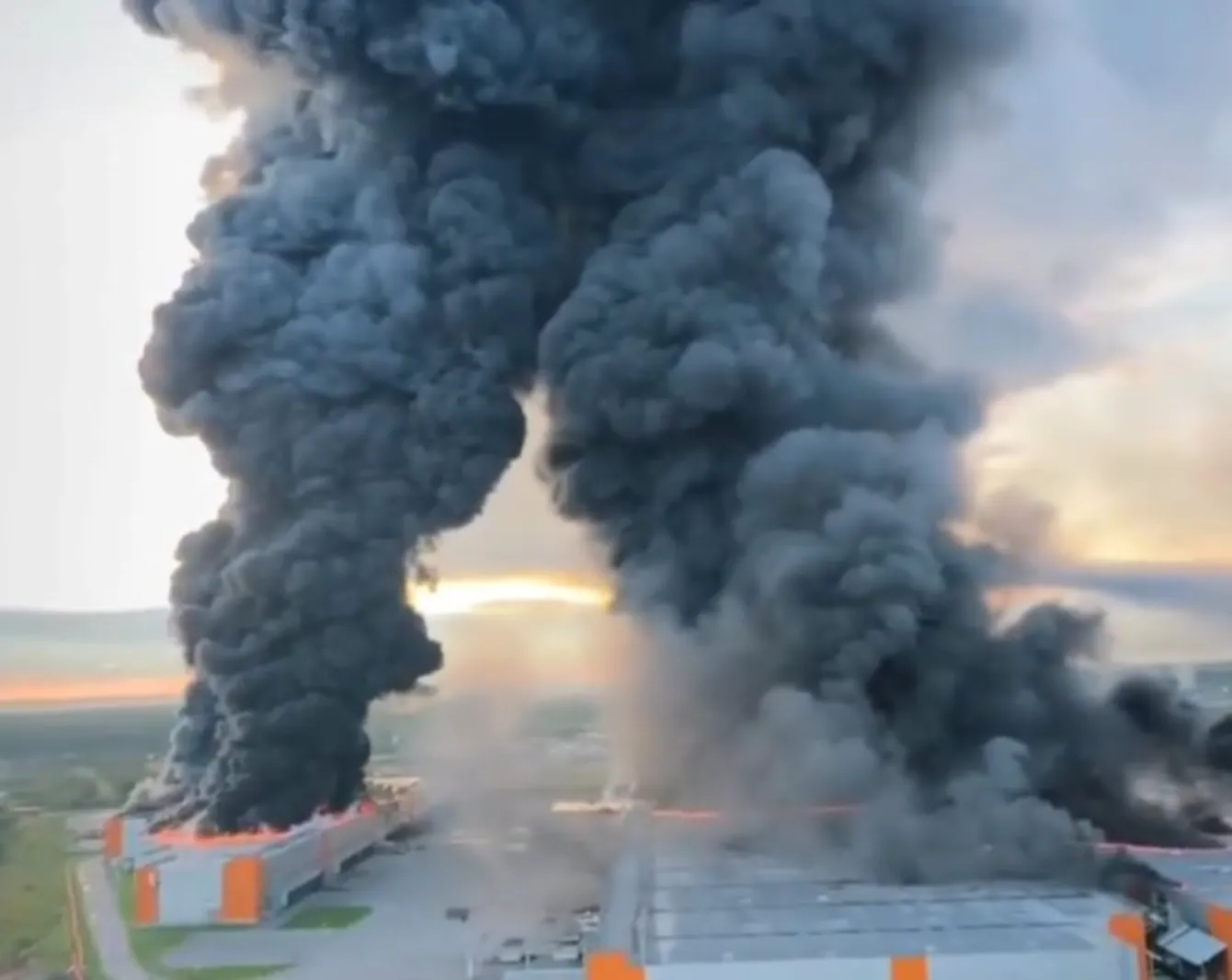
Ukraine’s armed forces continued their devastating campaign against Wildberries early this morning, striking three more warehouses and logistics facilities linked to the Russian e-commerce giant near Moscow, St. Petersburg and Tver.
Russian media said on July 23 that up to 10 percent of the retailer's logistics capacity, or 5.9 million square feet of warehouse space, had been damaged by Kyiv’s drones, with roughly eight percent left completely unusable. Ukraine’s drone operators have landed at least 10 more strikes on Wildberries facilities since those figures were published.
The impact of the strikes on the "Russian Amazon" for consumers, businesses and the wider economy is quite difficult to assess, but perhaps a better way to try and gauge the consequences is to bring it closer to home.
Read More on Analysis
What would happen if 10 percent or more of Amazon warehouses and logistics centers in the U.S. suddenly burst into flames? With the help of some supply chain experts and a bit of back-of-the-napkin math, Newsweek found out.
The Numbers
Amazon does not publish a single definitive figure for the size of its American warehouse network, and its regulatory filings group logistics facilities together with data centers and other property.
However, location and real estate data compiled by industry intelligence platforms puts Amazon’s warehouse and logistics footprint at roughly 445 million square feet, spread across more than 600 facilities.
Using that estimate, a 10 percent loss of capacity would mean taking about 44.5 million square feet of logistics space out of action—an area bigger than New York City’s Central Park, or the size of 770 football fields.
...
Of course, not every Amazon warehouse handles the same number of orders, and the size and importance of each facility varies. A square foot of logistics space in a multifloor robotics center in California or Texas focused on meeting same-day and next-day delivery orders is far more valuable in raw productivity terms than a square foot in a small fulfillment center in Wyoming, for example.
But Ukraine’s drone strike campaign has focused overwhelmingly on key Wildberries facilities in Western Russia around the likes of Moscow, St. Petersburg, and Krasnodar—locations that serve large population centers.
A comparable American scenario would therefore not simply involve 10 percent of Amazon’s buildings disappearing at random; it would mean major facilities serving the country’s largest urban markets bearing the brunt of the damage.
Amazon said that more than 8 billion items reached U.S. Prime members on the same day or the next day during 2025. If we say the damaged 10 percent of total logistics space belongs to larger, more important facilities, that suggests roughly 2.2 million items could be delayed or canceled every single day.
The Impact
The intensity of the disruption and the speed at which it could be felt by the American consumer would depend on three things: where the damage occurred, what type of facilities were hit, and how long they remained offline.
Unlike Wildberries, which relies on a small number of centralized megahubs to collect, pack and ship orders across Russia, Amazon operates a vast, decentralized network of different facilities designed to prevent any one part of the network from becoming a single point of failure.
Amazon divides the mainland United States into eight regional networks, each with various overlapping routes to get a product from the online checkout to the customer’s doorstep. The company says that 76 percent of orders are fulfilled by warehouses within the customer’s own region, but Amazon’s data intelligence platforms constantly track where products are stored and how busy each warehouse is, allowing orders to be shifted to another facility when problems arise.
Basically, if one warehouse goes down, most orders can be sourced elsewhere or sent around it with little to no delays. So, a 10 percent drop in logistics capacity would probably mean inconvenience before outright disaster for Amazon customers.
"Say goodbye to same-day and next-day deliveries. Orders will arrive late, and they'd be split across different shipments. Popular products will become temporarily or indefinitely unavailable, and your order visibility and tracking would go offline," Seçkin Özkul, Director of the University of South Florida’s Supply Chain Innovation Lab, told Newsweek.
This resilience has limits, however.
"The real vulnerability is not so much one big distribution facility going offline, it’s the cascading effect of multiple failures on the rest of the network. If more than one large facility goes offline in the same region, those failures overload the other logistics hubs that are supposed to take up the slack," Özkul said.
"This is where we would see a major impact very quickly. Delays and cancellations occur more widely, and the main thing no one wants, which is raised prices. As soon as that happens, consumers start to feel the effects and sellers that rely on Amazon start to collapse."
Bringing the War To Russia’s Shopping Basket
Wildberries lacks the scale and decentralized network of Amazon, and is therefore more vulnerable to strikes on key hubs.
"For Wildberries, disruption to a concentrated regional hub can have a disproportionately larger local effect which would probably last a lot longer, with wider ripples, than for Amazon," Usha Haley, Distinguished Chair in International Business & Kansas Faculty of Distinction at Wichita State University, told Newsweek. "The broader impact would depend on how much of the distribution network has been disrupted and how quickly capacity can be restored."

...
Wildberries is reportedly seeking around 1.1 million square feet of warehouse space in Kazakhstan, partly to move capacity beyond the reach of the strikes. But this would replace less than 20 percent of the 5.9 million square feet Russian media says has already been damaged or destroyed.
Whatever the true cost for Wildberries, the strikes on its infrastructure apply a different kind of pressure. Until very recently, Ukraine has concentrated on attacking Russian military targets, and the oil and gas refineries that constitute the main source of funding for the Kremlin’s war effort. Now, Kyiv’s military planners are trying a new approach—to make the wider Russian society feel the bite of war.
Whether this translates into meaningful political pressure on President Putin remains to be seen, but the immediate outlook for Russian consumers and businesses is bleak.
"Of course, consumers will not want to face raised prices, or find that popular products are simply no longer available. But third-party sellers that rely heavily on Wildberries to ship their orders will see a big loss in their sales, along with some destroyed inventory and maybe even delayed payments," Özkul said.
"The biggest losers here would be the small and medium-sized businesses, the mom and pops, because as soon as there's a loss of inventory and an increase in prices, they simply can't manage the cash flow… When order fulfillment becomes an issue, the small sellers that rely on one service provider will die out first.
"This in itself highlights the risk of relying heavily on a single supply chain or a single supplier—that goes for small businesses reliant on Wildberries or Amazon, up to huge companies and even world powers. Sometimes, though, you simply don't have a choice. You just have to cross your fingers."
View 0 Comments
Submit Correction
View Editorial & AI Guidelines