...

By Ryan Chan
China News Reporter
0
Share
Newsweek is a Trust Project member
See more of our trusted coverage when you search.Prefer Newsweek on Googleto see more of our trusted coverage when you search.
The United States deployed additional stealth fighter jets to Japan on Saturday as President Donald Trump questioned the Northeast Asian security ally for not having to "protect us."
Newsweek has reached out to the Japanese Defense Ministry for comment by email.
Why It Matters
Japan has an important role in America's Indo-Pacific strategy. It forms part of the first island chain under Washington's defense concept, seeking to constrain military activities by U.S. adversaries in the Western Pacific Ocean with allied and friendly territories.
Read More on World
The U.S. military maintains bases in Japan for hosting its forces, such as an aircraft carrier and fighter jets, for potential emergencies in the Taiwan Strait and the Korean Peninsula.
Trump, who met Japanese Prime Minister Shigeru Ishiba last month and claimed to have a "great relationship" with Japan, said on Thursday that the U.S.-Japan security treaty signed in 1960 was not reciprocal: "We have to protect them but they don't have to protect us."
What To Know
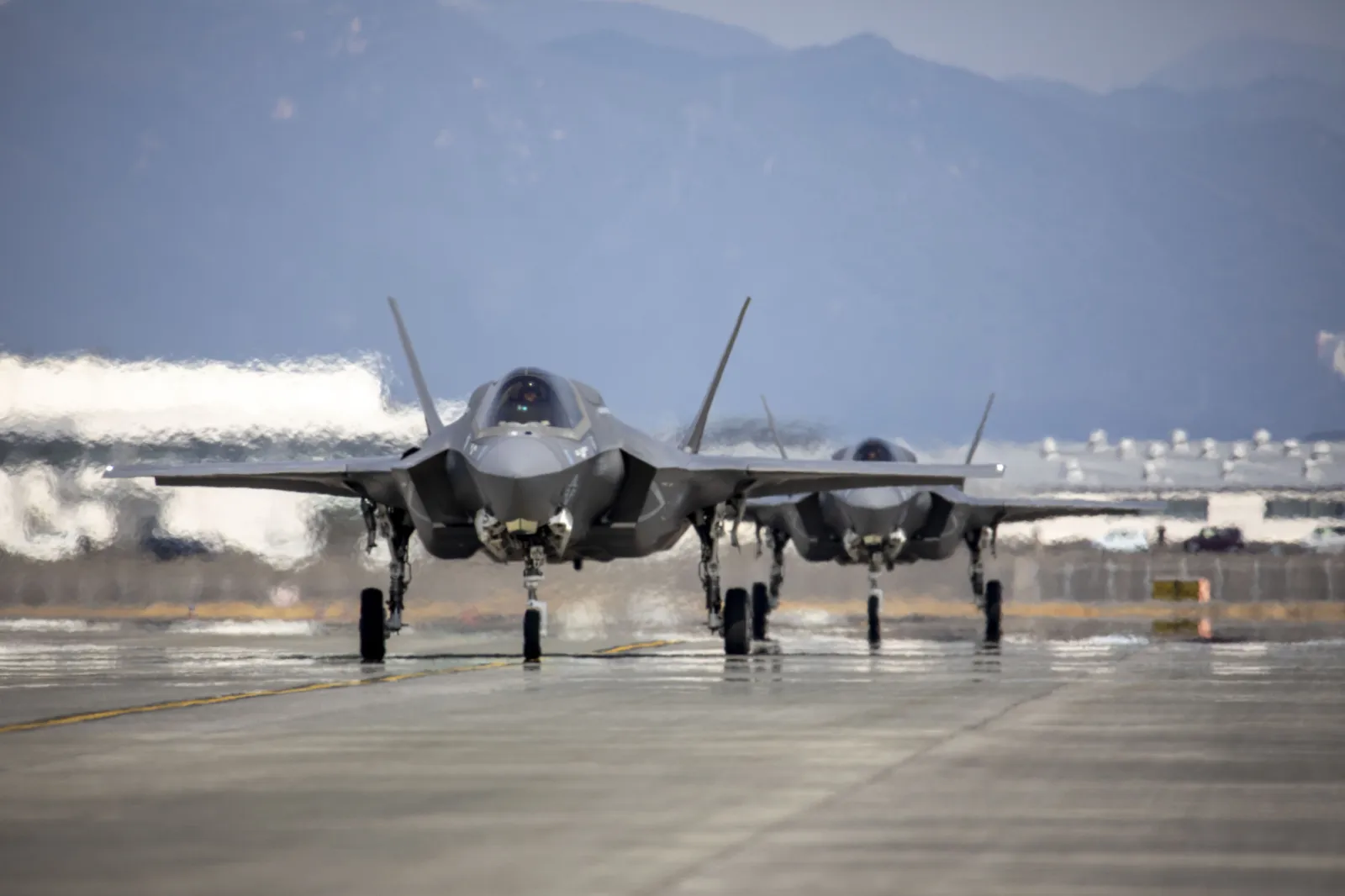
A group of U.S. F-35B fighter jets, originally based at Marine Corps Air Station Yuma in Arizona, deployed to Marine Corps Air Station Iwakuni in Japan for a temporary deployment, said the 1st Marine Aircraft Wing, an aviation unit of the U.S. Marine Corps.
The Marine Fighter Attack Squadron 214, which sent the fighter jets to Japan, became the first F-35B squadron to take part in this rotational mission known as the Unit Deployment Program, which augmented the U.S. Marines' aviation forces in the Indo-Pacific region.
The temporary deployment program provides continental U.S.-based units with experience of operating in the Indo-Pacific region, the 1st Marine Aircraft Wing said in a press release.
...
The Marine Aircraft Group 12, which is one of the 1st Marine Aircraft Wing's subordinate units, maintained two other F-35B squadrons in Japan before the arrival of the new aircraft.
This marked the transition of the so-called fighter jet generation for the Unit Deployment Program; this previously involved the less advanced, fourth-generation aircraft such as the F/A-18 and the AV-8B. The radar-evading F-35B jet is classified as the fifth generation.
The F-35B aircraft, which is capable of conducting short takeoff and vertical landing, is one of the three F-35 stealth airframe variants. The F-35A is built for operating from conventional runways, and the F-35C is designed for deployment aboard aircraft carriers.
China revealed two new stealth combat aircraft last November, as well as a pair of the sixth-generation aircraft prototypes the following month, which are expected to be superior to the fifth generation.
What People Are Saying
U.S. Marine Corps Major General Marcus Annibale, commanding general of the 1st Marine Aircraft Wing, said in a press release on Saturday: "As more F-35 squadrons deploy to the remote and contested environments of the Indo-Pacific, Marine Aviation's readiness will grow, and our capabilities as a combined force in this region will become even more lethal."
U.S. Marine Corps Colonel Kyle Shoop, commander of the Marine Aircraft Group 12, said in a press release on Saturday: "An additional F-35B squadron increases Marine aviation's contribution to operations in the Indo-Pacific with joint forces, allies, and partners alike from established and scantily developed locations for distributed operations."
What Happens Next
It remains to be seen whether the Pentagon will deploy further advanced units to Japan following Trump's remarks. In addition to the deployment of the third F-35B squadron, a laser-armed American destroyer, USS Preble, changed its home port to Japan last October.
View 0 Comments
Submit Correction
View Editorial & AI Guidelines