...

By Ellie Cook
Senior Defense Reporter
0
Share
Newsweek is a Trust Project member
See more of our trusted coverage when you search.Prefer Newsweek on Googleto see more of our trusted coverage when you search.
The U.S. is now using cheap drones in combat, embracing a new style of warfare honed above the battlefields of eastern Ukraine while still firing its top-of-the-line missiles.
One of the American weapons debuted for the first time in combat is the Low-Cost Uncrewed Combat Attack System (LUCAS), a one-way attack drone with a price tag of $35,000.
It is a fraction of the cost of sophisticated precision missiles the U.S. has often used, like Tomahawk cruise missiles. The head of U.S. forces in the Middle East, Admiral Brad Cooper, has already lauded the drone as "indispensable" since it debuted early in the U.S.-Israeli bombardment of Iran, now in its fifth week.
Read More on World
Western militaries have closely watched the fast-paced drone war that has dominated the war in Ukraine since Russia invaded in February 2022.
...
The world quickly saw that expensive air defense missiles, costing several million dollars apiece, can't be used to take out barrages of drones worth just tens of thousands of dollars for any length of time.
More simplistic drones can also be effective against vital targets like power grids or government buildings, whereas the high-end, often scarcer missiles can be saved for attacks on well-defended military sites.
But until now, U.S. forces didn't typically use lots of throwaway, explosive drones to overwhelm an enemy's air defenses—or have much experience intercepting drone barrages launched from Iran for weeks on end.
"This is the first time the U.S. has used large numbers of low-cost drones," said Robert Tollast, a research fellow in land warfare at the U.K.-based defense think tank, the Royal United Services Institute (RUSI).
The past few weeks "reflect a change in tactics," both for operations targeting Iran and how the U.S. is defending its bases and Gulf allies, said Mark Cancian, a retired U.S. Marine Corps Reserve colonel and a senior adviser with the U.S. think tank Center for Strategic and International Studies.
But countries like the U.S. don't need to turn entirely to quantity over quality. Ukraine, bound by restrictions on very limited numbers of donated long-range, high-tech Western missiles and without a fearsome air force, had to develop cost-effective ways to continually hit Russian targets. Tehran and Moscow have faced their own problems in rolling out cutting-edge, highly effective kit.
"Contrary to, say, Russia or Iran, the USA is not forced to use relatively expensive, sophisticated and hard-to-produce missiles," said Frederik Mertens, a strategic analyst with the Dutch think tank TNO. But neither does it have to depend entirely on drones sat on the lowest rung of the pricing ladder, he said.
U.S. forces have the luxury of significant stockpiles of powerful but not eye-wateringly expensive bombs, including free-falling weapons that can be easily fitted with guidance kits to reliably hit a target from an aircraft.
There will always be a place, too, for the most advanced weapons, and America is a world leader in churning them out.
Even so, Mertens told Newsweek, one-way attack drones are certainly useful when staring down a formidable enemy's air defenses, distracting an adversary to stop them taking out the most destructive incoming threats.
"The crux is in what is the best mix of systems considering your own and your enemies’ capabilities," Mertens said.
But the U.S. isn't launching its cheap drones en masse—at least, not on the same scale as Russia, Tollast told Newsweek.
Nearly 1,000 Russian drones bore down on Ukraine within just 24 hours in late March, killing at least seven people. It was the largest drone assault over a single day since the war started, with UAVs careening into Ukrainian buildings in broad daylight.
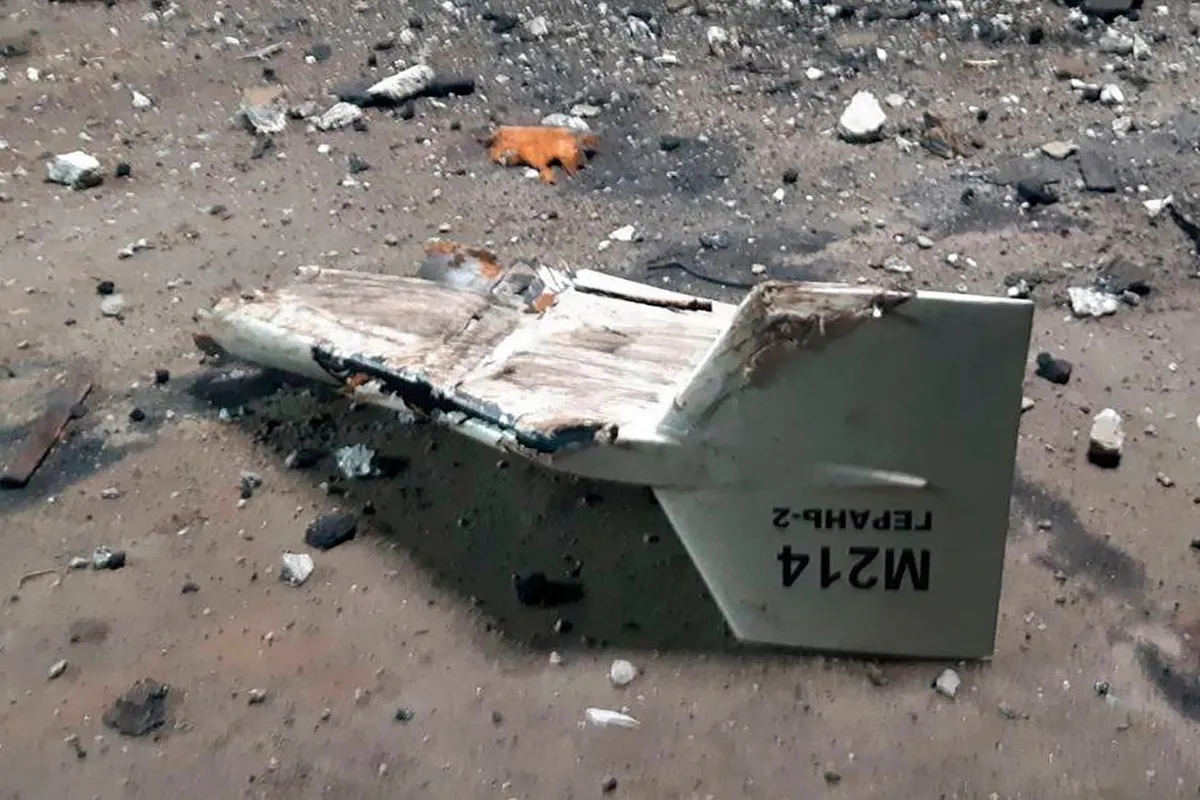
"The Russians took this brilliantly simple Iranian idea of a super cheap platform for a bomb, the Shahed-136, and kept souping it up," Tollast said.
The Shahed-136 is the larger version of the Shahed-131, and Iran later developed the Shahed-238, a jet engine-powered iteration able to fly twice the speed of the earlier models.
Iran and Russia have upgraded the initial designs multiple times, including making them harder to jam—when electronic defenses cut off the drone off from the signals controlling the device, like its flight path—and added dark paint to make them harder to spot.
"Now the U.S. has gone further, because they can easily access some very impressive space-based capabilities for navigation, as well as on-board computing," Tollast said. "This is much harder for Tehran and Moscow to pull off."
View 0 Comments
Submit Correction
View Editorial & AI Guidelines