
...

By Jasmine Laws
Reporter
0
Share
Newsweek is a Trust Project member
See more of our trusted coverage when you search.Prefer Newsweek on Googleto see more of our trusted coverage when you search.
The U.S. workforce is aging, and workers who are 55 or older have been the fastest-growing age group in the labor force for more than two decades, according to new research by the U.S. Census Bureau.
Those aged 55 or older made up almost a quarter (24 percent) of the U.S. workforce in 2022, which was up from 10 percent in 1994. The data also revealed which industries have greater concentrations of older workers than others.
Why It Matters
There is growing concern about America's aging population as a whole, particularly in light of the declining birth rate. The issue has been at the forefront of the Trump administration's political agenda, and President Donald Trump has brought in new policies trying to support and encourage Americans to have more children.
Read More on News
According to a study published by Nature, the country lacks the infrastructure and services to meet the needs of its aging citizens, with some communities more affected than others.
...
What To Know
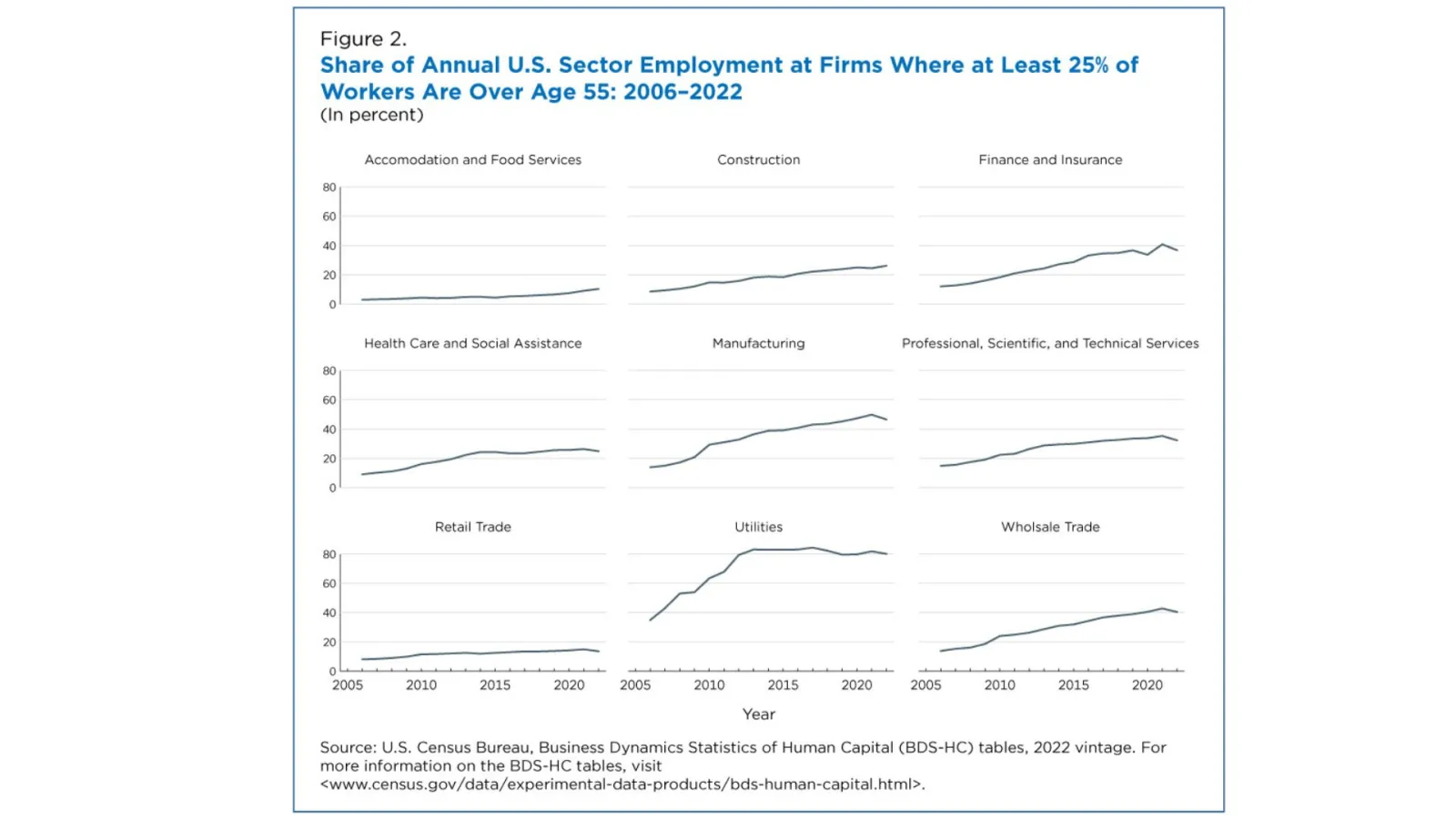
The U.S. Census Bureau data showed that in the utilities sector, the share of employment at firms with at least a quarter of their workers over age 55 went from 33 percent in 2006 to 80 percent in 2022.
A similar pattern was recorded in manufacturing and wholesale trade, industries which also had a notable increase in the share of employment at firms with at least a quarter of their workers over age 55—from 14 percent in 2000 to over 40 percent in 2022.
Other industries like health care and social assistance have also seen a rise in the number of firms where workers aged 55 make up at least 25 percent of employment, as has the finance and insurance industry and professional, scientific and technical services.
In comparison, the retail trade, accommodation and food services sectors have had relatively few firms employing a high share of older workers, with those over the age of 55 making up 14 percent of the overall employment in the retail trade and 10 percent in the accommodation and food services industry.
...
Certain states also had more notable aging workforces, the U.S. Census Bureau data indicated, which often aligned with the median population age of the state.
In Maine, the median age of the population in 2022 was the highest in the nation, at 44.7. The state also had the highest share of firms which had a 25 percent or higher employment of those aged 55 or over—at 39 percent of firms.
That share comparatively was 14 percent in Utah, which was the lowest share in the country, and the state also had the lowest median population age, of 32.
Other states with higher median population ages (between 39.1 and 40.9), and higher shares of firms with at least 25 percent of their workforces being 55 or older, included New York, Pennsylvania and Illinois.
Younger states like California (2022 median population age 37.8) and Texas (35.6) also had a smaller share of firms with the same concentration of older workers.
What Is Behind the Aging Workforce?
The country's aging work force is likely down to a number of factors. "People are living longer while fertility rates are dropping, so the population as a whole is also getting older which means there are fewer younger workers entering the labor market," Matt Piszczek, a professor of management at Wayne State University, told Newsweek.
He said that on average people living longer means they are also "healthier and physically able to work longer."
"At the same time, many older workers cannot afford to retire and end up working longer than they want to. So we have fewer younger workers entering the labor force and more older workers staying longer," he said.
Alongside changes to birth and fertility rates, and increases in life expectancy, immigration also plays a role, Peter Berg, a professor of employment relations at Michigan State University, told Newsweek.
"Immigrants tend to be younger, so they add youth to the population and workforce. We are currently restricting immigration which contributes to aging," he said.
Looking at why certain industries have a greater proportion of older workers, Piszczek said that industries like manufacturing are "hiring fewer entry level workers, who tend to be younger, due to technological advances."
"Overall it is a combination of labor market supply and demand. Some industries have a better match between older workers’ needs, preferences, and skills with what employers need out of their employees," he said.
Also, industries with "longer employee tenure will age faster than industries where turnover is high," such as food service and retail, Berg said.
What People Are Saying
Matt Piszczek, a professor of management at Wayne State University, told Newsweek: "The impact is substantial. Organizations may need to redesign work around the needs and preferences of older workers, and they will have more difficulty managing retirements because they will be more spread out but less predictable. But the impact on workers is also huge.
"For many workers, working longer is a necessity and not a choice. Many of the jobs we see older workers in—specially those who would rather retire—are low-quality jobs that have unpredictable hours, low pay, or are physically demanding. There are also major policy implications for managing social security."
Peter Berg, a professor of employment relations at Michigan State University, told Newsweek: "Labor force growth is restricted in an aging workforce because fewer young people are entering the labor force. This is associated with lower economic growth. Also, fewer young people in the labor force results in fewer workers to pay into social security which puts pressure on social security solvency.
"Productivity growth can also be affected by the lack of young workers entering the labor force. Particularly industries that rely on younger, more physical labor."
What Happens Next
Research has suggested that by 2030, one fifth of America's population will be over 65, having significant impacts on the country's workforce as well as potentially straining certain services.
Update 12/9/25, 9:41 a.m. ET: This article has been updated with comment from Peter Berg and Matt Piszczek.
View 0 Comments
Submit Correction
View Editorial & AI Guidelines