10
Loading video...

By Ellie Cook
Senior Defense Reporter
0
Share
Newsweek is a Trust Project member
See more of our trusted coverage when you search.Prefer Newsweek on Googleto see more of our trusted coverage when you search.
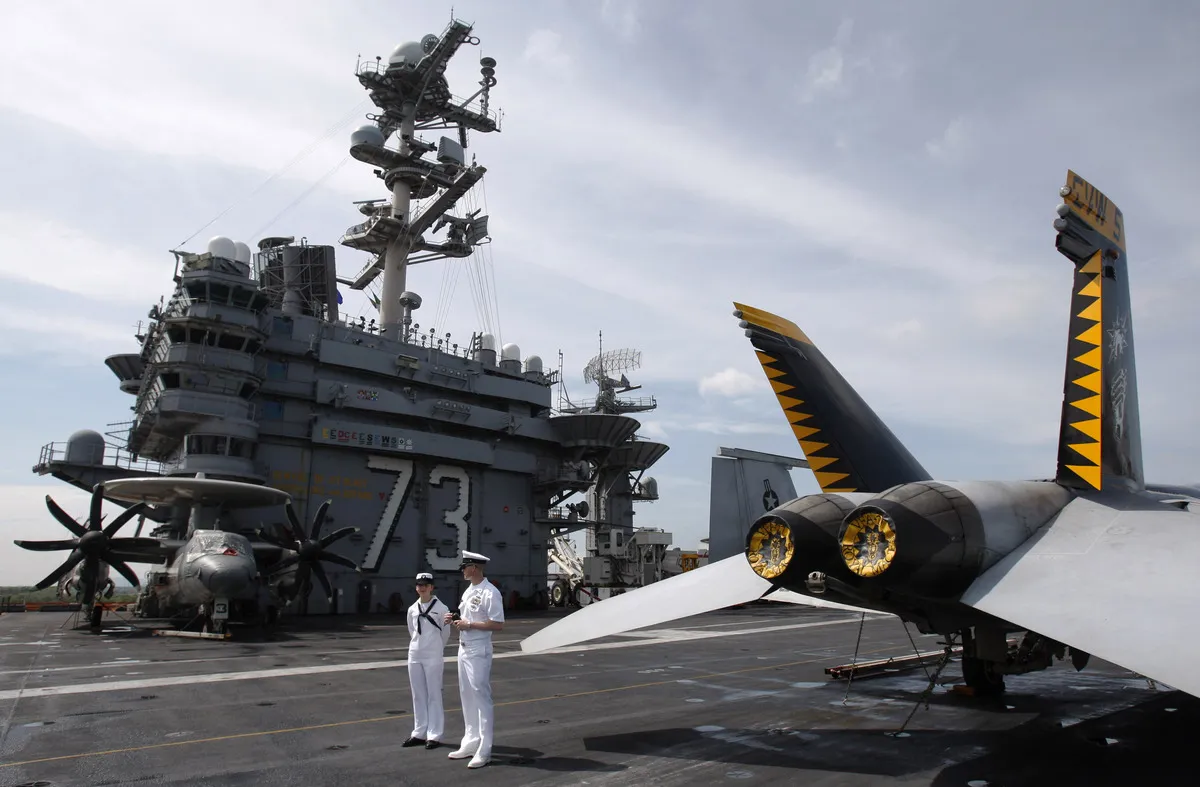
Moving the USS George Washington from the Pacific to the Middle East will pose a "national security risk" to the United States, a former commander on the aircraft carrier has said, as the final carrier deployed in Asia becomes the latest U.S. Navy ship to be sucked into the war with Iran.
The George Washington is expected to relieve the crew of the USS Abraham Lincoln. The Lincoln has found itself the focus of Democratic calls for investigations into reports of dwindling supplies and poor mental health among the roughly 5,000 sailors and Marines who have not set foot on land since December, which has put fresh attention on living conditions aboard U.S. Navy ships.
They also raised concerns that the U.S. Navy, while powerful, is overly stretched by the months of war in the Middle East and not prepared enough for a potential future confrontation with China.
Read More on World
Redeploying the Washington to the Gulf will leave the U.S. "with limited naval presence" for over a year and a half, because the carrier will return for a maintenance stint once it's finished in the Middle East, said retired Rear Admiral Mark Montgomery, a former commander of Carrier Strike Group 5 aboard the Washington who also headed operations for the U.S. Pacific Command.
"This is a national security risk as it sends a weak deterrence message to China and does not assure America's allies and partners in the Pacific," Montgomery, who is now with the Washington, D.C.-based Foundation for Defense of Democracies think tank, told Newsweek.
...
The U.S. Navy referred questions to the U.S. Pacific Command, which, like the White House, directed queries toward the Pentagon.
The Department of Defense doesn't comment on topics it says would compromise operational security, and a Pentagon official said the department "maintains the capability to respond to global contingencies while meeting our commitments to allies and partners in the Indo-Pacific."
President Donald Trump and his administration have signaled to U.S. allies that their defense spending must surge so the U.S.'s forces can be freed up to meet the threat posed by China's burgeoning, sophisticated military.
The White House, while insisting it's focusing on the Indo-Pacific, has piled pressure on Japan, Taiwan and South Korea to invest in their militaries and has often rattled officials in their capital cities.
Related Story
What the Trump-Erdogan Call Reveals About the New Middle East
Trump abruptly scaled back planned U.S. military drills with South Korea on Sunday, just hours before wargames largely focused on how to tackle North Korea kicked off. The president said the exercises, which Pyongyang condemned, were "totally inappropriate and hostile” to North Korea while also blaming the eleventh-hour change on Seoul's unwillingness to join the U.S.'s war against Iran.
In May, Trump worried Taiwanese lawmakers by appearing to use weapons sales to Taipei, which are vital for Taiwan's armed forces, as a bargaining chip with Chinese President Xi Jinping.
Beijing considers Taiwan, a self-governing island since 1949, to be a breakaway part of China and has pledged to bring the territory back under its control, including by using military force. The U.S. has long supported Taiwan with aid and weapons, but doesn't officially recognize Taipei because it adheres to the "One China" principle.
U.S. officials have said Xi wants China's armed forces to be able to be ready to invade Taiwan by 2027, even if war plans are not put into motion around that date.
China already has a formidable military force, including a nuclear arsenal, while the Chinese People's Liberation Army Navy (PLAN) now has more ships than the U.S. Navy. Chinese ships and planes are outfitted with advanced, long-range missiles, and its nuclear program is under few restrictions.
Beijing "is quite happy with U.S. distraction, with the frustration of U.S. allies and partners," Greg Poling, director of the Southeast Asia Program at the Center for Strategic and International Studies (CSIS) think tank, told the Associated Press.
Related Video

01:25
Officials Demand USS Abraham Lincoln Investigation as Families Raise Alarm
The Washington's Journey
By Thursday, the Washington was moving through the Singapore Strait, according to the U.S. Navy.
An unnamed official speaking to the Associated Press said the ship was transiting the Strait of Malacca, just north of the Singapore Strait, late Thursday evening.
The Strait of Malacca joins the Pacific Ocean to the Indian Ocean. When the Lincoln was redirected toward the Middle East, it also passed through the Strait of Malacca toward the Indian Ocean.
The U.S. said the Washington was in Guam in mid-June and was tracked operating in the Philippine Sea by early July. The carrier arrived in Da Nang, central Vietnam, for another scheduled port call on July 30 and left just under a week later.
Contact Newsweek editors on this story: Ben Kelly, Sam Wilson and Cristina Diciu.
Update 8/20/2026 at 9:10 a.m. ET: This article was updated with additional information.
View 0 Comments
Submit Correction
View Editorial & AI Guidelines