...

By Jenna Sundel
News Reporter
0
Share
Newsweek is a Trust Project member
See more of our trusted coverage when you search.Prefer Newsweek on Googleto see more of our trusted coverage when you search.
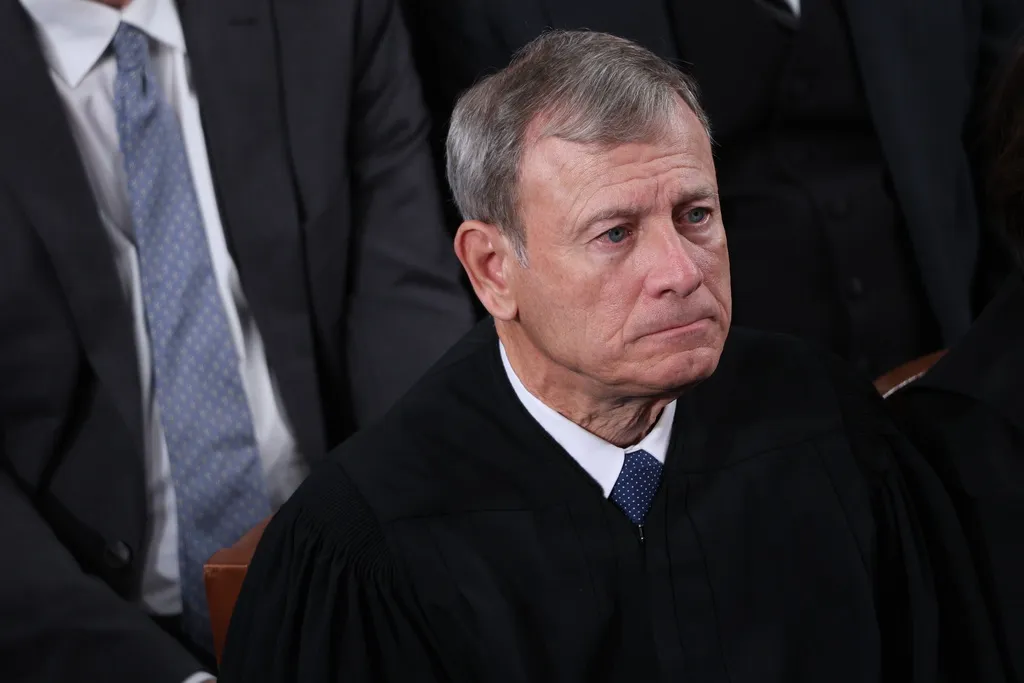
Chief Justice John Roberts on Tuesday questioned whether Verizon and AT&T's challenge of Federal Communications Commission (FCC) fines over the sharing of consumers' location data amounts to little more than a "PR problem," during Supreme Court oral arguments.
The case centers on whether the FCC’s forfeiture penalty system violates the Constitution and could reshape how federal regulators enforce privacy rules against major telecommunications companies.
“I wonder if, at the end of the day, you’re really just talking about a PR problem,” Roberts said.
Read More on U.S.
Why Verizon and AT&T Were Fined
The FCC announced it would be fining major wireless carriers Verizon and AT&T, along with Sprint and T-Mobile, in April 2024 for illegally sharing access to customers’ location information without consent. Sprint and T-Mobile merged after the investigation began.
AT&T was fined more than $57 million, and Verizon was fined almost $47 million.
Verizon and AT&T challenged the process as unconstitutional, arguing that it gives them little opportunity to present their side in court.
The federal government said the penalty is an essential part of regulation, and it does provide a path to challenge it in court. The government also said that companies do not have to pay the penalties immediately, which Justice Brett Kavanaugh said was a win for the companies.
“It seems like you’ve won on the law going forward one way or the other,” Kavanaugh told an attorney for AT&T and Verizon.
FCC v. AT&T and Verizon Communications v. FCC: What To Know
The two cases reached the Supreme Court after federal appeals courts split on whether the forfeiture penalty system is constitutional. The FCC is permitted to impose these penalties to enforce the Communications Act.
When companies are notified that they have violated FCC regulations, they can either pay the penalty and then contest it before an appeals court or refuse to pay and wait for a federal lawsuit that could lead to a jury trial.
In FCC v. AT&T, the U.S. Court of Appeals for the Fifth Circuit ruled that the FCC’s process violated the Constitution. In Verizon Communications v. FCC, determined that the forfeiture order complies with the Seventh Amendment, which grants the right to a trial by jury.
Verizon's petition for a writ of certiorari acknowledged the split.
"The Second Circuit and D.C. Circuit have both blessed the FCC’s theory, while the Fifth Circuit has rejected it as pure constitutional circumvention," attorneys for Verizon wrote.
The Supreme Court consolidated the cases.
When is a Ruling Expected?
The Supreme Court is expected to issue a ruling by late June.
This article includes reporting by The Associated Press.
...
Do you have a story that Newsweek should be covering? Do you have any questions about this story? Contact LiveNews@newsweek.com.
View 0 Comments
Submit Correction
View Editorial & AI Guidelines