...

By Andrew Stanton
Reporter
0
Share
Newsweek is a Trust Project member
See more of our trusted coverage when you search.Prefer Newsweek on Googleto see more of our trusted coverage when you search.
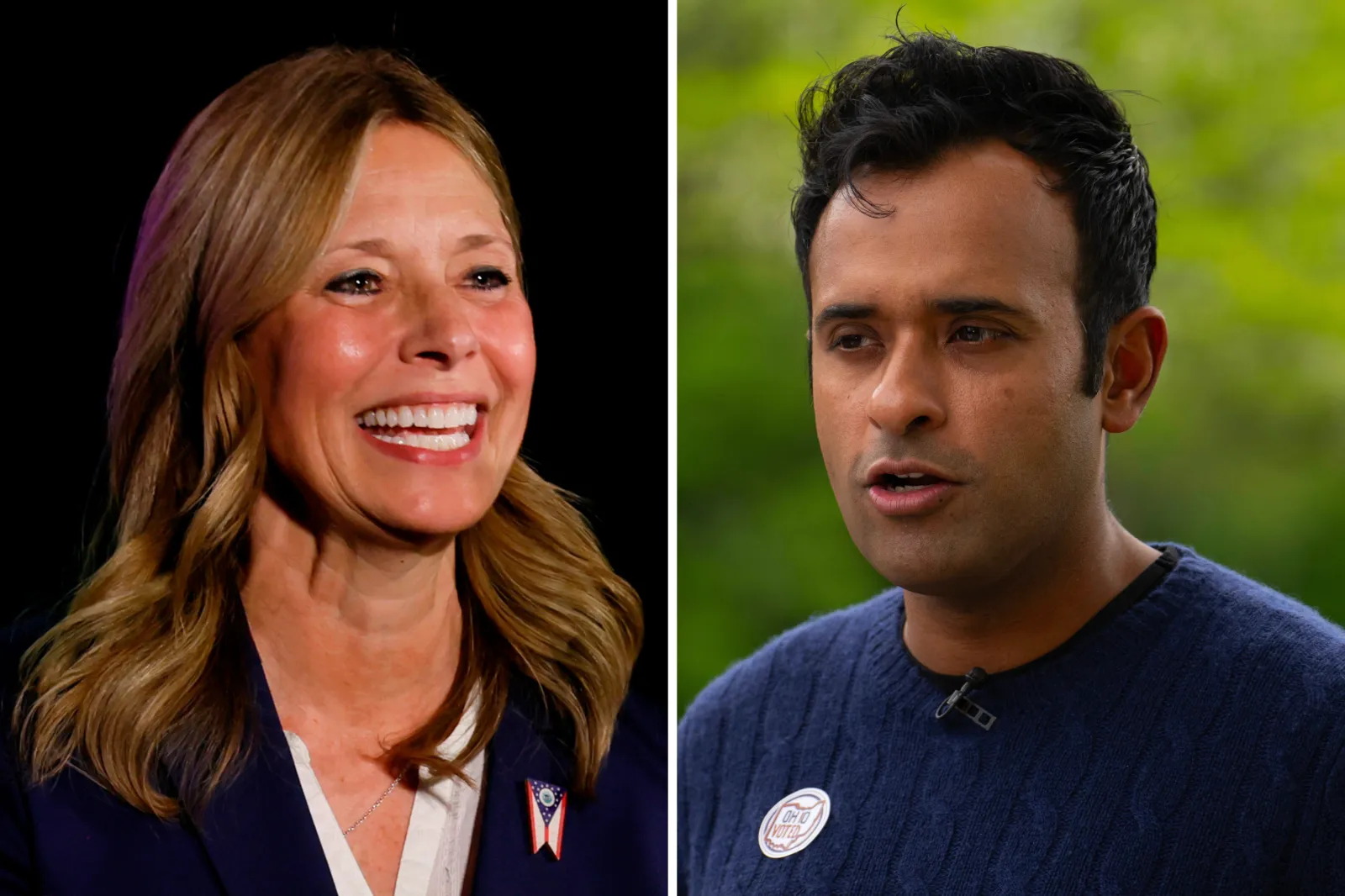
Republican Vivek Ramaswamy trailed Democrat Amy Acton in a new poll of the Ohio governor's race released by Tulchin Research on Wednesday, as Democrats hope to make the Buckeye State competitive in this year's midterm elections.
Once a swing state, Ohio has drifted rightward over the past decade and now routinely elects Republicans. But Democrats are hoping to expand the electoral battleground this year as President Donald Trump’s national approval rating continues to decline in polls. Historically, the party of the president suffers midterm losses when his approval falters, and Democrats believe Trump’s numbers reaching record lows in new polls could give them a chance to win back voters in states like Ohio.
Acton, who led the Ohio Department of Health during the COVID-19 pandemic, is running against Ramaswamy, an entrepreneur who rose to national prominence during his 2024 presidential run.
Read More on Politics
The Tulchin poll, sponsored by Democratic attorney general candidate John Kulewicz, showed Acton with a 2-point lead over Ramaswamy, 46 percent to 44 percent. Five percent said they would vote for another candidate, while 6 percent were undecided. The survey was July 29-August 4 and had a margin of error of plus or minus 4 percentage points.
Acton’s campaign manager Philip Stein told Newsweek that polls continue showing “that Ohioans are not falling for the $35 million worth of lies that billionaire Vivek Ramaswamy and his out-of-state friends like Elon Musk are spreading.”
“Unlike Vivek Ramaswamy who has spent 40% of his time this year traveling outside of Ohio, Dr. Acton is talking directly to voters across our state. Ohioans know that she is the only candidate in this race they can trust to take on the affordability crisis, tackle the cost of corruption, and build an affordable Ohio for all of us,” Stein said.
Newsweek also reached out to Ramaswamy’s campaign for comment via email.
...
Acton, Ramaswamy in Close Race: Polls
Several polls show a close race.
The latest poll from the Times and Siena University showed a tied race, with each candidate receiving 47 percent support. It polled 601 likely voters June 15-28, with a margin of error of plus or minus 4.7 percentage points.
An AARP poll, which surveyed 800 likely voters June 14-16, showed Acton up 3 points, 47 percent to 44 percent. It had a margin of error of plus or minus 3.5 percentage points.
A Fox News poll, which surveyed 1,015 registered voters May 28-June 1, showed Acton up a single point, 50 percent to 49 percent. It had a margin of error of plus or minus 3 points.
An earlier poll from YouGov and Bowling Green State University gave Ramaswamy a 1-point lead, 48 percent to 47 percent. It surveyed 1,000 registered voters April 7-14 and had a margin of error of plus or minus 3.9 percentage points.
What Do Prediction Markets Show?
Prediction markets show a close race, with Ramaswamy having a 51 percent chance of victory on Kalshi, and Acton having a 52 percent chance on Polymarket as of Wednesday.
Prediction markets allow traders to buy and sell contracts tied to political outcomes and current events, aggregating real‑money wagers into probability estimates.
Prices fluctuate as traders react to polling, fundraising, candidate developments and broader political trends. They measure trader sentiment at a given moment but do not always accurately predict the future.
Related Story

Max Miller’s Chances of Losing to Democrats With Withdrawal Deadline Passed
How Ohio Shifted From Purple to Red
Trump won Ohio by about 11 percentage points in 2024, an improvement on his 2020 and 2016 performances, when he won by about 8 points each time.
But Ohio was viewed as more competitive for Democrats not long before. President Barack Obama narrowly carried Ohio in 2008 and 2012. It has shifted as Trump performed well among the state’s working-class voters.
Trump made inroads with white, working-class voters who were previously more divided between Democrats and Republicans. His gains came from rural counties as well as the northeastern region near Cleveland. Democrats have gained some ground in Cincinnati and Columbus suburbs, but not enough to offset Republicans' gains in rural areas.
Still, Ohio has been competitive in some recent elections. Former Democratic Senator Sherrod Brown won reelection in 2018, then lost in 2024 by fewer than 4 percentage points. He is running for Senate against GOP incumbent Jon Husted this year, another race that is expected to be competitive.
When Did Ohio Last Elect a Democratic Governor?
Ohio last elected a Democratic governor 20 years ago in 2006, when Ted Strickland, then a member of the House, flipped the seat in a major blue wave year. In 2010, a stronger year for the GOP, Republican John Kasich defeated Strickland by about 2 points.
Since then, Ohio has elected moderate Republican governors like Kasich in his reelection and Mike DeWine, who is ineligible to seek a third term in office.
Ramaswamy Booed at Young Conservatives Event
In late July, Ramaswamy faced boos during a speech at the Young Americans for Liberty convention in Cincinnati. He spoke for about 14 minutes about his support for capitalism but faced heckling over his positions on issues like Israel.
"No matter what happens, in whichever direction we go, the people in my generation—we've already made it, and we're going to be fine," he said over loud boos and heckling. "It's going to be your generation that pays the price. That choice belongs to you."
Acton Breaks From Democrats on Transgender Sports, Voter ID
Meanwhile, Acton has faced criticism from some LGBTQ+ activists after saying she does not “support boys playing in girls’ sports” in remarks reported by The Toledo Blade.
The Ohio Democrats Progressive Caucus wrote in a statement that progressives were less ready to knock doors for Acton over her remarks “out of a bad feeling in our chests.” The statement was taken down but was posted to X by journalist Andrew Tobias.
She has also said she supports Issue 3, an amendment that would put the state’s voter ID requirements into its constitution, a break from other Democrats in the state who have opposed the measure.
“This amendment has overwhelming support from Ohioans across the state," Acton said, according to WEWS, a Cleveland-based news station. "As this doesn’t change what is already law, as governor, I will support it."
What Happens Next
Ohio’s gubernatorial race is expected to be one of the closest of the midterms, and candidates will spend the coming months making their cases to voters. The Cook Political Report classifies the race as a toss-up, while Sabato’s Crystal Ball views it as leaning toward Republicans.
Contact Newsweek editors on this story: Jason Lemon and Dave Siminoff.
View 0 Comments
Submit Correction
View Editorial & AI Guidelines