
...

By Jenni Fink
Senior Editor
0
Share
Newsweek is a Trust Project member
See more of our trusted coverage when you search.Prefer Newsweek on Googleto see more of our trusted coverage when you search.
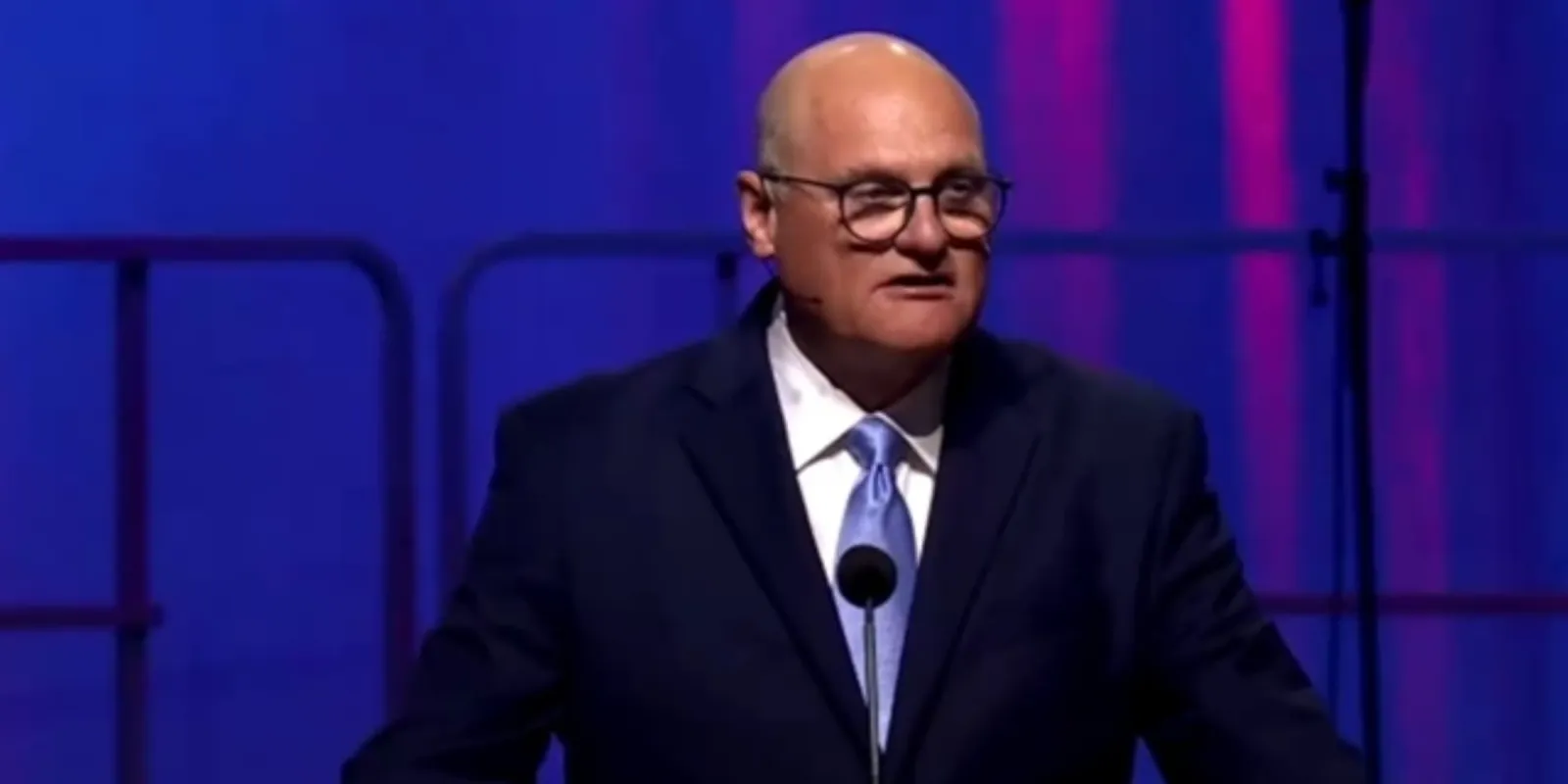
Pastor Willy Rice was elected president of the Southern Baptist Convention (SBC)—after being backed by a former official's staffer in President Donald Trump's administration—but he hasn't always been complimentary of the president.
Rice's election marks an ideological shift to the right in the nations largest Protestant denomination. Rice has been critical of the crackdown on sexual abuse in the church, saying the social justice movement has gone too far, and has championed a resurgence of a new conservative resurgence in the church. Rice warned people ahead of the vote that the church would become defunct like Blockbuster or Kodak if they weren't careful and criticized the church for becoming too "woke."
Rice's victory was celebrated by the Center for Baptist Leadership, a faction of the church, for being a step toward moving the church to a more conservative era.
Read More on News
Who Is Pastor Willy Rice?
Rice is senior pastor of Calvary Church in Clearwater, Florida, and a longtime Southern Baptist leader with decades of ministry experience. He was elected SBC president with about 57 percent of the vote at the denomination’s 2026 annual meeting in Orlando on Tuesday, defeating South Carolina pastor Josh Powell.
Rice’s election is widely seen as a victory for a conservative bloc within the SBC that argues the denomination has drifted too far toward what they call “woke” or liberal positions on issues like race, gender and politics.
In speeches surrounding the convention, Rice warned that SBC leadership had been pulled by a “cultural riptide” in recent years, leading to decisions that undermined trust among rank‑and‑file Baptists. He has also taken firm positions on key doctrinal debates—supporting a ban on women pastors, pushing for stricter theological boundaries and criticizing internal reforms tied to broader cultural concerns.
His rhetoric consistently emphasizes “faithfulness” over cultural relevance and rejects what he sees as compromise with broader social trends.
Rice previously ran for president of SBC in 2022 but withdrew himself from the race over concerns about the sexual misconduct of an ordained deacon in his church. Ahead of dropping out, he said in a video posted on social media that a deacon committed "sexual sin that could also be described as abusive."
“It did not involve criminal charges, and he has never been identified by law as a sexual offender," Rice said at the time.
Rice said the abuse took place before the deacon became a Christian and that the deacon "repented of his sin." He said the person didn't "hide his story" and made it part of his testimony and it was "a story of God's amazing grace."
“We were challenged to think more accurately about our leadership structure and allowing him to serve as a deacon was inconsistent with our desire to stand against all forms of sexual abuse. We have all agreed that our brother should not continue to serve as a deacon at Calvary. Over the last three to four years, we have grown in our understanding of the dynamics of sexual abuse and predatory behavior,” Rice said at the time.
In a statement a few days later announcing he would no longer run for president of SBC, Rice said his calling was to his local church, family and "to the mission field God has given me," and said he wanted to return "my time and attention to those things."
Rice has been a pastor for over 35 years and became the leader of Calvary Church in 2004 after getting a Master of Divinity Degree and Doctor of Ministry degree from New Orleans Baptist Theological Seminary. He graduated with a bachelor's degree from Samford University in 1985.
Rice and his wife, Cheryl, have three children and six grandchildren.
Pastor Willy Rice Backed by Trump Admin Staffer
Rice’s victory was backed by influential conservative networks within the SBC, including groups that have ties to political advocacy aligned with the Trump era.
Supporters included organizations like the Center for Baptist Leadership, which has pushed the denomination to take harder stances on issues such as immigration, gender identity and race. William Wolfe, leader of the Center for Baptist Leadership, previously served in the Trump administration and endorsed Rice for president.
“Willy Rice’s election proves that there is an appetite in the SBC for real conservative reform and renewal,” Wolfe told Religion News Services (RNS) in an interview. “We believe his victory is a major vindication of the issues we have addressed and fought for over the last few years in the SBC.”
Wolfe's pushed for the church to speak out on immigration, saying in a controversial video posted on social media that he doesn't want his white children being minorities.
“I want my boys to grow up in a country where they don’t look like they’re the foreigners here," Wolfe said.
At the same time, divisions over how closely evangelical leaders should align themselves with political figures—especially Trump—have been a defining debate within the SBC. Rice’s coalition includes voices that view political engagement as essential, particularly in shaping public morality and policy.
Rice was asked about the controversial statements some of his supporters have made online, but he dismissed it as problematic. He said that a lot of people say controversial things online and that he needs to listen to everyone.
“Unity is not telling people to hush,” Rice said at the meeting. “It’s listening, it’s sitting down and saying, ‘Tell me why you’re bothered.’”
What Pastor Willy Rice Has Said About Donald Trump
Rice’s public record on Trump is nuanced—combining theological criticism with acknowledgment of political support from many Christians.
In April, Rice condemned a now‑deleted Trump social media post that appeared to depict the former president as a Christ‑like figure. He said it wasn't hard to "condemn this outright," adding in no uncertain terms that the photo was "wrong."
"Many Christians appreciate the President’s administration and have supported him in meaningful ways, but this is wrong. God alone deserves our worship and highest praise. All human leaders are His servants who will give an account to Him, and they are best advised to walk in circumspect humility," Rice said at the time. "I continue to be thankful for many things our President has done and pray for him regularly, but this is wrong and should be removed.”
Earlier, in a 2021 blog post written after the January 6 Capitol attack, Rice was more pointed in his criticism of the evangelical movement’s relationship with Trump.

...
"Inarguably white evangelicals overwhelmingly supported the President, both fueling his rise to power and enthusiastically wanting his administration to continue. There are defensible reasons for that position, but there are grave concerns about what unhealthy political passions in this recent season have revealed about the state of the church in America," Rice wrote in a now-deleted blog post.
Rice warned about the "unhealthy and dangerous co-mingling of religion and politics" and to beware of idols that cause people to protest when "someone challenges them or tries to take them away."
"We don’t need Donald Trump to save us," Rice said. "I know this will sound hard to some, but God never called us to Make America Great Again."
While Rice has now condemned the "wokeness" of current life, after the Capitol riot, he wrote in the blog post that America's greatness is "tempered" by the country's sins and shortcomings, particularly with regard to minorities. He reminded readers that they need to "remember" that for Black people, wanting to relive America's past isn't a point of pride or promise and he encouraged Americans to want the country to be "greater in her future than she has ever been in her past."
"That people who claim to follow Christ have embraced conspiracy theories like Q-Anon is to our shame. Some of the same people, who hear about other cults and conclude that they would never fall for such nonsense, are the same ones posting and sharing utter falsehoods about orphans trapped beneath cities who are being rescued by President Trump, liberals practicing cannibalism, and the mysterious Q," Rice wrote. "This is garbage!"
Pastor Willy Rice's Criticism of Sexual Abuse Crackdown
In addition to his commentary on politics, Rice has emerged as a controversial voice in the SBC’s long‑running debate over how to address sexual abuse within the denomination.
He has argued that reform efforts aimed at addressing abuse allegations have “gone off the tracks almost from the start.” He wrote in a blog post in May 2024 that he realized the effort to crack down on sexual abuse wasn't to support victims but to force the church to become more progressive.
"Good people have been slandered, and millions of dollars have been flushed down the drain. Our movement is divided, and right now, we don’t seem any closer to some imaginary solution that those steering this reform movement keep assuring us is out there," Rice wrote.
Rice told The New York Times that there was a "legitimate concern" with what was going on within the church with regard to sexual abuse but there was an overreach because "activists" were driving the agenda.
What Happens Next
Rice’s presidency comes at a pivotal moment for the SBC, as it continues to face declining membership, internal divisions and heightened public scrutiny.
Several major issues are expected to define his term:
- Doctrinal debates: Ongoing efforts to formalize bans on women pastors and strengthen conservative theological positions.
- Political engagement: Continued tensions over how closely SBC leadership should align with political movements and figures.
- Sexual abuse response: Decisions about whether to expand, scale back or redirect reform efforts.
- Organizational trust: Efforts to rebuild confidence among churches that feel alienated by national leadership.
Rice has framed his leadership vision around returning the SBC to what he describes as its core convictions and resisting cultural pressures.
In remarks to fellow pastors, he warned that success rooted in compromise could ultimately lead to “a greater defeat,” underscoring his emphasis on doctrinal fidelity over institutional popularity. How that approach translates into policy—and whether it unites or further divides the denomination—will likely determine the trajectory of the SBC in the years ahead.
View 0 Comments
Submit Correction
View Editorial & AI Guidelines