...

By Jeff Young
Environment and Sustainability Editor
0
Share
Newsweek is a Trust Project member
See more of our trusted coverage when you search.Prefer Newsweek on Googleto see more of our trusted coverage when you search.
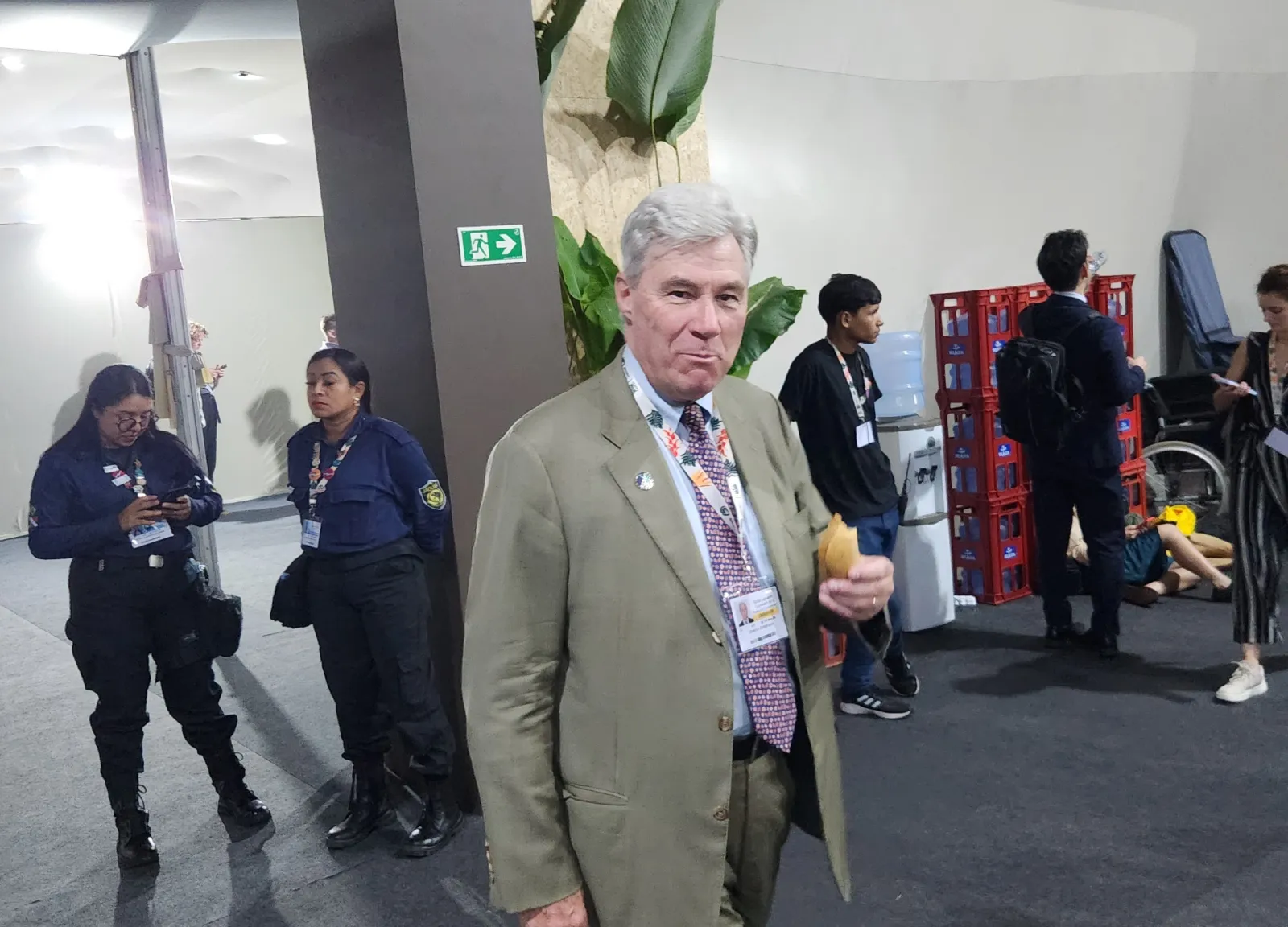
Senator Sheldon Whitehouse, perhaps the most consistent and clear voice for climate action in Congress, almost didn’t make it to the COP30 climate talks.
First, the 43-day U.S. government shutdown complicated travel. Then, he said, his staff found that the U.S State Department would not provide the official badges required to enter the United Nations negotiations area.
“We couldn't get these,” Whitehouse said, holding up the badge his staff eventually managed to wrangle via a nonprofit group for legislators. “There was a very deliberate pattern of behavior to try to discourage official attendance here.”
Read More on Better Planet
Whitehouse said the badge incident was further evidence of “thuggish” efforts by the Trump administration to impede climate action. The U.S. is pulling out of the Paris Climate Agreement and did not send any personnel to the climate talks, making Whitehouse “the entirety of the U.S. delegation here,” he said.
“Trump does not represent the United States with respect to climate change,” Whitehouse said. “He represents the fossil fuel industry. It's a matter of capture and corruption.”
Whitehouse, from Rhode Island, is the highest-ranking Democrat on the Senate Environment and Public Works Committee.
In a lively 30-minute briefing with a handful of reporters in office space loaned by a nonprofit in the COP30 Blue Zone, Whitehouse addressed the “huge economic damage looming” for the U.S. due to climate impacts, how climate and energy issues might play in mid-term elections and what he called the “narrow pathway to climate safety” that is still possible.
Here are some highlights from that conversation, edited for length.
Climate and Energy on the Ballot
Polling in the U.S. shows majorities concerned about climate change but not as much as other issues such as affordability, inflation and the economy. Whitehouse predicted that it could soon change. He warned that climate-driven extreme weather and wildfire are already making it difficult for people in Florida and fire-prone Western states to get homeowner’s insurance, and that could soon impact the real estate market in the U.S. That, coupled with surging electricity prices, could make climate change a campaign issue, he said.
Senator Sheldon Whitehouse: “There’s huge economic damage looming. It's already here in Florida in the form of the homeowner's insurance crisis that Floridians are having to live through. But, you know, go west and find wildfire places. We're headed into a significant meltdown that the Freddie Mac chief economist compared to the 2008 recession, and that was just based on a coastal property values crash, before you dialed in wildfire. So being ready for that, not just to deal with it as a pain point, but to see it coming, warn people about it, and use it to help correct our climate path is really important right now.
“I think it's going to be a big deal in the coming elections at home. I did a poll in Texas and 92 percent of Texas voters are concerned about homeowner’s insurance—more than health care, more than groceries, more than mortgages. It is top of mind, 63 percent are very concerned and 66 percent see a connection to climate change through extreme weather. So, you know, I think this can be a real inflection point in our climate conversation.
“And I think with respect to electric utility prices, it's not complicated to explain that when the Trump administration is suppressing clean energy on the grid, it is driving the grid to go to the generation stack and call up more and more expensive fossil fuel units. What you have is like a hydraulic transfer of money from the pockets of ratepayers to the owners and fuel dealers of these big fossil fuel plants that would otherwise be idle and making no money. It's a direct payoff to fossil fuel.
“If we can explain to voters that the reason their electric utility bills are jumping isn't because it's anything the electric utility did, it's because the Trump administration is deliberately raising their prices in order to crank up fossil fuel units that are very expensive and would otherwise be idle so that their big donors get payback—with those two messages we can do a lot of good.”
The ‘Last Lifeboat’ for a Price on Carbon
Two years ago, the European Union adopted the Carbon Border Adjustment Mechanism (CBAM) as a way to put a price on the greenhouse gas emissions from the manufacturing of many products the E.U. imports. In effect, CBAM is a CO2 tariff on carbon-intensive products like aluminum, cement and steel. Whitehouse said he hopes to see the idea expand to other countries. However, he fears it will come under attack from the Trump administration in the same way that the U.S. pressured other countries to drop support for a carbon fee on maritime shipping fuels.
“The first step is to protect the CBAM at all costs. I describe it as our last lifeboat. If it sinks, there is no pathway that I can see to the climate safety, period, end of story. If it grows, the pathway to climate safety widens a little bit. So, the U.K., Australia, Canada, Mexico—who knows, others?—would be really a good outcome.
“I'm also warning that the thuggish attack of the Trump administration on the International Maritime Organization over its [carbon] shipping fee, which would be virtually unnoticeable to U.S. consumers [but] nevertheless provoked an onslaught, which is still reverberating around here. It was so brutal and unprecedented. So that's something that we've been urging the E.U. members to prepare for, for when the Trump thugs turn their attention on them.”
Trump vs States on Climate Action
Even as the Trump administration scraps support for clean energy and attempts to block wind and solar projects, several states, most notably California and New York, are pressing ahead with climate action. Several northeastern states participate in the Regional Greenhouse Gas Initiative (RGGI), although Democratic Pennsylvania Governor Josh Shapiro recently withdrew the state from RGGI. Whitehouse criticized Shapiro’s choice and cautioned that climate-forward states will face opposition from the Trump administration.
“I don't think that was a smart move on [Shapiro’s] part. RGGI is very small, just to begin with. And our experience in Rhode Island with RGGI has been that the money that comes back from it, invested in clean energy, gives a far greater economic lift than the amount that gets paid into RGGI in the first place. So, it's a big win and I hope he reconsiders.
“Remember the days when the Republicans were into states' rights and pushed for cooperative federalism, where the states were laboratories of democracy? Like I said, principles are soluble in oil in the Trump administration. But I do think that the states are in a strong position to make these choices for themselves.”
View 0 Comments
Submit Correction
View Editorial & AI Guidelines