
...


By Brendan Cole and Micah McCartney
0
Share
Newsweek is a Trust Project member
See more of our trusted coverage when you search.Prefer Newsweek on Googleto see more of our trusted coverage when you search.
U.S. CEOs met Chinese President Xi Jinping during talks with President Donald Trump in Beijing, their presence highlighting the importance the world’s biggest economies attach to expanding access into each other’s markets.
In a read-out of the talks, the White House said Thursday that leaders from the largest U.S. companies joined a portion of the meeting in which both sides discussed expanding market access for American businesses into China and increasing Chinese investment in the U.S.
Trump individually introduced Xi to 17 business leaders, including Tesla CEO Elon Musk, Nvidia CEO Jensen Huang and outgoing Apple CEO Tim Cook, who have an eye on making inroads into a key market.
Read More on World
The executives attended Thursday's welcoming ceremony at the Great Hall of the People, where Chinese state media reported that Xi told them that U.S. companies would have broader prospects in the country.

...
“The inclusion of the business leaders reflects Trump’s priority in getting a deal in trade and business links, but I doubt that their presence will shift the dial in the basic issues that hold back stronger ties,” Steve Tsang, director of the SOAS China Institute at SOAS University of London, told Newsweek on Thursday.
Huang and Musk told reporters the meetings went well with the Tesla CEO saying, “many good things had been achieved.” Cook gave a thumbs-up to reporters. Other executives accompanying the Trump delegation include Cristiano Amon from Qualcomm, Sanjay Mehrotra (Micron Technology) Jacob Thaysen (Illumina) Henry Lawrence Culp Jr. (GE Aerospace) and Kelly Ortberg (Boeing).
Singaporean newspaper Lianhe Zaobao reported the executives also met Chinese Premier Li Qiang, commerce Minister Wang Wentao, National Development and Reform Commission Director Zheng Shanjie and People’s Bank of China Governor Pan Gongsheng.
Tsang from SOAS believes that whatever trade, investment or economic deals Xi may agree with Trump, implementation will be a different matter.
“China has a, shall one say, a record of being very selective in delivering what it had promised,” Tsang said. ”It also does not trust Trump to deliver whatever Trump may promise.”

...
The Trump administration authorized sales of Nvidia H200 chips to China last year, but disagreements from both sides about shipments have meant none have yet been sold there.
Tsang noted that Nividia is now permitted to sell H200 chips but Xi did not give the go ahead for Chinese companies to buy. Apple is also diversifying production with additional facilities outside China, he added.
“Tesla had done what it could for China in transferring technology and is now outcompeted by its Chinese rivals,” he said.“None of these are going to change because their bosses are in Beijing with Trump.”
The White House didn't mention the contentious political issue of Taiwan, which Beijing claims as part of China, in its readout. However, Xi warned of "clashes and even conflicts" if the situation concerning the self-governing island, is not "handled properly."
"'Taiwan independence' and cross-Strait peace are as irreconcilable as fire and water,” Chinese Foreign Ministry spokesperson Mao Ning said on X. “Safeguarding peace and stability across the Taiwan Strait is the biggest common denominator between China and the U.S."
Trump’s 12-Strong Delegation
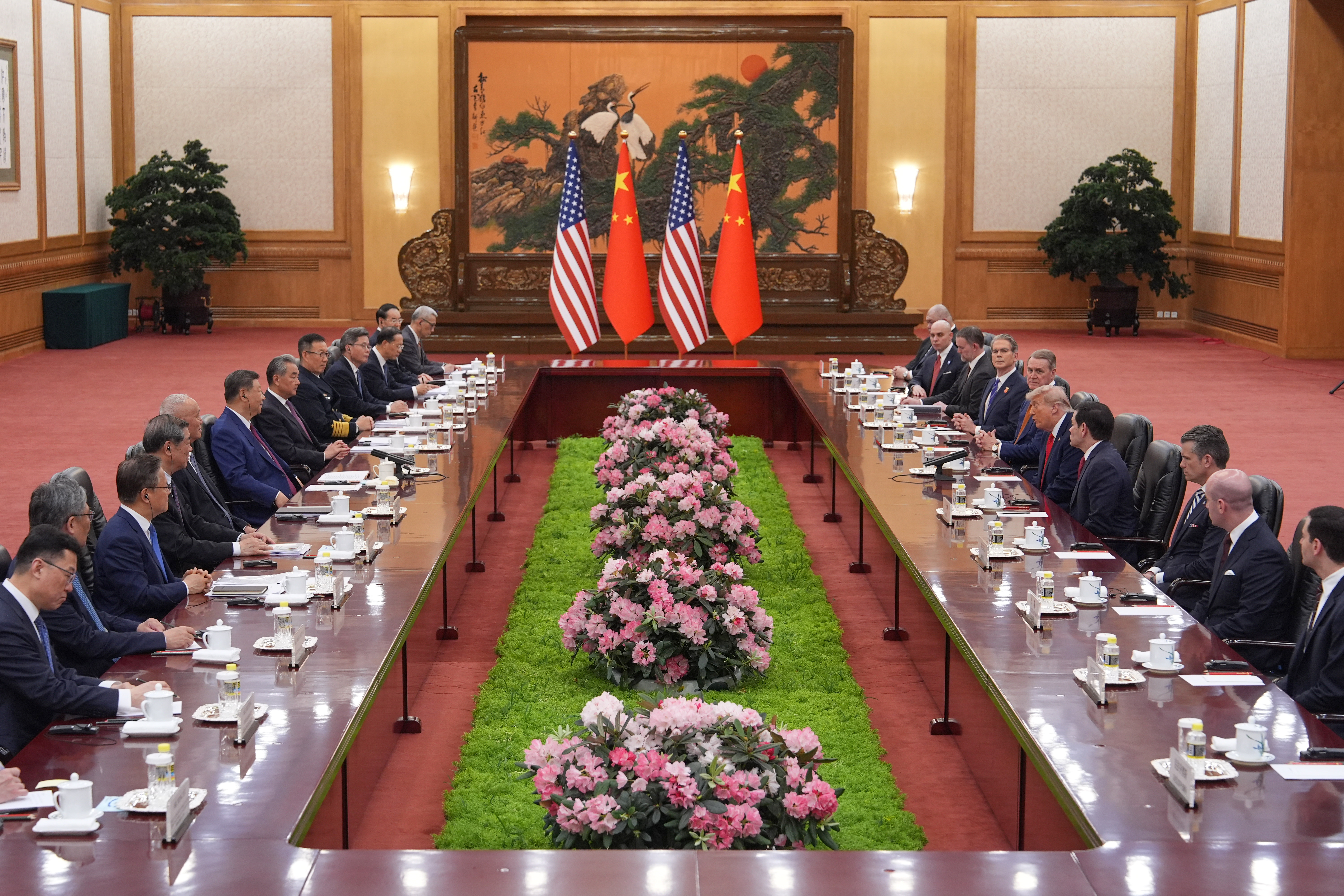
Images released of the negotiations in the Great Hall of the People showed 10 U.S. officials sitting opposite the 12-strong Chinese delegation.
To Trump’s left was Secretary of State Marco Rubio, a China hawk who was sanctioned by Beijing in 2020 when, as a Florida senator, he condemned Beijing’s crackdown in Hong Kong. Rubio has also criticized Beijing for its treatment of the mostly Muslim Uighur minority in Xinjiang, in northwest China.
However, Beijing has appeared to have used a diplomatic workaround to let Rubio in without lifting the sanctions, transliterating the first syllable of his surname with a different Chinese character. The Chinese foreign ministry also said in March that the sanctions were aimed at “Rubio’s words and deeds concerning China during his tenure in the United States Senate.”
Sitting left of Rubio were Defense Secretary Pete Hegseth, White House Deputy Chief of Staff for Policy Stephen Miller, Deputy National Security Adviser Robert Gabriel and science adviser to the president Michael Kratsios.
On the right of Trump were U.S. Ambassador to Beijing David Perdue, Treasury Secretary Scott Bessent, trade representative Jamieson Greer, White House Deputy Chief of Staff James Blair and White House Communications Director Steven Cheung.

...
Chinese Delegation's Seating Plan
The seating around Xi offers a visual cue to the level of importance of the officials at the table.
To his immediate right sat Cai Qi, widely seen as the second-most powerful official in China. He is a member of the Communist Party’s seven-man Politburo Standing Committee—the country’s top decision-making body—and director of the General Office, which controls access to Xi and the flow of information around him. In practical terms, he is Xi’s closest aide and gatekeeper.
Next to Cai was He Lifeng, a vice premier who oversees economic policy and has been serving as Beijing’s point man in trade talks with Washington. Next to him was Zheng Shanjie, head of the National Development and Reform Commission, the powerful state planning agency that sets economic priorities.
Then came Commerce Minister Wang Wentao, responsible for trade policy, and Xie Feng, China’s ambassador to the United States and a key diplomatic channel between the two sides. Furthest out sat Hong Lei, an assistant foreign minister who runs the ministry’s protocol department, managing the logistics and choreography of high-level visits.
On Xi’s left, the top seat went to Wang Yi**,** China’s foreign minister and director of the Communist Party’s top foreign affairs body. Also a Politburo member, he is the country’s senior diplomat and ranks just below the Standing Committee.
Next to him was Defense Minister Dong Jun, followed by Finance Minister Lan Fo’an, then Ma Zhaoxu**,** the foreign ministry’s executive vice minister who handles much of its day-to-day work, and Cai Wei, an assistant foreign minister and member of the ministry’s internal party committee.
The arrangement is “literally a visualization of power” in the room but not of China's leadership structure overall, former Chinese journalist Soyonbo Borjigin wrote in a blog post.
Fentanyl, Iran and Strait of Hormuz
The White House readout also referred to the need to end the flow of fentanyl precursors into the United States and increasing Chinese purchases of American agricultural products. Reopening the Strait of Hormuz closed, that has been closed by Iran, and the importance of Tehran not having a nuclear weapon were other points of agreement, according to the statement.
“China will certainly be looking to use its leverage on tech and Iran to pressure Trump,” Rory Green, TS Lombard’s chief China economist told Newsweek. “The top objectives are Taiwan and increased access to advanced semiconductor manufacturing tools.”
“For now Beijing has more leverage, especially in tech,” he said. “Chinese industry is well adapted to reduce access to advanced Nvidia chips, moreover officials are concerned of future security risks if the domestic market is dominated by an American firm.
“For Washington, the need for rare earths is more acute, particularly for weapons related inputs. The Iran conflict has significantly reduced stockpiles."
Toasting Good Ties
At a banquet in the Great Hall of the People beneath chandeliers, pagoda-style roofs with U.S. and China flags, Xi toasted Trump by saying that the “rejuvenation of China” and “make America great again” can go hand in hand. Trump in turn said he had invited Xi to visit the White House on September 24.
"Both Xi and Trump want the visit to be a success so it will be a resounding success—at least on the surface," said Tsang, from SOAS.
Craig Singleton, China program senior director at the Foundation for the Defense of Democracies (FDD), a U.S. think tank, said that after the first day of Trump's visit, “Taiwan remains the strategic stress point beneath the summit smiles.”
"Xi’s warnings about Taiwan make clear that commercial calm depends on Washington handling Taiwan with caution,” he said in comments sent to Newsweek. “I would not overread this as a new threat. It is consistent with Beijing’s long-standing position. But the setting matters.
“Xi put Taiwan at the center of a summit Trump wants to define around deals and personal diplomacy,” Singleton added.
Singleton believes China needs stability because its economy is under pressure, while Trump needs visible results because his brand of statecraft depends on the appearance that personal diplomacy produces deals.
“That creates room for limited movement on beef, agriculture, energy, and other niche issues,” said Singleton, “but none of those steps resolve deeper structural fights over Taiwan, technology, sanctions, rare earths, and supply-chain dependence."
View 0 Comments
Submit Correction
View Editorial & AI Guidelines