...

By Ellie Cook
Senior Defense Reporter
0
Share
Newsweek is a Trust Project member
See more of our trusted coverage when you search.Prefer Newsweek on Googleto see more of our trusted coverage when you search.
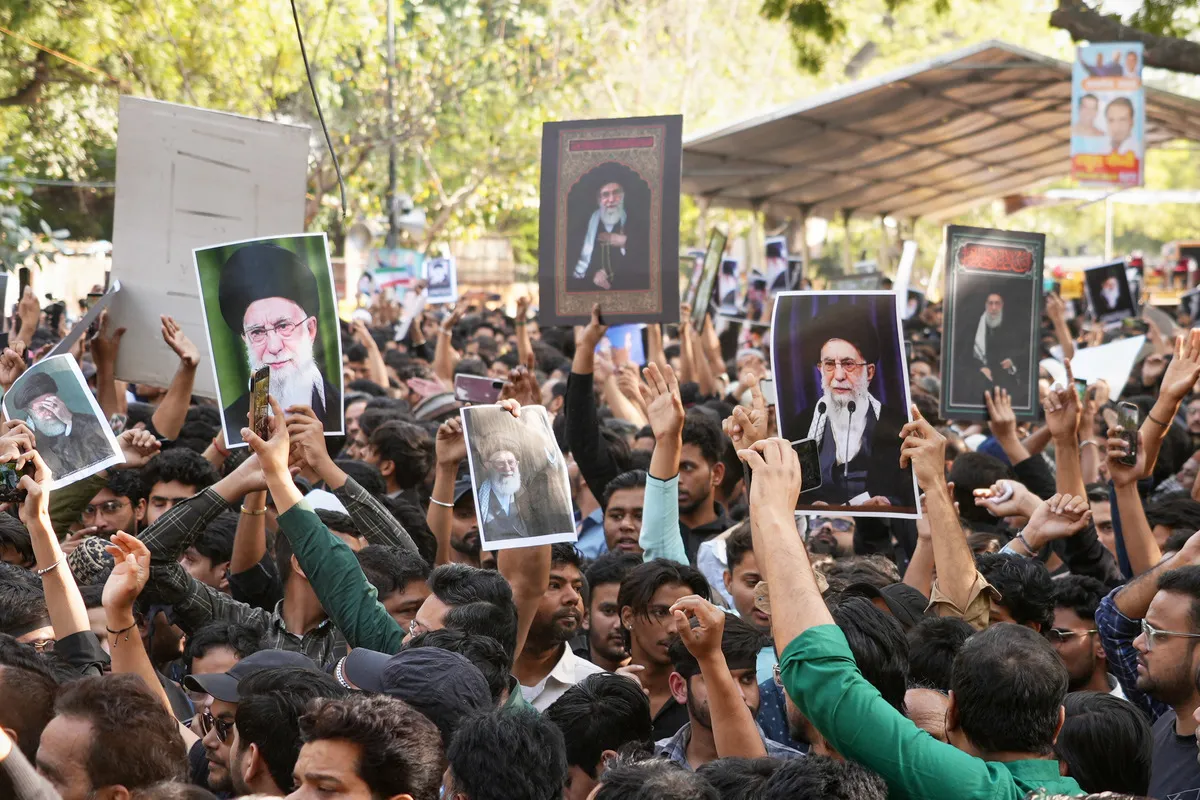
U.S. and Israeli strikes on Iran have killed the country's Supreme Leader, Ayatollah Ali Khamenei, state media confirmed on Sunday.
Khamenei, who had headed up the regime in Tehran since 1989, was killed along with a raft of senior Iranian military and political officials after the U.S. and Israel started striking the country early on Saturday.
Iran's retaliation against Israel and Middle Eastern countries allied with the U.S. raised fears of instability rippling across the region, with travelers stranded and many carriers canceling flights as drones and missiles were reported heading for Bahrain, Kuwait, Qatar, the United Arab Emirates (UAE) and Jordan.
Read More on World
Israel launched fresh attacks on central Tehran on Sunday, with Iranian state media reporting at least one huge explosion in the capital.
U.S. President Donald Trump has repeatedly called for regime change and for the Iranian people to rise up against the government.
...
But in the wake of Khamenei's death, Iran's future is uncertain. Since the Islamic regime was founded in 1979, there have only been two leaders, including Khamenei's 36-year stretch. A temporary leadership council was set up in Tehran on Sunday.
Khamenei did not publicly name a successor before he died, and there is still some confusion about which of the top officials have been killed.
With looming questions about who could fill the power vacuum in Tehran, who could be vying for the top spot?
Ali Larijani
Ali Larijani, a longtime figure in Iranian politics and the current secretary of the Supreme Council for National Security (SCNS), has quickly emerged as a front-runner.
Larijani is described as pragmatic but nationalistic, well-versed in Iran's diplomatic strategy with an established track record of loyalty to Khamenei. While occupying a central role among Iran's delegations for nuclear negotiations with the U.S., he has also made several trips to Moscow in recent months.
The U.S. sanctioned Larijani last month over what the administration called his support for Iranian authorities brutally cracking down on protesters who took to the streets in Iran from late December.
Mojtaba Khamenei
Some observers have tentatively pointed to the late supreme leader's son as a likely candidate to take the reins. While a well-known cleric, he has never held a senior political role and is more aligned with the military.
The handing down of power from father to son could also prove an unpopular choice among influential regime players. It was the toppling of the Iranian monarchy and the country's last shah that brought the clerics to power in 1979.
Ebrahim Raisi, the former Iranian president who was close to the late Khamenei, was widely considered a more realistic leadership prospect before he was killed in a helicopter crash in May 2024.
A few, lesser-known names are floating around, although it is hard to distinguish a clear favorite. Also thought to be in the mix is Hassan Khomeini—the grandson of the first Supreme Leader, Ayatollah Ruhollah Khomeini—and senior cleric Ayatollah Alireza Arafi.
Temporary Council
Arafi is one of the three people appointed to a temporary council tasked with overseeing the rule of Iran for the time being. Joining Arafi are Iran's president, Masoud Pezeshkian and judiciary chief Gholam-Hossein Mohseni-Ejei.
The council will be in charge of the country until an 88-person collective, dubbed the Assembly of Experts, elects a permanent leader.
It is a powerful group of Shiite clerics elected for eight-year terms, thoroughly vetted by watchdog authorities in Iran and officially tasked with appointing or dismissing a supreme leader. But experts say the assembly has never posed serious challenges to the supreme leader and has excluded reformist or critical voices within Iran.
From Further Afield?
Trump, who said the military attacks had killed Khamenei before Iranian officials confirmed the leader's death, framed the strikes as offering up the "single greatest chance for the Iranian people to take back their country."
Reza Pahlavi, the son of the last shah who resides in the U.S., said Khamenei's death marked the end of the regime and said the current rulers would "very soon be consigned to the dustbin of history."
"Any attempt by the remnants of the regime to appoint a successor to Khamenei is doomed to fail from the outset," Pahlavi said in a statement. "Whoever they place in his stead will have neither legitimacy nor longevity, and will undoubtedly be complicit in the crimes of this regime as well."
Pahlavi has positioned himself as a champion of a free, U.S.-aligned Iran, although he is a divisive figure in the country and Trump himself has cast doubt on whether the exiled crown prince could lead from Tehran in the future.
In a polarized era, the center is dismissed as bland. At Newsweek, ours is different: The Courageous Center—it's not "both sides," it's sharp, challenging and alive with ideas. We follow facts, not factions. If that sounds like the kind of journalism you want to see thrive, we need you.
When you become a Newsweek Member, you support a mission to keep the center strong and vibrant. Members enjoy: Ad-free browsing, exclusive content and editor conversations. Help keep the center courageous. Join today.


View 0 Comments
Submit Correction
View Editorial & AI Guidelines