10
Loading video...

By Amanda Greenwood
Associate News Editor
0
Share
Newsweek is a Trust Project member
See more of our trusted coverage when you search.Prefer Newsweek on Googleto see more of our trusted coverage when you search.
Republican Senator Susan Collins is facing questions about her husband’s work for a Washington lobbying firm as she approaches a closely contested reelection vote against Democrat Troy Jackson.
Collins, Maine’s senior senator and chair of the powerful Senate Appropriations Committee, is seeking a sixth term in the November 3 election. She’s represented the state in the Senate since January 1997 and has built her political identity around bipartisanship and independence from the Republican Party leadership.
But the work of her husband, longtime Republican operative and former lobbyist Thomas Daffron, is now receiving scrutiny amid a wider debate over data centers, political influence and rising electricity costs.
Read More on News

...
Who Is Thomas Daffron?
According to his biography from the nonprofit Stennis Center for Public Service, Daffron has held multiple senior positions across business, politics and the government. For instance, he previously served as chief of staff to Republican senators William Cohen, Fred Thompson and Lisa Murkowski. He also managed Elizabeth Dole’s 1999 presidential campaign and advised on multiple state and federal political campaigns, including Collins’.
Before becoming the Chief Operating Officer of Jefferson Consulting Group, a Washington-based government consulting firm, Daffron worked as Executive Vice President of Chesapeake Enterprises, which is a firm that advises clients on government policy and lobbies officials on their behalf.
What Was Chesapeake Lobbying For?
Federal lobbying records show that Chesapeake Enterprises was registered to lobby on behalf of Hillwood Investments. A 2022 disclosure shows Chesapeake representing Hillwood and reporting $20,000 in lobbying income for the reporting period, with "Real Estate Investments" listed as the specific lobbying issue.
Hillwood is involved in industrial development, including data-center projects. Its website says it has been involved in data-center work for at least 20 years and that its AllianceTexas development includes a 400-acre data-center campus.
Although the federal disclosure doesn’t specify that Chesapeake's lobbying concerned data centers, American Journal News has linked the firm's work for Hillwood to data-center development. The outlet also reported that Daffron received consulting income from Chesapeake in 2025, when the firm was also lobbying the federal government on behalf of Hillwood.
There is, however, an important distinction to make here. While American Journal News reported that Daffron received consulting income from Chesapeake while the firm represented Hillwood, there’s no evidence in the available lobbying records that Daffron personally lobbied for Hillwood or worked on data-center policy.
The Maine Democratic Party has highlighted Daffron’s work for Chesapeake as part of its criticism of Collins ahead of the November election.
Newsweek has contacted Collins’ campaign for comment about Daffron’s consulting work for Chesapeake Enterprises.

...
Why Data Centers Matter in Maine
Data centers have become an issue in Maine over concerns about their electricity demands, potential impact on utility bills and use of natural resources, including water.
Many Maine officials and municipalities have considered temporary restrictions on large data centers while weighing regulations to address their potential impacts. In Bangor, for example, officials considered a 180-day moratorium to give the city time to develop appropriate regulations.
Collins’ approach to data centers forms part of her broader position on the rapid expansion of artificial intelligence. Newsweek’s AI Policy Scorecard evaluates her record across five areas, including data centers and energy, based on her votes and public positions. On data centers specifically, Collins has backed efforts designed to protect electricity customers from infrastructure costs associated with large energy users, suggesting support for AI expansion alongside safeguards intended to prevent those costs from being passed to households.
Collins supported the Ratepayer Protection Act, legislation designed to protect households and other electricity customers from being saddled with hefty infrastructure costs generated by large data centers. The measure failed to advance in the Senate on September 30.
Meanwhile, Jackson has called for tighter regulation of data centers, arguing that developers should pay for necessary power infrastructure and that the facilities shouldn’t raise residents' power bills or drain local water supplies, saying "under the Jackson administration I can assure you that tech billionaires will not be deciding this alone and not be getting their way."
Could The Daffron Controversy Affect the Collins-Jackson Race?
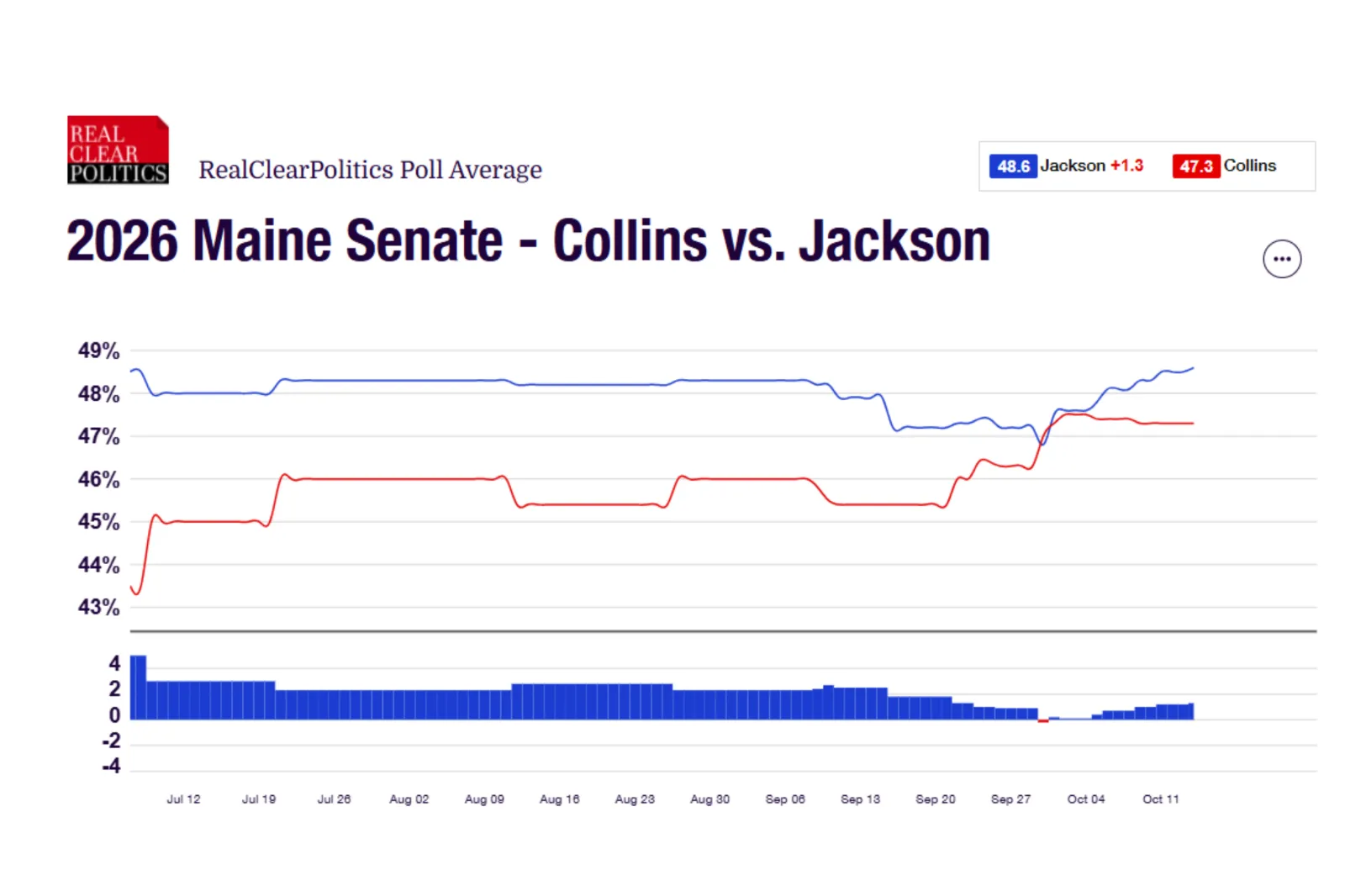
The RealClearPolitics average for surveys conducted between September 15 and October 11 placed Jackson at 48.6 percent and Collins at 47.3 percent, giving the Democrat a narrow 1.3-point advantage.
The Daffron disclosures may provide Jackson with an additional line of attack in a race where even a small movement among undecided and independent voters could be significant. However, Collins has defied unfavorable polling before. In 2020, she won re-election by 8.6 percentage points despite trailing Democratic challenger Sara Gideon in public polling throughout the campaign.
...
Whether the lobbying ties change voters’ minds may depend on whether additional records reveal what Daffron’s consulting work involved.
Newsweek’s reporters and editors used Martyn, our AI assistant, to produce this story. Learn more about Martyn here.
Contact Newsweek editors on this story: Ben Kelly and Tony Phillips.
View 0 Comments
Submit Correction
View Editorial & AI Guidelines