...

By Micah McCartney
Reporter
0
Share
Newsweek is a Trust Project member
See more of our trusted coverage when you search.Prefer Newsweek on Googleto see more of our trusted coverage when you search.
China’s move to sink a U.N. draft resolution aimed at reopening the Strait of Hormuz this week may appear at odds with its own interests given its exposure to the oil crisis, but the decision lines up with Beijing’s strategic priorities, analysts said.
China and Russia, both permanent members of the Security Council, vetoed the Bahrain-sponsored resolution just one day before the United States and Iran announced a 14-day ceasefire, reportedly negotiated with the help of Beijing.
That deal is already under strain but in it Tehran agreed to reopen the Strait of Hormuz, the world’s most critical energy chokepoint. The 21-mile-wide waterway has become emblematic of the nearly six-week conflict and of Iran’s leverage over the global economy despite the damage inflicted on its military by the U.S. and Israel.
Read More on World
The Chinese and Russian ambassadors, while expressing support for reopening the strait, argued that the resolution failed to address what they described as the root cause of the crisis: the U.S. and Israeli attacks on Iran, launched on February 28, that triggered the war and the ensuing disruption.
...
"Disregard for the root causes of the crisis in the Middle East, namely the illegal and reckless acts by the US and Israel targeting Iran, is not possible and not acceptable," Russian Ambassador Vasily Nebenzya said in his remarks.
Mike Waltz, the U.S. ambassador to the U.N., blasted both countries, saying they had tolerated a regime that is "holding the global economy at gunpoint."
The failed resolution demanded that Iran refrain from further attacks on merchant vessels and called on concerned governments to deploy forces in a coordinated effort to safeguard shipping. On its face, that would appear to benefit China—the world’s largest energy importer, which gets roughly 40 percent of its oil imports and about 30 percent of its liquefied natural gas from the Middle East.
China is better positioned than some of its neighbors to weather a limited energy shock because of its large strategic reserves and heavy investment in renewable energy. But with the strait disrupted for nearly six weeks, Beijing’s concern is growing—and a prolonged war lasting months poses an even greater risk.
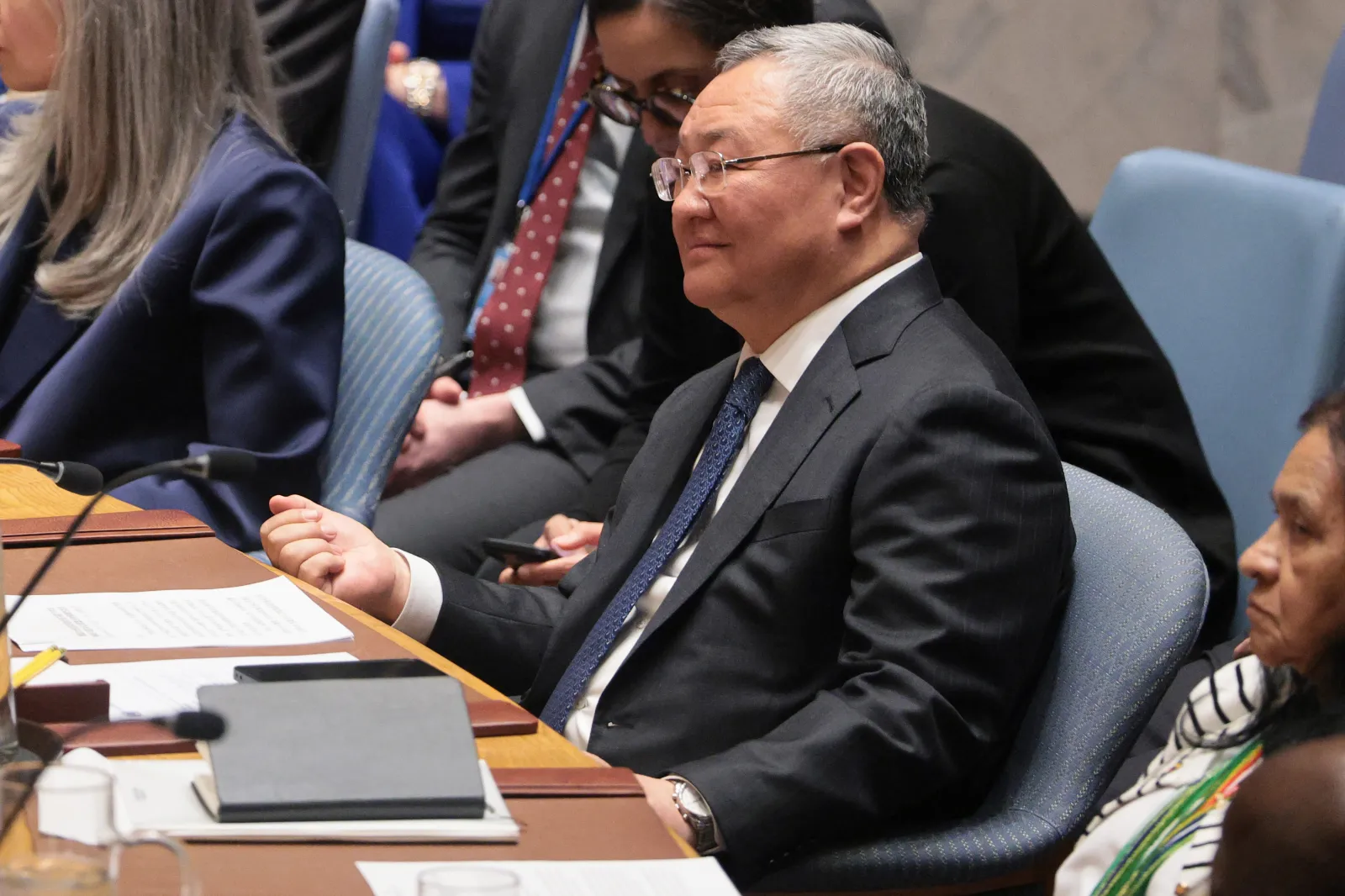
In his Security Council remarks, Chinese Ambassador Fu Cong warned that even after revisions responding to earlier Chinese and Russian objections, the draft still risked escalating the conflict rather than containing it.
"[The resolution] contains one-sided condemnation and pressure, characterizing the situation as a threat to international peace and security, as well as the use of armed escorts," Fu said. "Such language is highly susceptible to misinterpretation or even abuse. At a time when the United States is openly threatening the very survival of civilization, the current hostilities imposed on Iran is very likely to further escalate."
Andrea Ghiselli, assistant professor of international relations at Beijing's Fudan University, and Courtney Fung, assistant professor of international relations at the University of Hong Kong, for the Lowy Institute think tank, wrote: "China’s economy is in no position to weather a global recession with ease. Persistently weak domestic demand means that exports remain essential for absorbing industrial output, sustaining economic growth, and supporting employment. A decline in external demand, combined with disruptions in access to key industrial and agricultural inputs, could therefore undermine a critical pillar of the economy."
A prolonged war could also further delay U.S. President Donald Trump’s highly anticipated visit to Beijing for talks with Chinese counterpart Xi Jinping, now planned for mid-May and a high priority for Beijing, which sees it as a chance to stabilize ties with Washington, build on modest concessions reached in their last meeting, and buy time to prepare for possible future American sanctions.
Reiterating Beijing’s opposition to Iran’s missile strikes on Gulf targets, Fu said the resolution failed to acknowledge the “root causes” of the war and did not adequately balance protecting shipping lanes with promoting dialogue and peace—an argument that echoed themes pushed by Chinese state media ahead of the vote.
"It is regrettable though, the draft resolution fails to capture the root causes and full picture of the conflict in a comprehensive balanced manner. It contains one-sided condemnation and pressure, characterizing the situation as a threat to international peace and security, as well as the use of armed escorts," he said while explaining his vote.
Past Security Council resolutions have shaped Beijing’s narrative on such interventions. Fu argued that language authorizing maritime protection measures could send the wrong message, pointing to the council’s 2011 vote authorizing international military intervention in Libya and later resolutions on Red Sea shipping attacks by Yemen’s Houthis, which Beijing says were later used to justify military actions beyond their original mandate. China and Russia abstained in both cases.
Notably, Bahrain’s resolution had broad backing from Gulf states, which, while angered by Iranian attacks on their soil, also maintain strong economic ties with China—a country that has spent years trying to erode U.S. influence in the region.
"When talking with Gulf Arabs, the overwhelming position is that Chinese transactionalism is great for business but stops there," Jonathan Fulton, nonresident senior fellow for the Atlantic Council's Middle East Programs, wrote in a post on Substack. "They don’t describe these economic relationships as having a diplomatic impact. Certainly not a security impact.
"So no doubt there’s disappointment that the resolution didn’t pass, but at the end of the day I suspect it just confirms that neither Russia nor China are the type of partners that you should count on when you’re in a crisis."
Newsweek reached out to the Chinese Foreign Ministry and Bahrain’s U.N. mission by email for comment.
View 0 Comments
Submit Correction
View Editorial & AI Guidelines