...

By Tom O'Connor
Deputy Editor, National Security and Foreign Policy
0
Share
Newsweek is a Trust Project member
See more of our trusted coverage when you search.Prefer Newsweek on Googleto see more of our trusted coverage when you search.
As Iran moves to fill the vacuum left by the killing of Supreme Leader Ayatollah Ali Khamenei in the opening phase of the ongoing U.S.-Israeli war against the Islamic Republic, the next man chosen to rule may not enjoy the same level of absolute authority as his predecessors.
Iran's semi-official Mehr news agency reported Sunday that the 88-member Assembly of Experts in the country, responsible for picking a new head of the regime, had elected a replacement after days of uncertainty over who would succeed Khamenei.
Such a succession has only taken place once before, when Khamenei was elected in 1989 to the top position upon the death of Ayatollah Ruhollah Khomeini, the Islamic Republic founder who led for a decade after the revolution toppled Iran's West-aligned monarchy.
Read More on World
Since then, however, Iran's Velayat-e Faqih (Guardianship of the Islamic Jurist) system has undergone a quiet, gradual transformation, delegating greater power to a collective group of actors, including the Islamic Revolutionary Guard Corps (IRGC) and other political, military and business stakeholders.
Now, that process—already afoot as succession talks sparked insider intrigue even prior to 86-year-old Khamenei's demise last week—is likely to shape the future of the Islamic Republic as it fights for its survival.
"I think the broader trend was already underway before Khamenei’s death," Babak Vahdad, researcher and analyst on Iranian dynamics and Shiite Islam, told Newsweek. "The Islamic Republic had been evolving toward a system in which power was increasingly exercised through interlocking networks rather than through the purely personal authority of one office, even if the supreme leader remained the apex of legitimacy.
"Khamenei’s death in the middle of a war accelerates this process," Vahdad said. "In practical terms, this almost certainly increases the relative weight of actors such as the IRGC, the intelligence-security apparatus, and key regime coordinating bodies, not necessarily because they formally replace the office of the supreme leader, but because crisis management favors institutions that control force, information, and operational continuity."
While few expect the supreme leader's office to be abolished altogether, given its unique political and religious significance, Vahdad argued it "may become less singular in practice, with authority exercised in a more collective, securitized, and bureaucratic manner."
...
Iran's Game of Thrones
No candidate has yet been officially named to replace Khamenei. But number of senior Shiite Muslim clerics who constitute the 88-member Assembly of Experts that—vetted by the even more exclusive 12-member Guardian Council—is tasked with overseeing the succession process have been quoted in Iranian state-aligned media indicating a selection has been made.
The official line from Tehran, according to the semi-official Mehr News Agency, is that the final vote lies with Ayatollah Hashem Hosseini Bushehri, head of the Assembly of Experts. Meanwhile, mixed messages regarding the exalted title continue to emerge from the Islamic Republic, though a steady stream of reports emanating from within the Islamic Republic indicate some leading candidates.
Vahdad noted that, "at this stage, much of the discussion around succession is still shaped by limited signals, controlled leaks, and factional messaging, so caution is essential."
But one of the "names most often mentioned," he pointed out, is that of one of Khamenei's sons, Mojtaba.
"Mojtaba Khamenei remains central to speculation because of his proximity to the late supreme leader, his long-assumed ties to parts of the security establishment, and the perception that he represents continuity under wartime conditions," Vahdad said. "The IRGC is pushing his standing especially after Trump's latest statements against him, which definitely increased his support even beyond IRGC network."
Trump slammed Mojtaba Khamenei as a "lightweight" during an interview Thursday with Axios and referred to his candidacy as "unacceptable." Since launching the war in collaboration with Israeli Prime Minister Benjamin Netanyahu, the U.S. leader has teased having several names in mind to lead Iran, though he has also indicated that some or all of these individuals have since been killed.
The Israel Defense Forces (IDF) is also specifically targeting the Iranian effort to select the next supreme leader, having struck a suspected meeting of the Assembly of Experts in Tehran on Tuesday. The IDF told Newsweek at the time that the gathering of senior Shiite Islamic clerics constituted a legitimate military target due to its relation to Iran's leadership.
"The IDF only targets military targets," IDF spokesperson Lieutenant Colonel Nadav Shoshani said following the strike. "We have a rigorous process with international law to make sure that every target we carry out a strike against is a lawful military target. And that was also the case in this case."
But there are also internal factors weighing against Mojtaba Khamenei, who does not yet bear the necessary religious credential of marja al-taqlid ("source of emulation"). His father found himself in a similar position upon striving for the supreme leader spot after Khomeini dismissed his original designated successor, Ayatollah Ali Hossein Montazeri, shortly before Khomeini's death due to the aspiring heir's criticism of Iran's policy of executing political prisoners and calls for democratic reforms.
Ali Khamenei was ultimately upgraded from hojjat al-Islam ("proof of Islam") to obtain the proper religious rank, a path likely available now to his son as well. However, Mojtaba Khamenei's controversy does not end there.
"The main issue with Mojtaba is not simply religious rank (he is being elevated in that regard by senior Shia figures) but political acceptability: for some, he offers coherence and control; for others, his elevation would deepen the image of dynastic succession and could sharpen tensions inside the clerical establishment," Vahdad said.
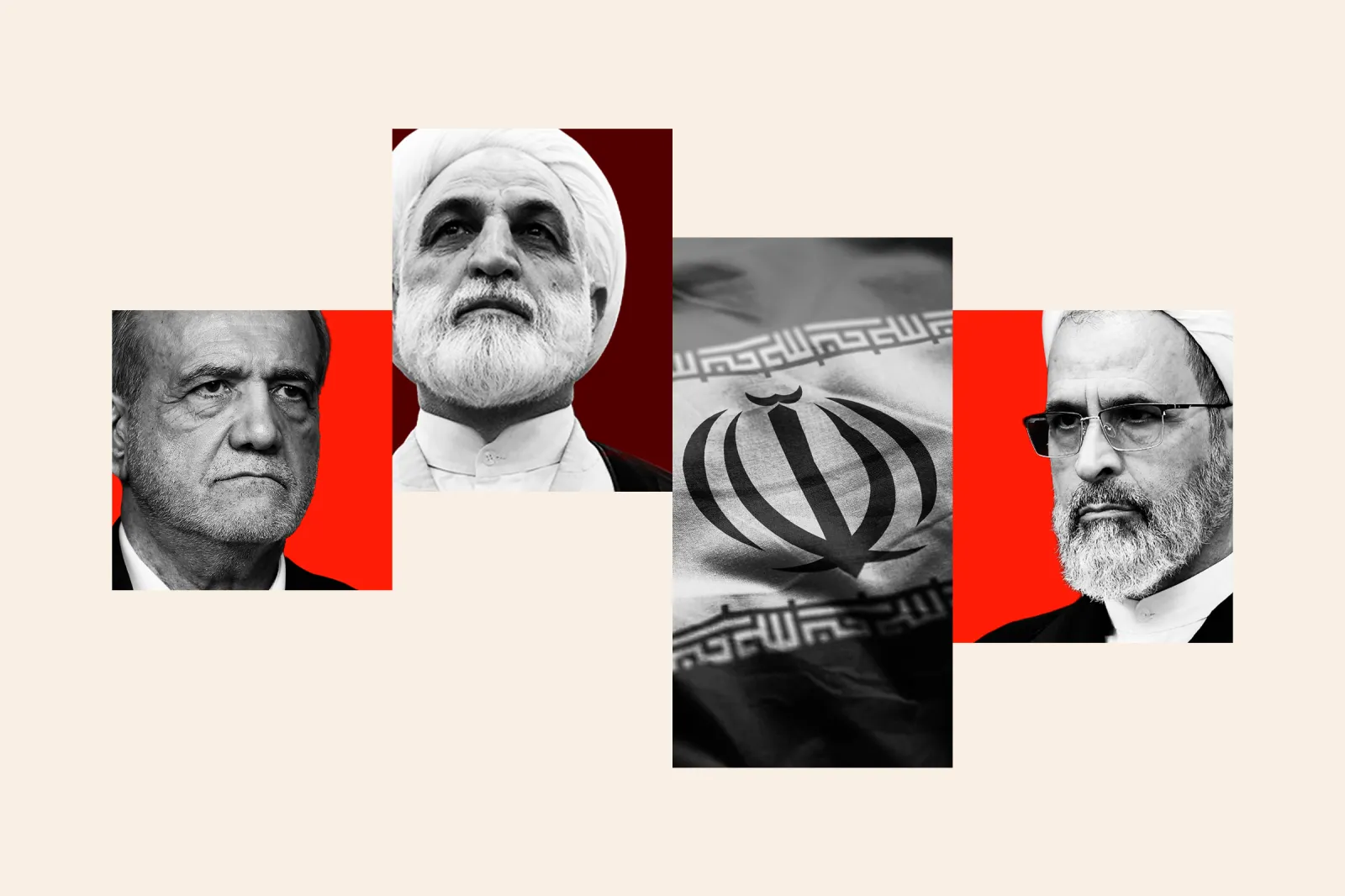
Another senior cleric mentioned in the discussions surrounding the succession process is Ayatollah Alireza Arafi, who currently sits alongside President Masoud Pezeshkian and Chief Justice Gholam-Hossein Mohseni-Eje'i in the three-person Interim Leadership Council established in the immediate wake of the supreme leader's slaying. Arafi is typically viewed as a staunch principlist eager to toe a hard line against the U.S. and Israel.
In addition to Arafi, some sources have indicated support growing around the candidacy of former President Hassan Rouhani, a reformist who oversaw the signing of the 2015 nuclear deal ultimately abandoned by Trump during his first term in 2018. Iran's reformist camp won a major political victory with Pezeshkian's election in July 2024, and while regional conflict even prior to the current direct war has galvanized principlists, popular support for change was demonstrated in the nationwide protests in January.
In either scenario, Vahdad noted that "one could also imagine a model in which a high-ranking cleric formally occupies the top position while real influence is more diffusely shared with security and state institutions. Time will tell."
A Deep State Showdown
While much of the remnant Iranian government's capacity is devoted to self-preservation and raising the costs for its enemies now more than a week into the U.S.-Israeli campaign, key players are seizing the chaotic moment to attempt to shape the future of the Islamic Republic.
Among the most influential is the IRGC. More than just a traditional military branch, the IRGC espouses ideological devotion to the Velayat-e Faqih system and by virtue, the supreme leader. At the same time, it has established a sprawling internal empire with distinct security, political and economic interests.
"The current disarray creates opportunities for the IRGC, but more as a steward of continuity than as an institution executing a clean coup," Andreas Krieg, senior lecturer at the School of Security Studies at King’s College London, Royal College of Defense Studies and fellow at the Institute of Middle Eastern Studies, told Newsweek. "Its strongest play is to deepen council-style governance while retaining a clerical veneer, using emergency conditions to justify tighter securitization of decision-making."
"That can look like the IRGC shaping the agenda of the interim leadership council and security coordination bodies, controlling operational responses, and steering succession timing," Krieg said. "The IRGC is also likely to argue that convening formal institutions is unsafe or impractical, which supports delaying a permanent choice and maintaining decentralized 'mosaic' governance."
Another important faction is Iran's conventional armed forces, known as the Artesh. Though long sidelined in favor of the IRGC, the Artesh has slowly amassed political capital in the face of IRGC decapitations both during the current conflict and the previous 12-Day War.
Krieg described the Artesh as "the critical swing institution: it is central to territorial defense and has a distinct corporate identity."
"It is unlikely to lead a political project, but it can resist being marginalized by an IRGC-only order, especially if it fears being scapegoated, starved of resources, or subordinated in ways that damage its cohesion," Krieg said. "The reformist and pragmatic camp has narrower leverage, centered on crisis management and external channels: they will push for stabilization measures, lower domestic temperature, and limited diplomatic engagement to reduce pressure, while avoiding moves that expose them as a rival center of power."
The Task at Hand
Whoever prevails in the race to become Iran's next supreme leader will inevitably have to contend with these competing internal interests, which may ultimately converge in favor of decentralizing power away from a supreme leader position, temporarily or permanently.
"Perhaps this time the rules will be ignored again, for instance, by choosing a collective leadership, as has been much mooted in recent years," Patrick Clawson, director of Washington Institute for Near East Policy's Viterbi Program on Iran and U.S. Policy, told Newsweek. "More likely, though, one person will be selected—changing the rules in the midst of a war seems risky."
"That could be someone who is largely a ceremonial figure intervening seldom in the functioning of a system largely run by others," Clawson said. "That idea has been much discussed recently, when it became possible to raise the issue of succession without being slapped down."
In fact, Ali Khamenei found himself in a similar situation when he first ascended to power without previously obtaining the appropriate religious rank. Clawson recalls an anecdote from the memoirs of former Iranian President Akbar Hashemi Rafsanjani who served throughout the first eight years of Ali Khamenei's rule and later wrote that the supreme leader complained of having little to do.
Yet the late leader worked meticulously in the ensuing years to leverage his political capital, having served as president throughout much of the eight-year Iran-Iraq War in the 1980s, to consolidate power. This strategy did not always favor fellow hard-liners, who the former leader also worked to keep in line, such as during the 2013 presidential election that handed victory to Rouhani as opposed to the IRGC-favored candidate, Saeed Jalili.
With Ali Khamenei's son now emerging as the favorite, however, Mojtaba Khamenei may opt to prioritize working behind the scenes rather than in the spotlight, an approach in line with his famously elusive nature.
"If he takes the post, Mojtaba could well want to operate as he has in the past, namely, out of the public eye—unlike his father who often gave public audiences and speeches," Clawson said. "Mojtaba spent years assiduously avoiding public scrutiny—heck, it was hard to find a picture of him until a decade ago. That may make it hard to judge how much influence he actually has."
That may mean delegating even more authority to the IRGC, at least until Mojtaba Khamenei could gather the platform capable of mounting a similar power play as his father.
"To truly master the IRGC, Mojtaba would need some years of promoting those loyal to him, along the lines of how Supreme Leader Khamenei spent years cultivating the IRGC (with whom he had been quite hostile when he was president)—this is how Supreme Leader Khamenei prevailed over Rafsanjani who was initially much more powerful than Khamenei; Rafsanjani ignored the IRGC and tried to cut their powers," Clawson said.
"Until then," Clawson added, "Mojtaba would be well advised to follow the 'advice' he gets from the IRGC leadership."
Update 3/8/26 9:44 a.m. ET: This story has been updated with more information.
View 0 Comments
Submit Correction
View Editorial & AI Guidelines