

By Jesus Mesa
Reporter
0
Share
Newsweek is a Trust Project member
See more of our trusted coverage when you search.Prefer Newsweek on Googleto see more of our trusted coverage when you search.
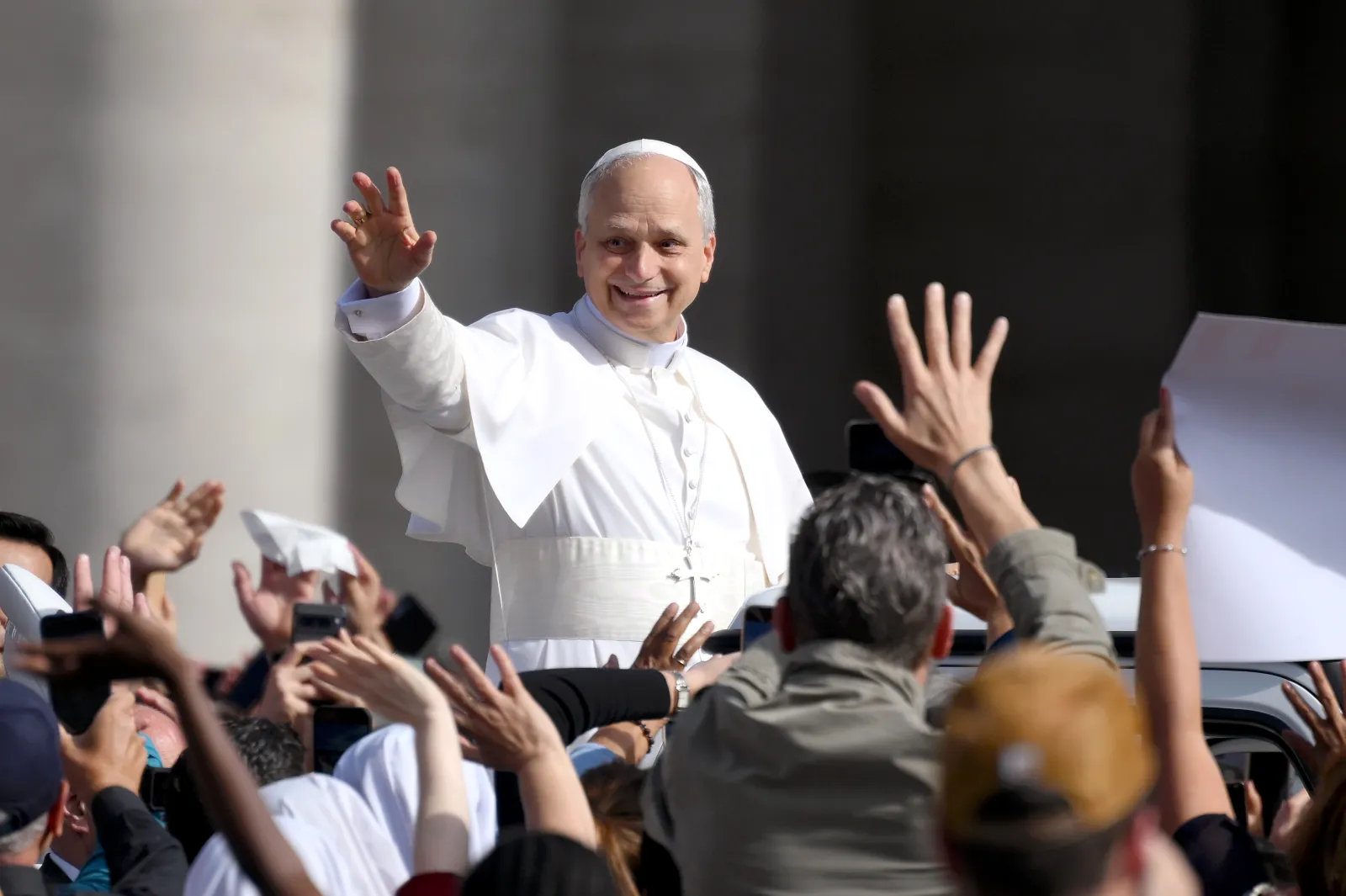
Pope Leo XIV released his first major encyclical on Monday, a 50,000-word document called "Magnifica Humanitas," or Magnificent Humanity, that demands international regulation of artificial intelligence, mandatory human oversight of consequential decisions, and strict data governance frameworks.
Christopher Hale has spent a year covering the intersection of Pope Leo XIV, American politics, and the digital age at his Letters from Leo Substack. He broke down the encyclical's implications for Carlo Versano in an interview on Newsweek's The 1600 podcast.
"He acknowledges the inevitability of artificial intelligence. He wants to help use the church use institutions to really guide where it's going," Hale said. And he warned that Silicon Valley chiefs who think they can outlast the Pope and his message are naive.
Read More on Politics
Watch Here: The 1600 Podcast Full Episode
The Tower of Babel and the Problem of Concentration
Leo XIV opens the encyclical with the Tower of Babel—the biblical story of a construction project that collapsed under competing interests and conflict.
"It's a very articulate understanding of what an LLM is at its worst," Hale said. "Hallucinations."
But the metaphor reaches further. Leo views artificial intelligence not as a narrow technological question but as a moral one fundamentally about the concentration of power. When OpenAI CEO Sam Altman said the day after the encyclical dropped that intelligence should be "metered" like a utility, Hale saw the exact problem Leo was describing.
"That phrase is exactly what Pope Leo XIV is talking about and what he's fighting against," Hale said. "Intelligence is not owned by private companies. It's a gift of creation. It should not be something that's owned. It's a human right."
What the Encyclical Actually Demands
The encyclical lays out three concrete demands. Leo wants international treaty frameworks so that "a handful of actors" cannot "dictate these processes on their own." He demands mandatory human oversight on any consequential decisions affecting human lives. And he wants data governance protections, explicitly warning that "those who control the health data of entire peoples possess a structural leverage over the future."
These are not theoretical arguments. They strike directly at how Silicon Valley has built its business.
"The Catholic Church's institutional power now exceeds that of multilateral bodies like the United Nations," Hale noted.

...
There was one company willing to engage. Dario Amodei, CEO of Anthropic, appeared on the dais with the pope and acknowledged what AI labs cannot answer alone. He posed three specific questions: How do we ensure poor countries benefit from AI? How does human flourishing look in a world of AGI? And what are we actually building?
Hale contrasted this sharply with Altman's response.
"I just cannot imagine the other folks in Silicon Valley in any way doing that," Hale said.
The Criticism From the Right
The response from the Trump administration came quickly. Interior Secretary Doug Burgum mocked the pope for weighing in on tech policy. David Sacks, Trump's AI Czar, rejected the encyclical's call for regulation, arguing that government control poses a greater threat than corporate concentration.
"That is a Silicon Valley argument that we are better at pleasing ourselves than the government is," Hale said. "They always go to the end extreme of saying that government will use its power to suppress viewpoints."
But what Silicon Valley underestimates, Hale argued, is the pope's unique institutional position.
"His greatest strength is that he is answerable truly to no person on this planet. As Catholics, we believe he's answerable only to God. And the pope cannot be removed from office. You cannot take him out of office. No one can vote on him. He cannot be impeached," Hale said. "And so I think that what Silicon Valley is hoping for is that they can outlast him and they can outlast his message. I think is naive."
The encyclical also faced pushback from the Catholic traditionalist right. Matt Walther, editor of the Lamp, argued Leo did not go far enough. To Walther, AI is not something to be regulated or disarmed. It is evil and should be vanquished.
"He basically says that AI is legitimately evil and it's an evil that needs to be vanquished," Hale said of Walther's position.
Walther also took issue with Leo's Tower of Babel opening, arguing the problem was not that the tower lacked stakeholder input but something more fundamental about ambition itself.
Pope Leo XIV's American Identity
Hale noted that Leo XIV was chosen in the conclave at least in part because the cardinals wanted someone who understood Trump not just as a political figure but as a movement. As an American pope, Leo XIV consumes American media—he watches CNN like "every boomer on background," Hale said—and understands the dynamics of Silicon Valley in ways his predecessors could not.
...
"He is very concerned about AI and war," Hale said. "And so, from what I understand from my reporting, from my conversations, is he was deeply impressed by the courage of Anthropic. During this event. That's really where this collaboration of sorts started coming along."
But beyond policy, Leo XIV speaks to something deeper in American skepticism. When he addresses the concentration of corporate power and the dignity of labor, he is not just speaking to Catholics.
"If pope Leo 14 is successful, the populist skeptics, the middle of the country that are fighting data centers, the media folks who are skeptical—I hope what he has provided them is a moral grammar to operate upon," Hale said. "Because I think we oftentimes talk about these in very policy-driven ways. And he just talks about it in just straight morality."
What Leo Is Saying About Human Life
But the encyclical's argument extends far beyond AI policy or regulation. In paragraph 220, Leo advocates for "wasting time"—for face-to-face encounters with family and strangers, for experiences that aren't measured or optimized, for freedom from constant protocols.
"He wants human encounters, face-to-face encounters, a non-measured experience, a non-protocol experience to be at the forefront of our lives," Hale said.
This reflects a claim about human meaning itself. Suffering and limitation, Leo argues, are intrinsic to love and flourishing. A world of total comfort without struggle diminishes what it means to be human.
"If there is a world with total leisure, with total comfort, and there is no suffering, we miss the human experience of love," Hale said.
Watch the full conversation between Christopher Hale with Carlo Versano in the video player above or on YouTube.
Subscribe to The 1600 newsletter for more interviews and to receive Carlo's popular daily column. Tap here to have it delivered straight to your inbox.
View 0 Comments
Submit Correction
View Editorial & AI Guidelines